The Link Building Checklist: Before, During and After Every Campaign
Every step that matters in one checklist, with links to the detailed guide for each.
This checklist pulls together every step of a link building campaign, with a link to the detailed guide for each stage. Use it as a working document: copy it into your project tool, assign owners and tick items off before, during and after every round of outreach or placements.
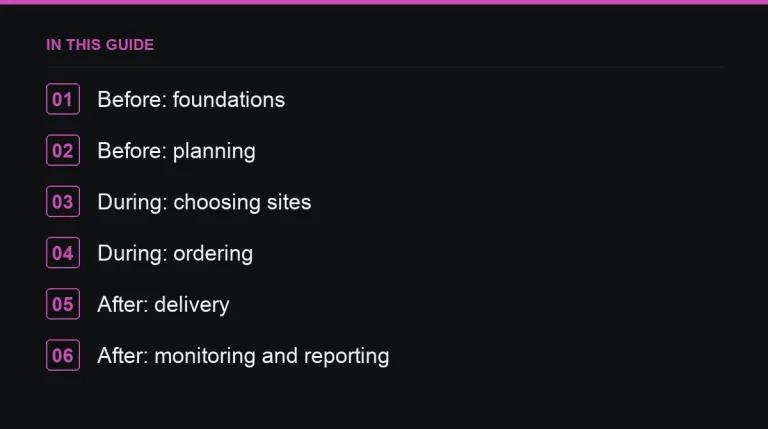
Before you start: fix the foundations
Links sent to a page that can’t rank are wasted, whatever their quality. Before spending anything on outreach or placements, confirm the basics.
- Target pages are indexable, canonical and reasonably fast (technical checklist).
- Target pages match what searchers actually want from the query (choosing link targets).
- Internal links pass authority from strong pages to the commercial pages you care about (internal linking).
- Baseline rankings, traffic and conversions are recorded so you can measure change later (measuring ROI).
Before you start: plan the campaign
- Run a competitor gap analysis to see who’s ahead and why (competitor analysis).
- Set a monthly budget and a sustainable pace (budget, velocity).
- Write an anchor plan per target page so text doesn’t drift toward exact-match keywords (anchor text).
- Choose a mix of tactics rather than one channel: placements, digital PR, linkable assets, partner links.
During: choosing sites
This is where most campaigns lose quality, usually under time pressure. Slow down here rather than at delivery.
- Relevance to your topic is confirmed, not assumed from the site’s general category (topical relevance).
- Real, stable organic traffic from the right country, not just a high authority score (traffic as a metric).
- Recent content has been read; no link-farm signs like AI-spun articles or unrelated niches jammed together (red flags).
- Terms are confirmed upfront: link attribute, number of links allowed, permanence (link attributes).
During: ordering and briefing
- A clear brief covers the target URL, anchor text, angle and any sources to use — vague briefs produce generic content (brief template).
- Payment is held in escrow until delivery is checked, not sent on trust.
- Turnaround expectations are agreed before the order, not chased afterward (turnaround times).
After: checking delivery
| Check | Why it matters |
|---|---|
| Link is live and points to the agreed URL | Wrong URLs happen more than you’d expect |
| Anchor text matches the brief | Publishers sometimes substitute their own |
| Attribute (dofollow/sponsored) matches terms | Some sites quietly add nofollow after payment |
| Page is indexable and not noindexed | A link on a noindexed page passes nothing |
| Placement location matches what was sold | Buried footer links aren’t what you paid for |
Run through the full version of this in the live-post checklist, and record every placement with its URL and date.
After: monitoring and reporting
- Turn on lost-link alerts for your important placements (monitoring lost links).
- Review target pages’ rankings and traffic monthly.
- Run a quarterly gap analysis and update the plan based on what’s working (strategy template).
- Cross-check what Google itself has indexed for your links using Search Console’s links report, alongside your third-party tool.
Who should own each stage
On small teams, one person often runs the whole list, which is fine as long as nothing gets skipped under time pressure. On larger teams or agencies, splitting ownership keeps quality high: one person owns target-page readiness and reporting, another owns site vetting and briefs, and a third checks delivery before payment is released. Whoever checks delivery should not be the same person under pressure to hit a monthly placement quota — that separation catches more problems than any tool does.
A short version for a quick weekly stand-up
- Any placements delivered this week — checked and recorded?
- Any lost links flagged — worth chasing?
- Anything in the pipeline blocked on a brief, a technical fix, or a payment?
Common ways this checklist gets skipped
Most failures aren’t from not knowing the steps — they’re from skipping them under deadline pressure. Teams check delivery for the first few orders, then stop as volume increases and trust builds, which is exactly when a bad site or a swapped anchor slips through. Treat the checklist as non-negotiable regardless of how many times a publisher has delivered cleanly before; the cost of one bad check is far lower than the cost of one missed problem (common link building mistakes).
Adapting the checklist to your channel mix
Not every item applies equally to every tactic. A digital PR campaign built around a data story skips most of the “ordering and briefing” section but still needs the same foundations and monitoring steps. A pure marketplace-based programme leans heavily on the site-vetting and delivery-checking sections since volume is usually higher. Treat this as a master list to select from, not a rigid sequence every single link must pass through identically.
Where to go next
Use this checklist alongside a one-page strategy template to keep planning and execution connected, and browse the marketplace when you’re ready to place the next round of links.
All link building tactics
- 15 Common Link Building Mistakes (and What to Do Instead)
- A Link Building Strategy Template (One Page)
- Alumni Networks and Professional Association Pages: A Relationship-Based Link Source
- App Store and Software Directory Listings: An Underrated Link Source
- Author and Speaker Profile Pages: A Quiet, Durable Link Source
- Awards, Badges and Certifications for Links
- Broken Link Building: How It Works and When It’s Worth It
- Building Free Tools and Calculators That Earn Links
- Building an FAQ Hub That Earns Links From Forums and Q&A Sites
- Charity Partnerships as a Link Building Channel
- Co-Branded Surveys: Sharing the Cost and the Links of Original Research
- Communities, Forums and Reddit: Participation Over Links
- Competitor Backlink Analysis: Finding Links You’re Missing
- Content Syndication With Canonical Tags: Getting Reach Without Losing SEO Credit
- Data Visualisation Outreach: Turning Numbers Into Linkable Charts
- Embeddable Widgets: A Slow-Burn Link Building Tactic That Still Works
- Events, Webinars and Speaking for Links
- Expert Roundups: Do They Still Earn Links?
- Expert Sourcing for Links: How to Get Quoted Without a Platform Subscription
- Finding and Earning Placement on .edu and .gov Resource Pages
- Free Templates as a Link Building Asset: What Actually Gets Downloaded and Linked
- Getting Included in “Tools We Use” and Software Roundup Posts
- Getting Into “Best Of” Lists: A Realistic Outreach Process
- Getting Your Comparison Page Cited: An Outreach Approach
- Guest Lecturing and University Links: A Legitimate but Slow Tactic
- How Long Do Backlinks Take to Work?
- How to Find Guest Post Opportunities in Any Niche
- How to Run a Backlink Audit
- Infographics and Visual Assets for Link Building
- Job Boards and Hiring Pages as an Overlooked Link Source
- Journalist Request Platforms: Getting Quoted at Scale
- Link Building KPIs That Actually Mean Something
- Link Building Myths That Won’t Go Away
- Link Building Outreach Emails: Templates That Don’t Sound Like Templates
- Link Building Through Newsletters: Sponsorships, Mentions, and Swaps
- Link Building Tools: What Each Type Does
- Link Building for Affiliate Sites
- Link Building for Consultants and Solo Professionals
- Link Building for Franchises and Multi-Location Businesses
- Link Building for Mobile Apps
- Link Building for News and Media Publishers
- Link Building for Podcasters
- Link Building for Shopify and Small Online Stores
- Link Building for Small Businesses: A Practical Plan
- Link Building for Startups on a Small Budget
- Link Building for Two-Sided Marketplaces
- Link Marketplace vs Manual Outreach: Which Should You Use?
- Local Sponsorship Link Building: Sports Teams, Events, and Community Groups
- Monitoring Lost Backlinks and Getting Them Back
- Open Source Contribution as a Link Building Tactic for Dev-Facing Brands
- Original Photography as a Link Building Asset
- Outreach Follow-Ups: How Many, When and What to Say
- Partner, Supplier and Customer Links
- Podcast Guesting for Links and Authority
- Press Page Optimisation: Turning Media Mentions Into a Link Building Asset
- Publishing a State-of-the-Industry Report as a Link Magnet
- Quizzes and Assessments as a Link Building Tool
- Quora and Similar Q&A Platforms: A Careful Approach to Link Building
- Reciprocal Links and Link Exchanges: Where the Line Is
- Reclaiming Brand Mentions in Images, Screenshots, and Video
- Reclaiming Links to Your 404 Pages
- Resource Page Link Building: A Step-by-Step Guide
- Running a Product Review Programme That Earns Real Links
- Running an Interview Series for Links, Not Just Content
- Scholarship Link Building: Why It Mostly Backfires
- Social Media and Links: How They Relate
- Statistics Pages: The Most Reliable Linkable Asset
- Supplier and Vendor Directory Listings: A B2B Link Source Hiding in Plain Sight
- Testimonial Link Building: Honest Endorsements That Earn Links
- The Skyscraper Technique: What Works Now
- Using Google Search Console’s Links Report
- Using a Glossary as a Link Building Asset, Not Just an SEO Page
- Which Directory Submissions Are Still Worth It?
- Wikipedia and Link Building: What You Should Know
- YouTube and Video for Links and Visibility
Frequently asked questions
What's the most skipped step in link building?
Checking the target page is technically sound and matches intent before building links.
How often should I review a link building campaign?
Monthly for delivery and pace, quarterly for strategy.
Can I use this checklist for agency clients?
Yes. It works for in-house and agency campaigns alike.
Put it into practice
Filter 54,483 websites by DR, traffic, niche and price, and order with escrow — you pay only after the link is live.
Browse the marketplace