Measuring the ROI of Link Building
Counting links tells you what you bought. Measuring rankings, traffic and revenue on target pages tells you what it did.
Link building is hard to measure because the effect is indirect and delayed. That’s exactly why it’s often reported badly: as a count of links, or a rise in DR. Neither is what you paid for. You paid for more qualified traffic to pages that make money, and that’s what the measurement should track.
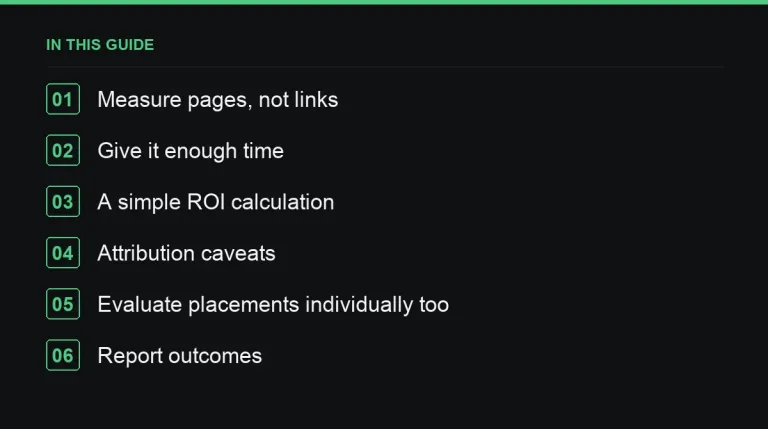
Measure pages, not links
Start from the target pages you planned around (budget guide). For each, track:
| Metric | Why | Where |
|---|---|---|
| Rankings for target keywords | Leading indicator | Rank tracker |
| Impressions and clicks | Visibility across all queries | Search Console |
| Organic sessions | Actual visitors | Analytics |
| Conversions / revenue | The outcome | Analytics / CRM |
| Referral traffic from placements | Direct value of each link | Analytics |
Make sure your analytics setup is actually reliable before you build a report around it; see measuring organic traffic properly for the common configuration mistakes that quietly skew these numbers.
Give it enough time
Rankings usually respond over several months. Set a baseline before the campaign starts and review at three and six months. Weekly swings are noise, and reacting to them tends to produce inconsistent, jumpy campaigns rather than steady ones.
It helps to write the review dates into the plan before the campaign starts, rather than deciding on the fly when to check. A fixed three-month and six-month review, agreed with whoever approved the budget, removes the temptation to declare victory or failure after two weeks based on nothing but noise.
A simple ROI calculation
- Incremental organic traffic to target pages compared with the baseline (and, ideally, with similar pages you didn’t build links to).
- Multiply by conversion rate and average order or lead value to get incremental revenue.
- Subtract total cost: placements, writing, tools and time.
The formula itself is simple: ROI = (incremental revenue − total cost) ÷ total cost. Organic traffic keeps arriving after the spend stops, so also look at the value over 12 months, not just the campaign period — this is one of the main advantages links have over paid channels that stop the moment you stop paying.
Attribution caveats
- Rankings change for many reasons: content updates, competitors, algorithm updates, seasonality.
- Use a control group: comparable pages you didn’t build links to. If both groups rise, the cause may be something else.
- Annotate your reports with major changes, such as site migrations (protecting backlinks during a migration) or big content updates.
- Cross-check any sudden ranking swing against known algorithm updates before crediting or blaming your own campaign.
Segment by tactic, not just by page
If your program mixes guest posts, digital PR, niche edits and internal linking work, break the ROI review down by tactic as well as by page. It’s common to find that one channel — often the cheapest, not the most impressive-looking — quietly delivers most of the measurable return, while a more expensive tactic mostly produces links that look good in a slide deck. You won’t see that pattern unless the reporting separates tactics from the start rather than lumping everything into one “link building” line.
Evaluate placements individually too
Over time, compare placements by referral traffic, whether the page got indexed, and whether the link is still live. Drop publishers who under-deliver and reorder from those who perform. On Digital PR your order history keeps every placement with its live URL, which makes this review straightforward. Our live-post checklist covers what to record for each, and a periodic check for lost links catches placements that quietly disappeared.
Report outcomes
For stakeholders, report in this order: revenue or leads, organic traffic, rankings, and only then links acquired. It keeps the conversation on what matters and makes future budget decisions easier (see also reporting on digital PR). A simple table with baseline, three-month and six-month figures for each target page usually communicates more than a paragraph of prose, and it’s easy to update every quarter without redoing the analysis from scratch.
It’s also worth separating two questions that often get conflated: whether link building worked at all, and whether this specific set of placements was worth the price paid. The first tells you whether to keep doing link building; the second tells you which publishers and tactics deserve more of next quarter’s budget. Track both, and don’t let a good headline number on one hide a weak result on the other.
Where to go next
Set this reporting cadence up once and reuse it for every campaign, so results are comparable quarter to quarter. When a target page’s ROI justifies more spend, the marketplace makes it straightforward to find the next batch of relevant, right-priced placements for it, and the platform’s order history gives you the live-URL record this kind of reporting depends on.
If a page’s numbers stay flat after six months of genuine effort, treat that as information too. Sometimes the honest conclusion is that the page itself, not the links pointing to it, is the bottleneck — a content or conversion problem no amount of additional linking will fix. Reviewing ROI regularly is what surfaces that distinction before budget gets wasted chasing it.
Frequently asked questions
How long does it take to see ROI from link building?
Usually several months for rankings to respond, and longer for revenue to accumulate. Review at three and six months, and value the traffic over 12 months.
Is DR growth a good success metric?
Not on its own. It's a third-party score. Rankings, traffic and revenue to target pages are the outcomes that matter.
How do I separate link effects from other changes?
Use a control group of comparable pages and annotate other changes like content updates and algorithm updates.
Put it into practice
Filter 54,483 websites by DR, traffic, niche and price, and order with escrow — you pay only after the link is live.
Browse the marketplace