Building an Entity and Topical Authority Strategy
Topical authority is built across a cluster of related pages and mentions, not by optimising one page in isolation.
Search engines increasingly evaluate sites in terms of entities and topics they’re recognised as authoritative on, not purely as a collection of individually optimised pages. This changes how link building should be planned — toward building recognised depth across a topic area, not just isolated wins on single URLs.
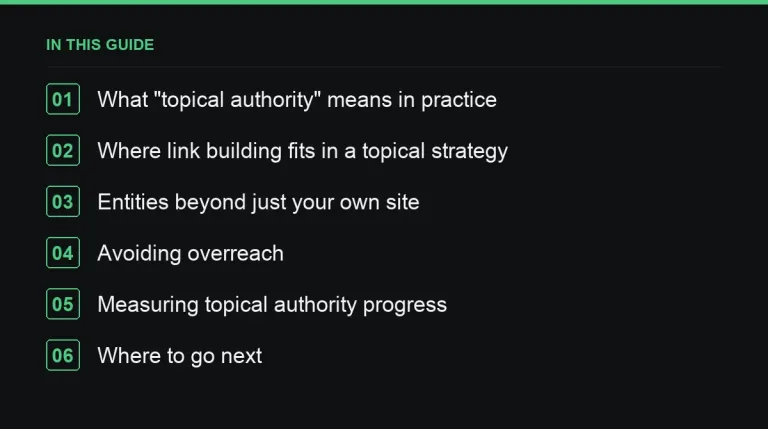
What “topical authority” means in practice
A site recognised as authoritative on a topic tends to have comprehensive coverage of that topic’s subtopics, consistent and accurate information across those pages, and a reasonable base of external validation — links and mentions — spread across the topic rather than concentrated on one flagship page. This recognition can help even pages that individually have modest link profiles, if they sit within a well-established topical cluster.
Structuring content around topics, not keywords
Rather than planning content and links purely keyword by keyword, map out the subtopics that make up your core area and check for gaps in coverage. https://successtoroad.com/blog/content-clusters-and-links/ covers building this structure, and it’s the content-side counterpart to the link strategy described here.
Where link building fits in a topical strategy
- Spread link building across several pages within a cluster rather than concentrating entirely on one pillar page
- Prioritise links from sites that are themselves recognised as relevant to the topic area, not just generically authoritative
- Use internal linking, per https://successtoroad.com/blog/internal-links-and-backlinks/, to make sure the cluster reads as connected to search engines, not just to human readers
- Look for opportunities where a single piece of coverage can reasonably reference multiple pages in the cluster
Entities beyond just your own site
Being consistently associated with a topic across the web — mentions, citations, and links from other recognised sources in that space — reinforces topical authority beyond what your own site’s structure can achieve alone. This is part of why https://successtoroad.com/blog/expert-commentary/ and consistent presence in relevant industry coverage matter beyond their direct link value.
A simple gap-mapping table
| Subtopic | Content coverage | External validation |
|---|---|---|
| Core subtopic A | Strong | Several relevant links |
| Core subtopic B | Thin | Few links |
| Adjacent subtopic C | Missing | None |
Gaps like subtopic B and C represent both a content opportunity and, once addressed, a link building opportunity within the same cluster.
Avoiding overreach
Trying to build topical authority across too broad a subject area spreads effort too thin to be recognised as authoritative on any of it. Most sites are better served picking a genuinely focused core topic and building real depth there before expanding, rather than attempting broad coverage from the start.
How this changes prioritisation
https://successtoroad.com/blog/prioritising-pages-to-build-links-to/ still applies, but within a topical strategy it’s worth weighting pages partly by how much they contribute to cluster completeness, not purely by their individual ranking potential — a moderately valuable page that fills a genuine gap in the cluster can be worth more to the overall strategy than its standalone metrics suggest.
Measuring topical authority progress
Unlike a single page’s ranking, topical authority is harder to measure directly, but tracking aggregate metrics across the whole cluster — average rankings, total referring domains across the topic, and overall organic visibility for the subject area — gives a reasonable proxy for whether the strategy is working, even without a single definitive number.
When a competitor already owns a topic
If a competitor is already firmly established as the recognised authority on a broad topic, competing head-on across the entire area may be unrealistic. Consider whether a genuinely differentiated sub-angle within the topic offers a more achievable path to building recognised authority in a narrower but still valuable space.
Balancing depth against publishing pace
Building genuine topical depth takes time, and rushing a cluster’s content out to hit an arbitrary publishing schedule tends to produce the same thin coverage problem the strategy was meant to avoid. Prioritise getting each subtopic genuinely right over hitting a fast timeline.
A note on team alignment
Make sure content and link building efforts are working from the same subtopic map, since misalignment between the two teams can lead to content gaps being filled in a different order than the one that would most efficiently support ongoing link acquisition.
Finally, be patient — recognised topical authority builds over a longer horizon than a single page’s ranking typically does, and rushing the underlying content work usually undermines the whole approach.
A simple shared subtopic map, kept up to date, is one of the more valuable artefacts a topical authority strategy can produce.
None of this requires a large team to execute — even a small site can apply the same disciplined, topic-first thinking at a smaller, more manageable scale.
Where to go next
Building topical authority is a longer-term, structural approach that changes how link building gets planned and measured across a cluster rather than page by page. See https://successtoroad.com/blog/building-a-12-month-link-plan/ to build cluster completeness into your annual targets, and https://successtoroad.com/marketplace/ to find publishers genuinely relevant to your specific topic area across the whole cluster, not just your flagship page.
Frequently asked questions
Is topical authority a replacement for page-level link building?
No, it's a framework for planning link building more strategically across related pages, not a replacement for building relevant, quality links to individual pages within that structure.
How broad should a topical cluster be?
Focused enough that real depth is achievable rather than spread thin across too many subtopics. Most sites are better served by real depth in a narrower area than shallow coverage across a broad one.
Do all pages in a cluster need equal link investment?
No, weight investment by both the page's own ranking potential and how much it contributes to overall cluster completeness — a gap-filling page can be worth more to the strategy than its standalone metrics suggest.
Does topical authority help newer pages within an established cluster?
It can, since a page in an already-recognised topical area may benefit from that established context even before it has built substantial links of its own.
Put it into practice
Filter 54,483 websites by DR, traffic, niche and price, and order with escrow — you pay only after the link is live.
Browse the marketplace