Aligning Link Building Targets With Conversion Pages
Rankable and valuable pages aren't always the same pages, so link priorities should weigh conversion value explicitly.
It’s easy to default to building links toward whichever pages already get the most traffic or seem easiest to move up the rankings, but these aren’t necessarily the pages that matter most to the business. A page can rank well and get plenty of visits while contributing very little to revenue, while a lower-traffic conversion page goes under-supported.
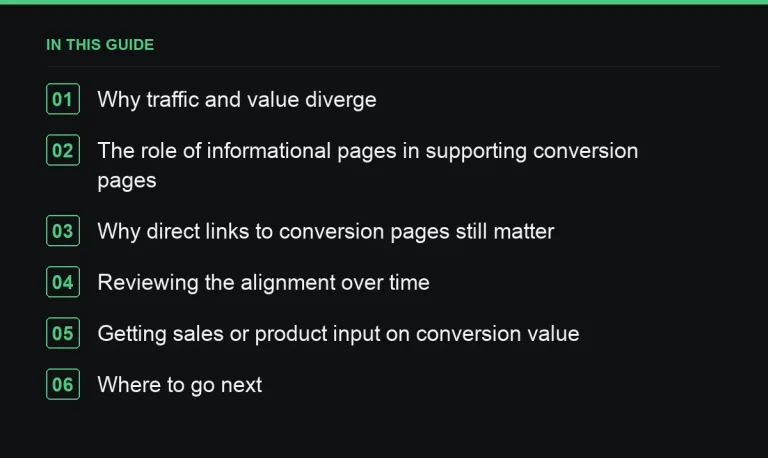
Why traffic and value diverge
Informational content often attracts significantly more search volume than commercial or transactional pages, simply because more people research a topic than are ready to buy or convert at any given moment. A blog post can dwarf a product or service page in visits while contributing a fraction of the revenue. Prioritising links purely by traffic potential systematically under-invests in the pages that actually drive the business forward.
Weighing conversion value explicitly
When scoring pages for link priority using a method like the one in https://successtoroad.com/blog/prioritising-pages-to-build-links-to/, include an explicit conversion or revenue weighting rather than relying on search volume and current position alone. A page with modest search volume but high conversion value can reasonably outrank a high-traffic informational page for link investment priority.
The role of informational pages in supporting conversion pages
This doesn’t mean informational content is worthless for link building — high-traffic, link-earning informational pages can support conversion pages indirectly through strong internal linking, per https://successtoroad.com/blog/internal-linking-to-distribute-earned-authority/. The point is to be deliberate about this relationship rather than assuming informational content’s own rankings are the end goal.
A simple weighting table
| Page type | Typical traffic potential | Typical conversion value | Link priority approach |
|---|---|---|---|
| Broad informational guide | High | Low-moderate, often indirect | Earn links, route authority internally |
| Product/service page | Moderate | High | Direct link investment despite lower traffic ceiling |
Why direct links to conversion pages still matter
Relying entirely on internal link flow from informational content to support conversion pages is a reasonable secondary strategy, but direct, relevant external links to the conversion pages themselves still tend to help more directly, particularly for competitive commercial terms. Don’t treat internal link routing as a full substitute for direct investment where the budget allows both.
Getting relevant links to commercial pages
Commercial and product pages are sometimes harder to get relevant, natural-looking external links to directly, compared to a shareable guide or piece of research. This is where https://successtoroad.com/blog/link-insertion-pricing-for-publishers/-style insertions into relevant existing articles, and targeted guest posts that naturally reference your product category, can work better than trying to make a purely commercial page independently link-worthy.
Reviewing the alignment over time
Conversion value shifts as the business changes what it sells or promotes, so this weighting should be revisited alongside https://successtoroad.com/blog/quarterly-reviews/ rather than set once. A page that was a minor product line last year might now be the business’s main focus, warranting a reassessed link priority.
Getting sales or product input on conversion value
Marketing teams don’t always have precise visibility into which pages or product lines actually drive the most profitable revenue. Checking this weighting against sales or finance data, where available, produces a more accurate conversion-value ranking than marketing assumptions alone, and can surface surprises about which pages deserve more link investment than initially assumed.
Revisiting after a product launch or discontinuation
A new product line or the discontinuation of an old one changes which conversion pages matter most, and this should trigger an off-cycle review of link priorities rather than waiting for the next scheduled quarterly review, since the change in business focus can be immediate.
Watching for a mismatch between stated and actual priorities
Occasionally a business says a certain product line is the priority while the actual conversion data tells a different story. Trust the data over the stated priority when the two disagree, or at least flag the discrepancy before committing significant link building budget based on assumption alone.
A note on attribution complexity
Conversion value itself can be hard to attribute cleanly, especially for pages that support a longer buying journey rather than converting directly. Use a reasonable, defensible estimate rather than waiting for perfect attribution data before weighting pages by their likely value.
Finally, revisit this weighting whenever the business’s product mix or margins change meaningfully, since conversion value is rarely static for very long.
A brief written record of the conversion weighting used keeps future prioritisation decisions consistent rather than starting the judgment call fresh each time.
None of this replaces ordinary commercial judgment — it simply gives that judgment a clearer, more defensible basis when link building budget is on the line.
Where to go next
Building links toward the pages that actually matter to the business, not just the ones that are easiest to rank or already get the most traffic, requires an explicit conversion weighting in your prioritisation process. See https://successtoroad.com/blog/balancing-links-and-content-investment/ for the related content-side decision, and https://successtoroad.com/marketplace/ for sourcing publishers whose audience and context suit commercial page placements specifically.
Frequently asked questions
Should informational or commercial pages get priority for link building?
It depends on actual business value, not just traffic potential. A high-traffic informational page can be worth less to link toward directly than a lower-traffic commercial page that converts well, if conversion value is properly weighted.
Is it harder to get natural links to commercial pages?
Often yes, compared to shareable guides or research. Techniques like relevant link insertions into existing articles and targeted guest posts that naturally reference your product category tend to work better than trying to make a purely commercial page independently link-worthy.
Can internal linking fully substitute for direct links to conversion pages?
Not fully — it's a useful secondary strategy, but direct, relevant external links to conversion pages themselves generally still help more, especially for competitive commercial terms.
How often should conversion value weighting be reassessed?
Alongside your regular quarterly review is reasonable, since which products or services matter most to the business can shift over time, changing which pages deserve priority.
Put it into practice
Filter 54,483 websites by DR, traffic, niche and price, and order with escrow — you pay only after the link is live.
Browse the marketplace