Link Building for Franchises and Multi-Site Brands
Franchise and multi-site brands need coordinated link building to avoid duplicated effort and internal competition between locations.

A franchise or multi-location brand faces a coordination problem most single-site businesses don’t: many individual locations, each wanting visibility, potentially competing with each other for similar terms, and often lacking central guidance on link building. Getting this coordination right prevents wasted budget and internal competition that helps no one.
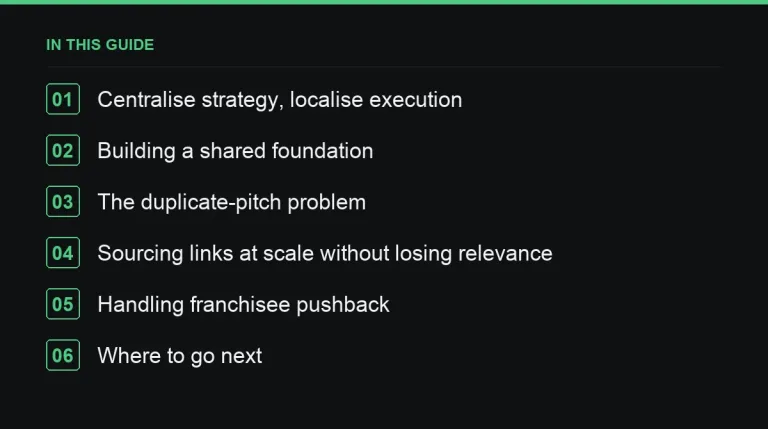
Centralise strategy, localise execution
A workable model for most franchise structures is a centrally defined strategy — priority page types, quality standards, risk tolerance — with execution adapted to each location’s specific market. This avoids both the chaos of every location doing its own uncoordinated thing and the inflexibility of a single national campaign that ignores real local differences.
Avoiding internal competition
Two franchise locations targeting the same broad commercial term can end up competing against each other in search results as much as against outside competitors, which benefits neither. https://successtoroad.com/blog/local-seo-links/ and clear geographic differentiation in targeting help make sure each location’s link building supports its own specific area rather than cannibalising a sibling location’s rankings.
Building a shared foundation
- A central set of brand-wide pages and assets that any location can reference or link to
- Consistent NAP (name, address, phone) standards across all location pages, which matters for local trust signals
- A shared quality bar for what counts as an acceptable link building tactic across the whole brand, per https://successtoroad.com/blog/risk-appetite-frameworks/
- A central point of contact or team who reviews location-level outreach before it goes out, to avoid duplicated pitches to the same publisher
The duplicate-pitch problem
Without coordination, multiple locations under the same brand can independently pitch the same publisher, which looks disorganised and can actually damage the brand’s credibility with that publisher. A shared tracking system, even a simple shared spreadsheet, listing which locations have contacted which publishers avoids this embarrassing overlap.
A coordination table
| Layer | Owned by |
|---|---|
| Overall risk tolerance and quality standards | Central team |
| Priority page types (e.g., location pages, service pages) | Central team |
| Specific local outreach and publisher relationships | Local or regional teams, tracked centrally |
Sourcing links at scale without losing relevance
A multi-location brand often needs links across many local and regional publishers rather than a small number of national ones. https://successtoroad.com/marketplace/ supports this by letting you filter by niche and, where relevant, geography, so different locations or regional teams can find genuinely local, relevant publishers rather than competing for the same limited pool of national sites.
Measuring across locations
Track link building results per location rather than aggregating into one brand-wide number, since performance can vary significantly by market and a strong location can mask a struggling one in combined reporting. https://successtoroad.com/blog/measuring-organic-traffic-analytics/ is worth setting up with location-level segmentation from the outset.
Handling franchisee pushback
Individual franchisees sometimes resist centrally coordinated link building if they’re used to running their own local marketing independently. Framing the central layer as protecting the brand’s overall reputation and preventing wasted duplicate effort, rather than removing their autonomy entirely, tends to land better than a purely top-down mandate.
Supporting new locations
A newly opened location starts with no local link profile at all, and deserves a version of https://successtoroad.com/blog/new-site-first-90-days/-style foundational treatment adapted to its specific area, rather than being expected to immediately match the link profile of long-established sibling locations.
Reviewing the central-local split periodically
As locations mature and gain their own local expertise, the right balance between central control and local autonomy can shift. Revisit this split at least annually rather than assuming the original coordination model remains correct as the brand grows.
A note on brand consistency
Even with decentralised execution, keep core brand messaging and quality standards consistent across locations, since a publisher or journalist who has a poor experience with one location’s outreach may reasonably generalise that impression to the whole brand.
Finally, revisit the overall coordination model as the brand grows, since a structure that suited ten locations may need adjustment once the brand reaches fifty or more.
A brief annual survey of franchisee sentiment on the coordination model is a low-cost way to catch friction before it becomes a bigger problem.
None of this requires a large central team either — even a single coordinator reviewing outreach plans can prevent most of the duplication and inconsistency described here.
Treat coordination as an ongoing relationship to maintain across locations, not a one-time policy document that’s circulated once and never revisited again.
A small amount of upfront coordination effort here saves considerably more time later than it costs, once duplicated outreach and internal competition are avoided from the start.
Keep this simple guiding principle in view throughout: the goal of coordination is to make every location more effective together than any one of them would be operating entirely alone.
Where to go next
Franchise and multi-site link building needs a central strategic layer to prevent duplication and internal competition, paired with local execution that respects each market’s actual relevance. See https://successtoroad.com/blog/local-seo-links/ for the location-specific tactics that fit within this coordinated structure, and https://successtoroad.com/blog/building-a-12-month-link-plan/ for setting central targets that individual locations then execute against.
Frequently asked questions
Should every franchise location run its own independent link building?
Not without coordination — independent efforts risk duplicated pitches to the same publishers and internal competition between locations for similar terms, which a central strategic layer helps prevent.
How do we stop two locations from targeting the same publisher?
A shared, centrally maintained tracking system, even something simple, listing which locations have contacted which publishers avoids embarrassing overlap and duplicated outreach.
Should link building strategy be fully centralised for a multi-location brand?
A blend works better for most brands — central strategy, quality standards and risk tolerance, with execution adapted to each location's specific local market and relevant publishers.
How should results be measured across many locations?
Per location rather than aggregated into one brand-wide figure, since combined reporting can mask a struggling location behind a strong one and make it harder to allocate support where it's needed.
Put it into practice
Filter 54,483 websites by DR, traffic, niche and price, and order with escrow — you pay only after the link is live.
Browse the marketplace