Google Algorithm Updates and Your Links
When rankings drop after an update, links are one suspect among several. Here's how to tell.
Search engines release core updates and spam updates several times a year. Some of these change how links are evaluated; many don’t primarily concern links at all. Knowing the difference is what separates a calm, evidence-based response from a panicked one that does more damage than the update itself.
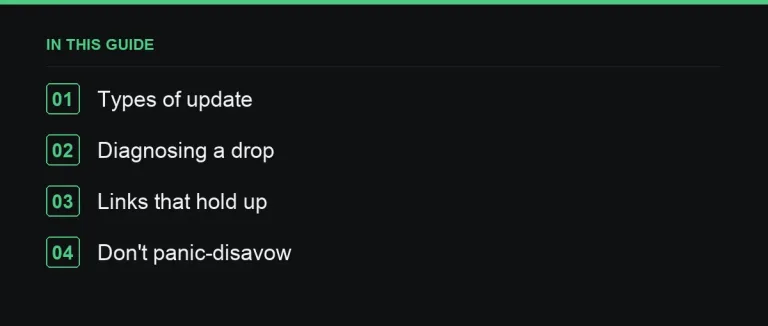
Types of update
- Core updates — broad reassessments of how content is judged, usually about relevance, depth and quality rather than links specifically. A drop after a core update is often a content signal, not a link one.
- Spam updates, including link-spam updates — these specifically improve detection of manipulative practices. Links identified as part of a spam scheme lose value, and sites that relied heavily on them can see a real drop.
Diagnosing a drop, step by step
- Note the exact date of the drop and compare it against announced update rollout windows.
- Check Search Console for manual actions first — a confirmed manual action is a different problem from an algorithmic shift (see manual actions for unnatural links).
- Look at which pages dropped. A handful of specific pages usually points to content or intent problems on those pages; a site-wide drop points to a broader quality or trust issue.
- Check what now outranks you. If it’s clearly more comprehensive, more current or better structured, that’s a content answer, not a link one.
- Review your recent link acquisition for patterns that look manipulative — a sudden burst of exact-match anchors, links from clearly unrelated sites, or a run of low-quality placements (see how to run a backlink audit).
What makes links hold up across updates
Relevant links from real publications with genuine audiences, a natural mix of anchor text, a steady acquisition pace rather than sudden spikes, and a meaningful share of links you earned rather than paid for directly (see the full link building checklist). Links that depended on manipulation — link schemes, irrelevant mass placements, exact-match anchor stuffing — are precisely the ones spam updates are designed to catch.
Don’t panic-disavow
A common reaction to a ranking drop is to disavow large numbers of links defensively, without evidence they’re the cause. This rarely helps and can remove links that were doing no harm at all. Use the disavow tool only after you’ve identified specific, clearly manipulative links — not as a blanket response to an unexplained drop.
What to do instead
| Situation | Response |
|---|---|
| Confirmed manual action for links | Remove or disavow the specific links named, then file reconsideration |
| Drop coincides with a core update, no manual action | Review content quality and intent match first |
| Drop coincides with a spam update, no manual action | Audit recent link acquisition for manipulative patterns |
| No clear cause found | Wait, keep building relevant links and quality content, re-evaluate in a month |
Building resilience going forward
The best defence against future updates isn’t reacting faster — it’s building a link profile that doesn’t depend on tactics updates are designed to catch. That means prioritising relevance and real audiences over pure metrics; see E-E-A-T and links for how trust signals fit into this.
Why waiting is often the right call
Search engines frequently take weeks to fully roll out an update, and rankings can fluctuate during that window before settling. Making changes mid-rollout — disavowing links, rewriting large amounts of content, restructuring navigation — makes it much harder to tell afterward what actually caused any subsequent change. Where the drop isn’t severe and there’s no confirmed manual action, giving it two to four weeks before making significant changes is usually the more disciplined approach.
Talking to clients or stakeholders about an update
Ranking drops after a public update announcement often trigger anxious questions from people who read about it in industry news. It helps to have a short, honest explanation ready: whether the update is known to target links or content generally, whether your site shows a manual action, and what the plan is for the next few weeks. Overpromising a quick fix when the real answer is “wait and monitor” tends to damage trust more than the drop itself.
Keeping a rolling log of updates and your response
Over several years, a simple log of which updates coincided with which changes in your traffic becomes genuinely useful — it turns anecdote into pattern. Note the update name or date, what changed in your rankings, what you found on investigation, and what (if anything) you changed in response. This log is often more valuable than any single diagnosis, because it shows you which types of links and content in your specific niche have proven durable over multiple update cycles.
Where to go next
Pair this with regular competitor backlink analysis so you know whether a drop is specific to you or affecting the whole niche, and revisit measuring link building ROI to keep perspective during short-term fluctuations. When rebuilding after an update, choose placements carefully via https://successtoroad.com/marketplace/ rather than rushing volume.
Frequently asked questions
Can an algorithm update devalue my links?
Yes, spam updates specifically can reduce or remove the value of links identified as manipulative, even if those links stay live on the publisher's site.
Should I disavow links after a ranking drop?
Not without specific evidence those links caused it. Disavowing broadly and defensively can remove links that were doing no harm.
How do I know if a drop is link-related?
Check the timing against announced updates, look for manual actions, see which pages dropped, and review your recent link acquisition for manipulative patterns.
Do core updates usually target backlinks?
Not primarily. Core updates are mostly about content relevance and quality; link-specific effects are more associated with spam updates.
Put it into practice
Filter 54,483 websites by DR, traffic, niche and price, and order with escrow — you pay only after the link is live.
Browse the marketplace