When (and When Not) to Use the Disavow Tool
The disavow tool is powerful and easy to misuse. Most sites never need it. Here's how to tell whether you do, and how to build the file properly.
Google’s disavow tool lets you tell Google to ignore specific links or entire domains pointing at your site, as if they never existed. It’s built for a narrow set of situations, and Google itself has said repeatedly that most sites don’t need it. Used on the wrong links, it can quietly strip out backlinks that were genuinely helping you — so it deserves more caution than the average “toxic link” alarm suggests.
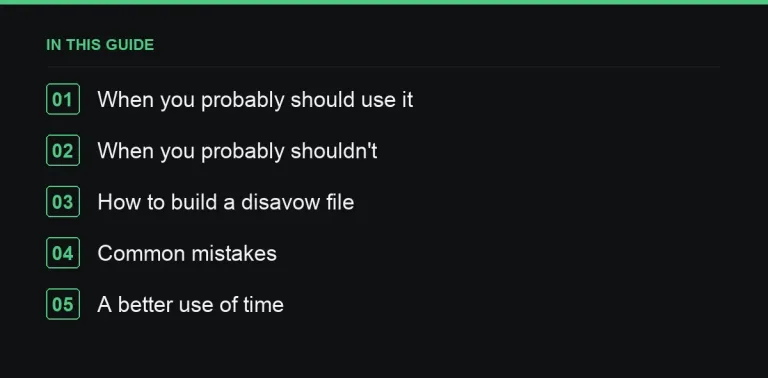
When you probably should use it
- You have a confirmed manual action for unnatural links, and despite genuine outreach, some of the problem links simply won’t be removed or altered by the sites hosting them — see the full recovery process.
- You know of a real, documented history of paid or network links pointing at your site — from a previous agency, a past owner, or an earlier version of your own strategy — and you want to get ahead of a manual action rather than wait for one.
When you probably shouldn’t
- To “tidy up” random low-quality links you never built. Google’s systems generally already discount these on their own; disavowing them changes nothing except your workload.
- Because a third-party tool assigned certain links a “toxic” score. Those scores are vendor estimates built on their own criteria, not a statement of how Google actually treats the link.
- As a reflexive response to a ranking drop with no evidence that links are the cause. Most drops trace back to content, technical issues or competitors improving — see competitor research beyond backlinks before assuming it’s a link problem at all.
How to build a disavow file correctly
The file itself is a plain UTF-8 text document, one entry per line, structured like this:
- Lines beginning with # are treated as comments — use them to note why each entry is there and when you tried to get it removed, for your own records.
- Use domain: followed by the domain name to disavow an entire site. This is the right choice for network or spam domains, since one bad page on a site usually means the whole domain is untrustworthy.
- Use a full URL on its own line only when a single specific page is the problem and the rest of that site is otherwise fine.
Upload the finished file through the disavow tool under the correct property in Search Console — note that HTTP and HTTPS, or www and non-www, can be tracked as separate properties depending on your setup. Uploading a new file replaces the previous one entirely, so always edit and re-upload your complete, cumulative list rather than just the new additions.
Common mistakes worth avoiding
- Disavowing large batches of links based purely on an automated “toxicity” score with no manual review.
- Accidentally disavowing genuinely good links, such as legitimate press coverage that happens to use an unusual anchor.
- Uploading the file to the wrong property when a site has several tracked in Search Console.
- Overwriting a carefully built cumulative file with a shorter, partial list from a later audit.
A better use of your time, most of the time
For the large majority of sites that have never received a manual action, time spent hunting for links to disavow is time not spent building the kind of profile that makes a handful of stray bad links irrelevant. That means genuine digital PR, content worth linking to on its own merits, and relevant, vetted placements rather than volume for its own sake.
What to do instead of disavowing on suspicion
If a link audit tool has handed you a long list of “toxic” domains and no manual action notice, a more useful exercise than disavowing the lot is a manual pass through the twenty or thirty worst-scored entries. Look at each site: is it clearly a spam network with no real content, or is it a small but genuine blog in your niche that a scoring algorithm penalised for low traffic estimates? The first category is a reasonable disavow candidate; the second usually isn’t, and blanket-disavowing based on a score alone risks removing links that were quietly helping you.
Documenting decisions for later
Whether or not you ever need to submit a reconsideration request, keeping a simple log of what you disavowed and why pays off later. If someone else takes over your SEO work, or if you’re auditing your profile again in a year, a dated list of domains with a one-line reason next to each is far more useful than a bare file of domain entries with no context attached.
Where to go next
If you’re dealing with an actual manual action, start with manual actions for unnatural links for the full step-by-step process, of which disavowing is only one stage. If you’re simply auditing a profile out of caution, our link building checklist and competitor backlink analysis guide are more productive starting points, and when you do add new links, sourcing them through the vetted marketplace keeps this problem from recurring.
Frequently asked questions
Does Google automatically ignore spammy links without me doing anything?
Generally yes. Google has said its systems already discount most manipulative links algorithmically, which is exactly why most sites never need the disavow tool at all.
How long does it take for a disavow file to take effect?
Links are only reprocessed as Google recrawls the pages that carry them, which can take anywhere from a few weeks to considerably longer depending on how often those pages are crawled.
Can I undo a disavow if I made a mistake?
Yes. Upload a new file with the incorrect entries removed. It still takes time for Google to reprocess the change, so treat every submission as something to get right the first time.
Should I disavow links a previous SEO agency built for me?
Only the ones you can show were genuinely manipulative, such as clear network or spam links. Don't disavow an entire historical profile on suspicion alone; review it link by link first.
Put it into practice
Filter 54,483 websites by DR, traffic, niche and price, and order with escrow — you pay only after the link is live.
Browse the marketplace