What Is Digital PR and How Is It Different From Link Building?
Link building gets links. Digital PR gets stories told about you — and the links come with them. Here's how the two differ and fit together.
Digital PR is the practice of earning online coverage for a brand by giving journalists and publishers something worth writing about: data, expert insight, a story, a reaction to the news. The links come as a by-product of the coverage. That’s the key difference from most link building, where the link is the product being bought or requested directly.
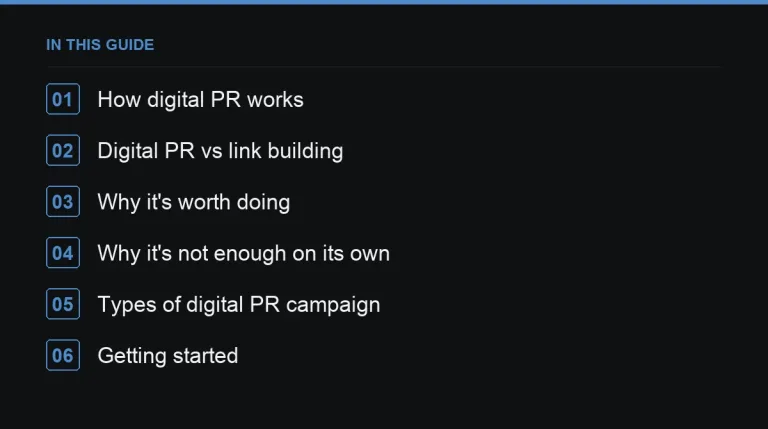
How digital PR works
- Find a story. Original data, a survey, an expert angle on a trending topic, or a creative campaign.
- Package it for journalists. A clear press release or pitch, headline findings, methodology, visuals and quotes.
- Outreach. Pitch relevant journalists and publications individually (how to get replies).
- Coverage. Publications write their own stories, citing and often linking to you.
- Follow-up. Ask for links where you’re mentioned without one (unlinked mentions).
Digital PR vs link building
| Digital PR | Paid placements / link building | |
|---|---|---|
| What you get | Editorial coverage, with links as a by-product | A specific link on a specific site |
| Control | Low: the journalist decides | High: site, anchor, target page |
| Link quality | Often very high: news and major publications | Varies with the site |
| Predictability | Low: campaigns can land big or flop | High |
| Brand value | High | Depends on the audience |
| Risk | Very low | Depends on site quality and practices |
Why it’s worth doing
Links from news sites and respected publications are the kind that are almost impossible to buy and that search engines trust most. A single successful campaign can earn dozens of referring domains, all editorially given. Coverage also builds brand recognition, which helps everything else, including outreach for future campaigns, and it feeds the same trust signals discussed in E-E-A-T and links.
Why it’s not enough on its own
Digital PR is unpredictable and hard to aim. Coverage tends to link to your homepage or the campaign page, not the category page you need to rank. That’s why most teams combine it with more controlled methods: placements to support specific pages, and internal linking to pass the value of PR links onward to the pages that actually need to rank.
There’s also a timing mismatch worth planning for. A digital PR campaign can take weeks to plan and land, and then produce nothing for months, followed by a burst of coverage in a single week. Paid placements are far more predictable in pace, which is why most serious programs run both in parallel rather than betting the whole plan on PR alone. See aligning digital PR with SEO goals for how the two fit together in a single plan.
Types of digital PR campaign
- Data-led — original research or analysis of public data (how to build one).
- Reactive — fast expert comment on breaking news (reactive PR).
- Expert positioning — becoming a go-to source journalists quote (getting quoted).
- Creative — tools, interactive pieces or stunts that are newsworthy in themselves (creative campaigns beyond data).
- Announcements — funding, launches and research, often via a release (do press releases still help SEO?).
Digital PR for different business types
The shape of a good campaign varies by business. B2B companies often do better with industry surveys and expert positioning than with mass-market data stories, since trade press cares more about implications for practitioners than a punchy national headline (digital PR for B2B). Ecommerce brands tend to get more mileage from seasonal, consumer-facing angles tied to buying behaviour (digital PR for ecommerce), while a genuinely local business can win coverage in local and regional press without ever needing a national story (digital PR for local businesses).
Common reasons campaigns underperform
Most disappointing results trace back to a handful of causes: an angle built around the brand instead of the reader, data too thin to support the claimed headline, outreach sent to the wrong journalists, or a launch that clashes with a bigger news day. Why digital PR campaigns fail goes through these in more detail, and it’s worth reading before your first campaign rather than after a disappointing one.
Getting started
If you don’t have an in-house team, you can hire PR and outreach specialists through press release services or PR link services, and use the marketplace for the targeted placements that complement it. Most teams start with one small campaign, learn what their audience and journalists respond to, and scale from there rather than committing a full year’s budget to an untested format.
Where digital PR fits in your wider plan
Treat digital PR as one input to link building, not a replacement for it. A realistic annual plan usually includes a handful of PR pushes, a standing programme of expert commentary, and a steady stream of relevant guest posts and niche edits to support pages PR rarely touches. Setting an overall link building budget that allocates across all three, rather than treating each as a separate decision, keeps the whole programme coherent and easier to defend to whoever signs off the spend.
All digital PR guides
- 25 Digital PR Campaign Ideas You Can Adapt
- Aligning Digital PR With SEO Goals
- Building a Newsjacking Calendar
- Building an Index or Ranking Campaign the Right Way
- Combining Digital PR With Marketplace Placements for Coverage Gaps
- Creating Visual Assets Journalists Will Actually Use
- Creative Digital PR Campaigns: Beyond Data
- Designing Map-Based Digital PR Campaigns
- Designing a Digital PR Campaign Landing Page
- Digital PR Campaigns for B2B Software Companies
- Digital PR Campaigns for Boring Industries
- Digital PR Campaigns for Finance Brands
- Digital PR Campaigns for Travel Brands
- Digital PR for B2B Companies
- Digital PR for Ecommerce Brands
- Digital PR for Local Businesses
- Do Press Releases Still Help SEO?
- Evergreen Digital PR Campaigns vs One-Off Campaigns
- Finding Regional Angles From National Data
- Getting Quoted as an Expert: A Step-by-Step Process
- Headline Writing for Digital PR Campaigns
- How to Build a Calculator-Led Digital PR Campaign
- How to Build a Data-Driven Digital PR Campaign
- How to Measure Digital PR Campaign Links and Coverage
- How to Pitch Multiple Angles From One Dataset
- How to Plan a Realistic Digital PR Campaign Timeline
- How to Report on Digital PR Beyond Link Counts
- How to Repurpose an Old Digital PR Campaign a Year Later
- How to Run Digital PR Campaigns on a Small Budget
- How to Run Responsible Health Digital PR Campaigns
- How to Run a Digital PR Ideation Workshop
- How to Think About Digital PR Campaign Budgets
- How to Validate a Digital PR Campaign Idea Before You Build It
- How to Write a Post-Campaign Digital PR Report
- Journalist Outreach That Gets Replies
- Pitching Regional and Local Press
- Planning Follow-Up Outreach Waves for Digital PR Campaigns
- Reactive PR: Earning Links From the News Cycle
- Running Digital PR Campaigns in Non-English Markets
- Running Survey-Based PR Campaigns
- Seasonal Digital PR Campaigns for Ecommerce Brands
- Survey Design Pitfalls That Sink Digital PR Campaigns
- Turning Unlinked Brand Mentions Into Links
- Using Freedom of Information Requests for Digital PR Campaigns
- Using Public Datasets for Digital PR Campaigns
- Why Digital PR Campaigns Fail (and How to Fix Them)
- Working With Designers and Developers on Digital PR Campaigns
Frequently asked questions
Is digital PR the same as press releases?
No. A press release is one tool. Digital PR is the wider practice of creating stories and pitching them to journalists.
How many links does a digital PR campaign get?
It varies widely. Some campaigns earn none; strong ones earn dozens of links from major publications.
Is digital PR safe for SEO?
Yes. Coverage earned on merit is exactly the kind of linking search engines aim to reward.
Put it into practice
Filter 54,483 websites by DR, traffic, niche and price, and order with escrow — you pay only after the link is live.
Browse the marketplace