How to Run a Digital PR Ideation Workshop
A step-by-step format for turning a room of people into a shortlist of testable campaign ideas.
Most digital PR ideation sessions fail before anyone opens a laptop. The room is full of opinions about what would be “shareable” but has no shared method for testing whether an idea is any good. A workshop with a clear structure produces more usable output in ninety minutes than a week of scattered Slack messages.
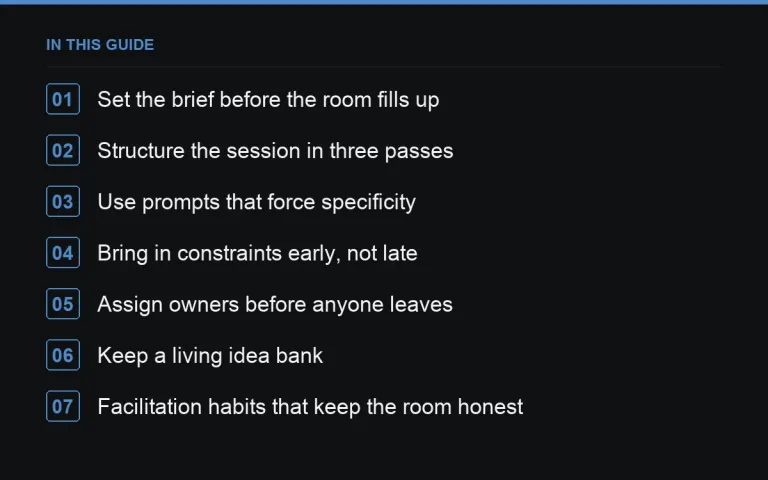
Set the brief before the room fills up
Send a one-page brief in advance: the client or site’s niche, the audience it needs coverage in front of, any topics that are off-limits, and two or three examples of coverage the team would be happy with. Ask attendees to bring three ideas each, written down, not just half-formed thoughts to riff on live. This single step raises the quality of a workshop more than any icebreaker exercise, because people arrive having already done some private divergent thinking, per https://successtoroad.com/blog/digital-pr-campaign-ideas/.
Structure the session in three passes
Run ideation in distinct rounds rather than one long open discussion:
- Divergence (20 minutes): every idea goes on the board, no discussion, no criticism.
- Clustering (15 minutes): group similar ideas by mechanic — survey, dataset, calculator, map, expert panel.
- Stress-testing (30 minutes): for each cluster’s strongest idea, ask who would cover it, what the headline would say, and where the data comes from.
This mirrors how you would later https://successtoroad.com/blog/validating-a-campaign-idea/ a concept before committing budget, so the workshop and the validation stage speak the same language.
Use prompts that force specificity
Vague prompts like “what would journalists love?” produce vague ideas. Better prompts force a concrete mechanic: “what number could we produce that no one else has published?”, “what could we rank cities, brands, or products on?”, or “what would this look like as a map?” These map directly onto recognised campaign formats covered in https://successtoroad.com/blog/index-and-ranking-campaigns/ and https://successtoroad.com/blog/map-based-pr-campaigns/, which makes the later build phase faster because the format is already chosen.
Bring in constraints early, not late
Teams often generate exciting ideas and only discover the data doesn’t exist, or the timeline is six months too long, after the workshop ends. Put a “reality check” column on the board next to every idea: available data source, rough build time, and who owns the write-up. An idea with no realistic data source should be parked, not killed — it might work with a different data source in https://successtoroad.com/blog/using-public-datasets-for-pr/.
Assign owners before anyone leaves
A workshop that ends without named owners produces a document nobody revisits. Each shortlisted idea needs one person responsible for validating it within a set number of days, and a second person responsible for scoping the data or design work. Without this, ideation sessions become a recurring meeting that generates enthusiasm and no output.
Keep a living idea bank
Not every idea from a workshop should be built immediately. Maintain a simple spreadsheet of parked ideas tagged by mechanic, seasonality, and data availability. Six months later, an idea that felt premature might fit a https://successtoroad.com/blog/campaign-timelines/ perfectly, or become the basis for https://successtoroad.com/blog/repurposing-old-campaigns/ with fresh data.
Facilitation habits that keep the room honest
A facilitator’s job in these sessions is less about generating ideas personally and more about stopping a handful of confident voices from dominating the board. Go round the table for the first contribution rather than opening the floor, so quieter team members get an idea on the wall before the loudest opinions set the tone. Write every idea down verbatim rather than paraphrasing it into something more polished — paraphrasing during divergence quietly kills ideas that needed more time to develop.
It also helps to separate the person proposing an idea from the person defending it during stress-testing. Ask someone other than the originator to argue for why a concept would get covered; this surfaces whether the idea’s appeal is genuinely obvious to a second person or only obvious to the person who thought of it.
What a good output document looks like
The workshop should end with more than a photo of a whiteboard. A usable output document lists each shortlisted idea with its proposed mechanic, a first-guess data source, an owner, and a target validation date. Ideas that were discussed but parked should still be recorded with a one-line reason, since that reasoning is exactly what a future workshop needs to avoid re-litigating the same rejected concept without new information.
Remote and hybrid workshop considerations
A workshop split across a physical room and remote attendees needs a shared digital board from the start, not a whiteboard that remote participants can only half-see over a video call. Give remote attendees the same round-robin opportunity to contribute first, and consider running the divergence phase entirely asynchronously beforehand, with the live session reserved for clustering and stress-testing where real-time discussion adds the most value. Teams that treat a hybrid session as a straightforward video call of an in-person format tend to find remote voices contribute noticeably less, which quietly narrows the range of ideas generated.
Where to go next
Once a shortlist exists, move straight into validation rather than debating further in the abstract — see https://successtoroad.com/blog/validating-a-campaign-idea/. If your team is short on campaign capacity, https://successtoroad.com/marketplace/ lets you find publishers ready to place the coverage once the idea is built, and https://successtoroad.com/services/writing/ can help draft the initial pitch angles. For inspiration on mechanics to bring into the room, https://successtoroad.com/blog/digital-pr-campaign-ideas/ and https://successtoroad.com/blog/index-and-ranking-campaigns/ are useful references to circulate before the session.
Frequently asked questions
How many people should attend a digital PR ideation workshop?
Between four and eight works best. Fewer than four limits the range of angles; more than eight slows down discussion and makes it harder to give every idea a fair hearing within a fixed time slot.
How often should we run these workshops?
Quarterly is enough for most teams, with a lighter monthly check-in to review the parked idea bank. Running them too often without new data sources or briefs tends to produce repeat ideas.
Should clients or stakeholders join the workshop?
Include them for the brief and the final shortlist review, but keep the divergent brainstorming phase to the core team — client presence in early stages tends to make people self-censor riskier ideas.
What's the biggest reason these workshops produce nothing usable?
No owner assigned to next steps. An idea without a named person responsible for validating it within days simply sits on a list until the next workshop replaces it.
Put it into practice
Filter 54,483 websites by DR, traffic, niche and price, and order with escrow — you pay only after the link is live.
Browse the marketplace