Working With Designers and Developers on Digital PR Campaigns
How to brief designers and developers so a campaign build matches the story the PR team actually needs to tell.

A recurring failure pattern in digital PR is a strong idea and solid data arriving at the design or development stage without a clear brief, producing a build that looks impressive but doesn’t actually serve the pitch. Good collaboration here is a process problem, not a talent problem — most of it is fixable with a better handoff.
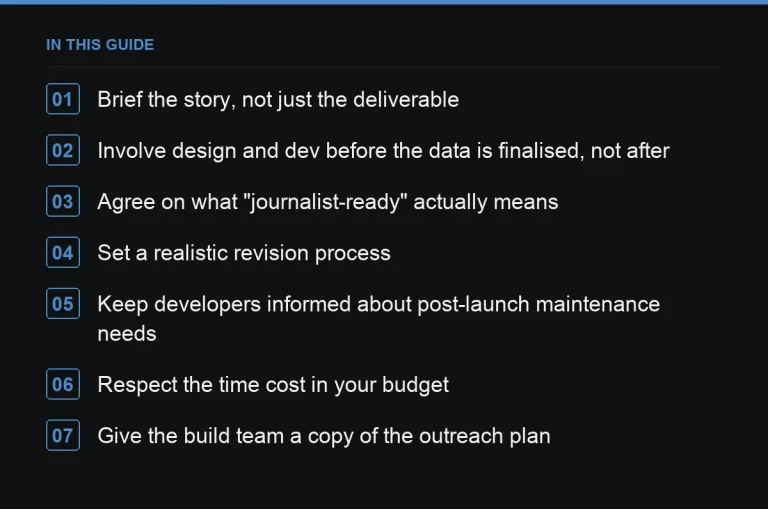
Brief the story, not just the deliverable
Telling a designer “we need a landing page and a chart” gives them far less to work with than explaining what the headline finding is, who the audience is, and what a journalist needs to see in the first few seconds. Share the https://successtoroad.com/blog/validating-a-campaign-idea/ and the intended https://successtoroad.com/blog/headline-writing-for-campaigns/ directly, not just a data file.
Involve design and dev before the data is finalised, not after
Bringing in the build team only once data collection is complete often means discovering, too late, that the data format doesn’t suit the intended visualisation, or that a planned interactive feature needs data structured differently. A short early conversation about data shape prevents a costly rework later in https://successtoroad.com/blog/campaign-timelines/.
Agree on what “journalist-ready” actually means
PR and design teams sometimes have different mental models of the deliverable. Be explicit that the build needs to produce the static, exportable assets described in https://successtoroad.com/blog/visual-assets-for-journalists/, not just a polished interactive experience — an impressive interactive page that produces no usable screenshot is a common and avoidable failure.
Set a realistic revision process
Build in one or two structured review rounds rather than open-ended back-and-forth. A simple structure works well:
- Round one: core structure and data accuracy review.
- Round two: visual polish and journalist-asset export check.
- Final sign-off: methodology text, links, and FAQ content confirmed live.
Keep developers informed about post-launch maintenance needs
If the campaign is intended as an https://successtoroad.com/blog/evergreen-vs-one-off-campaigns/, the developer needs to know at brief stage that data refreshes or annual updates are expected, so the build is structured to make that easy rather than requiring a full rebuild each cycle.
Respect the time cost in your budget
Design and development time is a real cost centre, not a background overhead — reflect it honestly in https://successtoroad.com/blog/campaign-budgets/ rather than treating it as free capacity that can always absorb late-stage changes without consequence.
Give the build team a copy of the outreach plan
Sharing the intended https://successtoroad.com/blog/pitching-angles-from-one-dataset/ and outreach segments with the design and development team helps them understand why certain regional crops or secondary views matter, even if those elements seem like extra scope at first glance. A build team that understands the outreach strategy is better placed to flag, early, where a proposed feature won’t actually serve a real pitch.
Plan for last-minute data corrections without panic
Data sometimes needs a small correction after the build is technically finished — a source revises a figure, or a reviewer spots an error. Agree in advance on a simple process for pushing a data correction to a live page quickly, so this doesn’t turn into an emergency rebuild each time it happens. A build architected with a clear separation between the underlying data and the page’s design makes this kind of fix far faster.
Give feedback on the finished asset, not just the brief
Once outreach starts and coverage comes in, share specific feedback on how the visual assets actually performed — which crop journalists used, which chart got embedded, which was ignored. This feedback loop helps a design team improve their instincts for this particular kind of brief over successive campaigns, rather than treating every project as a fresh, unconnected exercise with no accumulated learning between them.
Agree on ownership of source files, not just the finished page
Confirm who retains the editable source files for charts, layouts, and any custom components once the project wraps, particularly when working with external contractors. Losing access to editable source files is a common, entirely avoidable reason a simple future update ends up costing far more than it should, requiring a rebuild from scratch instead of a quick edit.
Put this ownership arrangement in writing before the project starts rather than assuming it will be straightforward to resolve later, since it’s a far easier conversation to have before any work begins than after a contractor relationship has already ended.
Hold a short retrospective with the build team specifically
Separate from the wider campaign report, a brief conversation focused just on the design and development process — what briefing worked, what caused rework, what would speed up the next project — improves the collaboration itself over time, independent of how any individual campaign happened to perform in the market.
Where to go next
Once the build is complete, check it against https://successtoroad.com/blog/campaign-landing-page-design/ before launch, confirm exportable assets meet the standard in https://successtoroad.com/blog/visual-assets-for-journalists/, and loop the design team into post-campaign https://successtoroad.com/blog/post-campaign-reporting/ so they see how their work actually performed. If capacity is tight, https://successtoroad.com/services/writing/ and https://successtoroad.com/marketplace/ can help supplement in-house resource for the content and outreach side of the project.
Frequently asked questions
Who should write the creative brief for a campaign build?
Whoever owns the PR strategy and outreach plan, since they understand what a journalist needs to see and act on. The brief should be reviewed by design and development before work begins, not handed over as a final instruction.
How early should developers be involved in a data-driven campaign?
As early as the data source is chosen, ideally before collection finishes. This avoids late discoveries that the data isn't structured in a way the intended build can actually use.
What's the most common handoff mistake between PR and design teams?
Briefing the deliverable format without explaining the underlying story or audience. This produces builds that look polished but miss the specific details journalists need to cover the story quickly.
Should design and development be involved in measuring results?
Yes, at least a summary of how the campaign performed. It closes the feedback loop and helps the build team understand which design decisions actually supported coverage in practice.
Put it into practice
Filter 54,483 websites by DR, traffic, niche and price, and order with escrow — you pay only after the link is live.
Browse the marketplace