How to Run Digital PR Campaigns on a Small Budget
How to get real coverage from a digital PR campaign without the budget for a commissioned survey or an elaborate interactive build.
A small budget rules out some options — a large commissioned survey, an elaborate interactive build, extensive paid distribution — but it doesn’t rule out effective digital PR. It just changes where the effort needs to concentrate: toward free or cheap data sources and toward outreach quality over build polish.
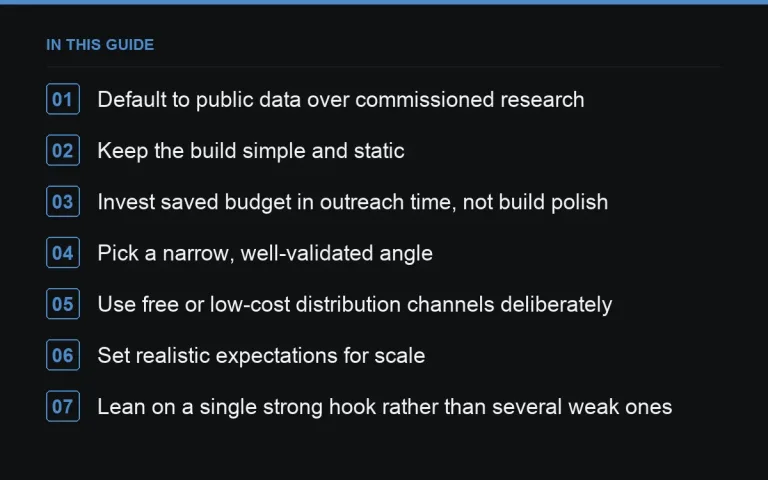
Default to public data over commissioned research
Commissioning even a modest survey often costs more than the entire budget available for a small campaign. Public datasets — see https://successtoroad.com/blog/using-public-datasets-for-pr/ — cost nothing beyond staff time to find and analyse, and a genuinely original angle within existing public data can outperform a generic commissioned survey anyway.
Keep the build simple and static
A clean, well-structured static landing page with a clear chart, following https://successtoroad.com/blog/campaign-landing-page-design/, does the job that an expensive interactive build would, for a fraction of the cost. Save interactive investment for ideas that have already proven themselves through a cheaper first version.
Invest saved budget in outreach time, not build polish
With a small budget, the highest-leverage spend is usually staff time on research and tailored pitching, not additional design iterations. A well-targeted, well-written pitch to twenty relevant journalists will usually outperform a beautifully designed page sent to a generic mailing list of two hundred.
Pick a narrow, well-validated angle
Small-budget campaigns can’t afford to be wrong about the idea — there’s no room to absorb a failed concept and try again quickly. Spend proportionally more time on https://successtoroad.com/blog/validating-a-campaign-idea/ relative to the overall project size than a larger-budget campaign would need to.
Use free or low-cost distribution channels deliberately
- Direct, well-researched outreach to a short, highly relevant journalist list.
- Regional press, which is often more accessible and less competitive than national press for smaller campaigns, per https://successtoroad.com/blog/regional-angles-from-national-data/.
- A small number of relevant https://successtoroad.com/marketplace/ placements to guarantee at least some baseline coverage.
Set realistic expectations for scale
A small-budget campaign will typically produce a smaller volume of coverage than a fully resourced one, and that’s a reasonable trade-off, not a failure. Judge success against the budget actually spent, using the framing in https://successtoroad.com/blog/campaign-budgets/, rather than against results from campaigns with substantially more resource behind them.
Lean on a single strong hook rather than several weak ones
With limited resource to prepare multiple angles per https://successtoroad.com/blog/pitching-angles-from-one-dataset/, concentrate on making one genuinely strong finding as sharp and well-supported as possible, rather than spreading thin effort across several half-developed angles. One well-validated, well-presented finding pitched properly outperforms several mediocre ones pitched hastily.
Reuse infrastructure across campaigns where possible
A simple, reusable landing page template and a maintained contact list, built once and refined after each campaign, reduce the marginal cost of each subsequent small-budget campaign considerably. Treat the first campaign partly as an investment in reusable infrastructure, not just a one-off project, so the second and third cost noticeably less in both time and money.
Trade time for money where the team has capacity
A small budget doesn’t have to mean a small effort if the team has spare time rather than spare cash — manual research into journalist contacts, hand-built charts, and personally written pitches can substitute for paid tools and services reasonably well, provided the team is realistic about how much time that substitution actually takes before committing to the schedule.
Be selective about which follow-up waves you can afford
A small team may not have capacity to run three full https://successtoroad.com/blog/follow-up-outreach-waves/ on top of the initial send. Prioritise one well-timed follow-up over several thin ones spread too widely, and accept that a smaller campaign may reasonably run a shorter outreach cycle than a larger, better-resourced one would.
Prioritise a short, targeted list over a long generic one
With limited time to research contacts thoroughly, a list of twenty genuinely well-matched journalists usually outperforms a list of two hundred pulled from a generic database with no real vetting. Spend the available research time narrowing the list rather than widening it, since quality of match matters more than volume when outreach capacity itself is the binding constraint.
A smaller, well-researched list is also easier to personalise properly, which compounds the advantage further since tailored pitches consistently outperform generic ones regardless of how large the recipient list is.
Track cost per placement even informally
Even without formal budgeting software, a rough running note of hours spent versus coverage earned helps a small team see which activities are actually paying off. This informal tracking, kept consistently across campaigns, becomes a genuinely useful guide for where to focus limited time on the next small-budget project.
Over several campaigns, this record often reveals that certain low-cost activities, like a well-targeted regional pitch, consistently outperform more time-intensive efforts, letting a small team focus its limited hours where they demonstrably matter most.
Where to go next
Plan a realistic https://successtoroad.com/blog/campaign-timelines/ that accounts for a smaller team doing more of the work directly, and consider https://successtoroad.com/services/writing/ for cost-effective help drafting pitches and landing page copy if in-house writing capacity is limited.
Frequently asked questions
What's the single best use of a small digital PR budget?
Staff time spent on research and tailored outreach usually outperforms additional spend on design or interactive features. A simple page pitched well beats an elaborate page pitched poorly.
Can a small-budget campaign still get national press coverage?
It's possible but less reliable than with a larger, more resourced campaign. Regional and trade press are generally more accessible targets for small-budget campaigns and still deliver real link value.
Should small-budget campaigns avoid commissioned surveys entirely?
Not always, but public data sources are usually a more cost-effective starting point, since a well-found angle in existing data can rival a commissioned survey's impact without the fielding cost.
How do we make a small campaign look professionally produced?
Focus the limited budget on a clean, simple landing page and clear, accurate visuals rather than spreading it thin across many features. A polished simple page reads better than an ambitious unfinished one.
Put it into practice
Filter 54,483 websites by DR, traffic, niche and price, and order with escrow — you pay only after the link is live.
Browse the marketplace