Combining Digital PR With Marketplace Placements for Coverage Gaps
Why the strongest campaigns treat marketplace placements as a deliberate gap-filler, not a replacement for real outreach.
Digital PR outreach and marketplace-sourced placements are often treated as separate, even competing strategies. In practice, the strongest campaigns use both — organic outreach for the earned-media core of the story, and marketplace placements to deliberately fill gaps that outreach alone predictably leaves behind.
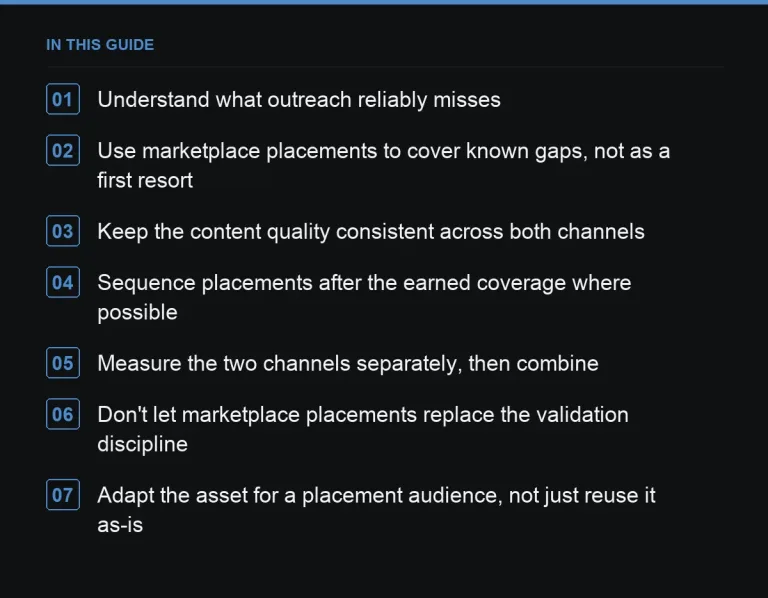
Understand what outreach reliably misses
Even a well-run campaign with strong angles per https://successtoroad.com/blog/pitching-angles-from-one-dataset/ won’t reach every relevant niche or region. Smaller niche sites, certain regional markets, and specific language or industry verticals are often under-served by a generalist outreach list, simply because building and maintaining contact relationships in every relevant vertical isn’t realistic for most teams.
Use marketplace placements to cover known gaps, not as a first resort
Identify gaps deliberately: after your main outreach waves and https://successtoroad.com/blog/follow-up-outreach-waves/ have run their course, review which niches, regions, or site types are missing from your coverage relative to your original angle map. That gap list is exactly what https://successtoroad.com/marketplace/ and specific https://successtoroad.com/niche/business/ or https://successtoroad.com/niche/technology/ filters are built to address.
Keep the content quality consistent across both channels
A placement secured through a marketplace should meet the same editorial bar as earned coverage — accurate, well-sourced, genuinely useful to that site’s readers. Treat the https://successtoroad.com/services/writing/ brief for a placement with the same care as a journalist pitch, since a weak placement undermines the credibility of the whole campaign regardless of how it was secured.
Sequence placements after the earned coverage where possible
Placements that reference “as covered by [notable outlet]” carry more weight than a standalone mention, so where your timeline allows, secure a few pieces of genuine earned coverage first, then use marketplace placements in the following weeks to extend reach into the gaps — a natural extension of the wave planning in https://successtoroad.com/blog/follow-up-outreach-waves/.
Measure the two channels separately, then combine
Track outreach-earned coverage and marketplace-sourced placements as distinct categories within your https://successtoroad.com/blog/measuring-campaign-links-and-coverage/, then combine them for a total picture of niche and geographic coverage. This keeps you honest about which channel is actually driving results and where to invest next time.
Don’t let marketplace placements replace the validation discipline
Cheap, easy access to placements can tempt teams to skip proper https://successtoroad.com/blog/validating-a-campaign-idea/ on the theory that coverage is guaranteed either way. Resist this — a weak idea placed widely through a marketplace still produces weak, low-engagement content that reflects poorly on the brand, regardless of the volume of links involved.
Adapt the asset for a placement audience, not just reuse it as-is
A landing page built for a journalist pitch, following https://successtoroad.com/blog/campaign-landing-page-design/, sometimes needs light adaptation for a guest-post placement audience, which may want more context or a slightly different framing than a time-pressed journalist would. Treat the placement brief as its own short writing task rather than pasting the press release copy directly into a guest-post draft.
Use publisher filters deliberately, not generically
Rather than requesting a broad batch of generic placements, filter by the specific niche, language, or regional gap identified in your coverage review. A handful of well-matched, relevant placements filling a genuine gap outperform a larger number of loosely related ones, both for reader engagement and for how the links read to anyone reviewing your backlink profile later.
Keep the two channels visible in the same report
Presenting earned coverage and marketplace placements in entirely separate reports, to separate stakeholders, makes it harder to see the full picture of how a campaign’s reach was actually built. Fold both into the single https://successtoroad.com/blog/post-campaign-reporting/, clearly labelled by channel, so anyone reviewing results later understands exactly how the total coverage was assembled.
Build the marketplace step into your standard workflow
Rather than deciding on a case-by-case basis whether to use marketplace placements, add a standard gap-review step to your usual campaign process, right after the main outreach waves conclude, so it becomes a routine part of every campaign’s later stages instead of an occasional afterthought only remembered for some campaigns and not others.
Making this a default step, rather than a special request only some campaigns receive, also makes it easier to compare gap-filling performance across campaigns over time, since the practice is applied consistently rather than sporadically.
Keep the two channels visually distinguishable in tracking
When reviewing your backlink profile later, having outreach-earned coverage and marketplace placements clearly tagged as separate categories from the outset makes it much easier to answer questions about the mix later, without having to reconstruct which link came from which channel months after the fact.
This clarity also matters if anyone outside the immediate team later reviews the backlink profile for its own sake, since a transparent, well-labelled mix of channels is far easier to explain and stand behind than one that only becomes clear after careful reverse-engineering.
Where to go next
Build the gap-filling step into your standard https://successtoroad.com/blog/post-campaign-reporting/, and use https://successtoroad.com/marketplace/’s filtering by niche, language, and country to make gap-filling a deliberate, planned step rather than a last-minute scramble.
Frequently asked questions
Should marketplace placements be planned before or after outreach?
After the main outreach waves have run their course is usually best, so placements can deliberately target the niches and regions your earned coverage didn't reach, rather than duplicating it.
Does combining channels dilute the credibility of a campaign?
Not if placement content is held to the same quality bar as outreach pitches. The risk comes from treating marketplace content as lower effort, not from using the channel itself.
How do we know which gaps to target with marketplace placements?
Compare your original angle map and target niche list against the coverage actually earned through outreach. The mismatch between the two is your gap list.
Can marketplace placements help with regional coverage specifically?
Yes, filtering by niche and language on a marketplace is often the fastest way to reach regional or non-English markets that a generalist outreach list wasn't built to cover well.
Put it into practice
Filter 54,483 websites by DR, traffic, niche and price, and order with escrow — you pay only after the link is live.
Browse the marketplace