How to Think About Digital PR Campaign Budgets
Where digital PR campaign budgets actually go, and how to avoid over-investing in the wrong stage of the process.
Digital PR budgets get allocated unevenly more often than they get allocated wrong. Teams frequently spend heavily on a polished interactive build and then run outreach on whatever time is left over, when the reverse allocation usually produces better results.
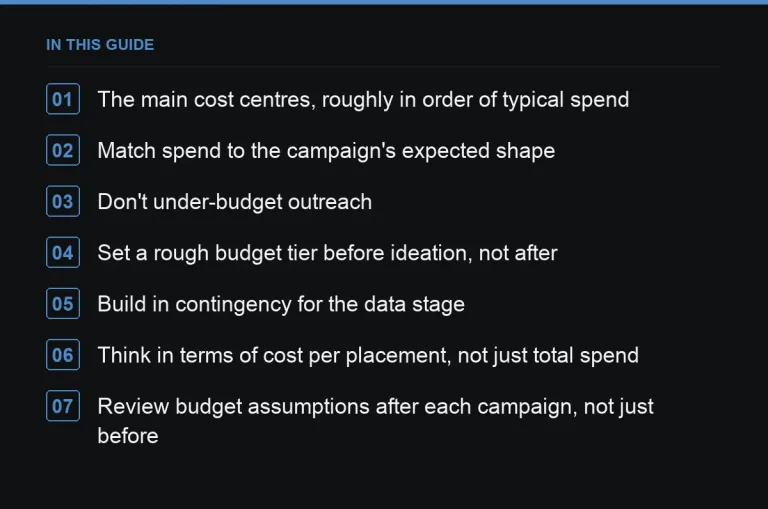
The main cost centres, roughly in order of typical spend
- Data: commissioning a survey, licensing data, or the staff time to source and clean public data.
- Design and build: the landing page, any interactive elements, visual assets for journalists.
- Outreach: the staff time to research contacts, write tailored pitches, and follow up across multiple waves.
- Distribution support: paid placements or wire distribution to extend reach beyond organic outreach.
Match spend to the campaign’s expected shape
A https://successtoroad.com/blog/calculator-led-campaigns/ justifies heavier build investment because it earns links over years, not days — see https://successtoroad.com/blog/evergreen-vs-one-off-campaigns/. A reactive, time-sensitive story justifies almost the opposite allocation: minimal build, maximum speed, and outreach effort concentrated in a very short window, per https://successtoroad.com/blog/reactive-pr/.
Don’t under-budget outreach
The most common budgeting mistake is treating outreach as free because it’s “just emails.” Researching the right contacts, tailoring pitches per https://successtoroad.com/blog/pitching-angles-from-one-dataset/, and running https://successtoroad.com/blog/follow-up-outreach-waves/ all take real staff time that should be costed the same way design time is.
Set a rough budget tier before ideation, not after
Deciding budget tier before generating ideas keeps https://successtoroad.com/blog/campaign-ideation-workshops/ realistic — a team that knows it has a modest budget will naturally gravitate toward smaller-scope, public-data-driven ideas rather than proposing an ambitious commissioned survey it can’t actually afford, a distinction covered further in https://successtoroad.com/blog/small-budget-digital-pr-campaigns/.
Build in contingency for the data stage
Data sourcing is the least predictable cost centre — a survey that needs a larger sample to be statistically credible, or a request to a public body that comes back requiring a follow-up, both add cost mid-project. A contingency buffer, even a modest one, prevents a mid-campaign scramble.
Think in terms of cost per placement, not just total spend
A qualitative way to sanity-check budget allocation is to ask: given this spend, how many pieces of coverage would make the campaign worthwhile, and does the current plan realistically produce that many? This framing, paired with https://successtoroad.com/blog/measuring-campaign-links-and-coverage/, keeps budget conversations grounded rather than abstract.
Review budget assumptions after each campaign, not just before
Actual spend rarely matches the original estimate exactly, and the gap is informative. If data sourcing consistently runs over budget across several campaigns, that’s a signal to either allocate more contingency there by default or to favour cheaper public-data-driven ideas more often, echoing the choice covered in https://successtoroad.com/blog/using-public-datasets-for-pr/. Fold this comparison into your https://successtoroad.com/blog/post-campaign-reporting/ rather than treating each campaign’s budget as an isolated exercise.
Avoid false economy on the wrong stage
Cutting corners on data sourcing to protect the design budget, or the reverse, often creates problems that cost more to fix later than the original saving was worth. A cheap survey with a shaky sample size can undermine an otherwise well-designed and well-pitched campaign entirely, since the credibility of the whole piece rests on the weakest link in the chain, not the strongest.
Get budget sign-off before ideas get emotionally attached
Present the available budget tier alongside the shortlisted ideas during https://successtoroad.com/blog/validating-a-campaign-idea/, rather than after the team has already fallen in love with an ambitious concept that turns out to be unaffordable. A budget conversation that happens too late in the process feels like a rejection of the idea itself, when it’s really just a sequencing problem that earlier planning would have avoided.
Separate one-off spend from ongoing spend
A build cost is a one-time expense, but an evergreen asset following https://successtoroad.com/blog/evergreen-vs-one-off-campaigns/ also carries a small ongoing maintenance cost that’s easy to forget when the initial budget is approved. Track these as two separate lines so the true annual cost of an evergreen asset is visible, rather than quietly absorbed into a general team overhead nobody reviews.
Revisit rates with freelancers and contractors periodically
Where external designers, writers, or data specialists are billed per project, rates and typical scope can drift over time without anyone formally reviewing them. A periodic check that current rates still match the market, and that project scope hasn’t quietly expanded without a corresponding budget increase, keeps future estimates realistic rather than based on outdated assumptions.
It’s also worth reviewing whether a fixed-project rate or an hourly arrangement better suits a given collaborator’s typical work pattern, since the wrong structure can quietly inflate cost on either side without either party intending it to.
Keep a shared reference of typical costs by campaign type
A simple internal reference sheet showing roughly what a survey-led campaign, a public-data campaign, and a calculator build have each cost historically gives anyone proposing a new idea an immediate, realistic sense of scale before detailed quotes come in, speeding up early planning conversations considerably.
Where to go next
Once budget tiers are set, plan the corresponding https://successtoroad.com/blog/campaign-timelines/ and pick a mechanic that fits both, following https://successtoroad.com/blog/validating-a-campaign-idea/. https://successtoroad.com/marketplace/ and https://successtoroad.com/services/writing/ offer ways to extend a limited internal budget with external placement and content support.
Frequently asked questions
What share of a digital PR budget should go to outreach?
There's no universal split, but outreach is frequently under-resourced relative to design and data. Treating researcher and pitch-writing time as a real, costed line item usually improves results more than extra design polish.
How do we budget for an idea with an uncertain data cost?
Set a contingency allowance specifically for the data stage, since it's the least predictable cost centre. A survey needing a larger sample or a delayed public data request are common mid-project cost surprises.
Is a bigger budget always better for digital PR?
No. A well-validated idea with a modest, focused build often outperforms an expensive, over-engineered one built around a weaker angle. Budget should follow a validated idea, not substitute for one.
Should paid distribution be part of every campaign budget?
Not necessarily every campaign, but it's worth considering for stories where organic outreach alone is unlikely to reach enough relevant publishers, particularly in competitive or crowded topic areas.
Put it into practice
Filter 54,483 websites by DR, traffic, niche and price, and order with escrow — you pay only after the link is live.
Browse the marketplace