Journalist Outreach That Gets Replies
Journalists get hundreds of pitches a day. The ones that get replies are specific, short and obviously written for that person.

Most PR pitches fail before they’re opened: wrong person, generic subject line, a story that isn’t one. Good outreach is less about volume and more about sending the right story to the right journalist in a form they can use in two minutes.
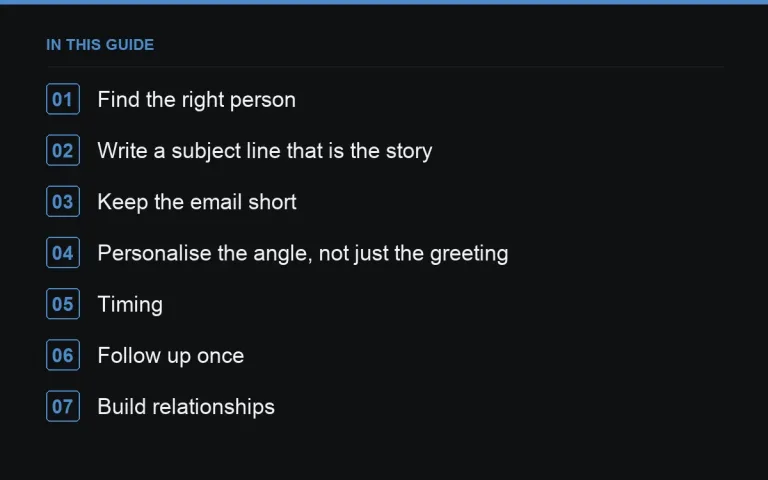
Find the right person
Pitch the journalist who covers your topic, not the publication’s general inbox. Read their recent articles. If they wrote about rental prices three times this month, your rent data is relevant; if they cover football, it isn’t. A smaller list of well-matched journalists outperforms a mass send every time. Journalist request platforms can also help surface who’s actively looking for sources right now (getting quoted at scale).
Write a subject line that is the story
Journalists decide in a glance. Make the subject line the headline:
- Weak: “Exciting new research from [Brand]”
- Strong: “Rents rose fastest in Leeds this year — new data”
Keep the email short
A pitch that a journalist can act on in under a minute typically follows a simple shape: a line acknowledging their recent piece on the topic, the headline finding and a second finding from your data, three or four key numbers as a short list, a link to the full data and methodology, a note that a named expert is available for comment, and an offer to send a regional or sector breakdown for their specific patch. That’s it — no attachments on first contact, no long company introduction, no marketing language, and nothing that reads like a template with the brackets filled in.
Personalise the angle, not just the greeting
For a data campaign, send regional journalists their region’s result and trade journalists the industry angle (building data campaigns). Changing “Hi [Name]” isn’t personalisation; changing the story is. The same principle applies to email templates more broadly — see outreach emails that don’t sound like templates for the wider pattern.
Timing
- Pitch early in the working day in the journalist’s time zone.
- Avoid days dominated by major scheduled news.
- Tie pitches to what’s being discussed now where you honestly can (reactive PR).
Follow up once
A single polite follow-up after a few days, ideally with a new detail, is reasonable. Repeated chasing damages the relationship for future campaigns. Outreach follow-ups covers how many is too many and what to say in the second message.
Build relationships
Journalists return to sources who are reliable: accurate data, fast responses, quotes that are actually quotable, and no spin. Respond quickly when they ask for something, and don’t pitch them stories that don’t fit their beat. Over time, that turns cold outreach into journalists coming to you (becoming a go-to expert).
Handling a “no” gracefully
Most pitches get no reply at all, and a portion get an explicit pass. Neither is worth chasing hard. A short, gracious acknowledgement — “understood, thanks for considering it” — keeps the door open for the next pitch far better than silence or a second attempt to change their mind. Journalists have long memories for sources who took rejection well and equally long memories for the ones who didn’t.
What not to do
- Don’t ask for a link in your first pitch. Earn the coverage first.
- Don’t send the same pitch to multiple journalists at the same outlet without saying so.
- Don’t offer payment for editorial coverage. That’s advertising, and reputable outlets will treat it that way.
What a bad pitch looks like
It’s worth reading a handful of pitches from the journalist’s side occasionally, if you can. Most bad ones share the same traits: a subject line about the company rather than the story, an opening paragraph that introduces the brand before saying anything newsworthy, three paragraphs of background nobody asked for, and the actual finding buried near the bottom, if it’s there at all. Fixing outreach is often less about learning new tricks and more about ruthlessly cutting a pitch down to the one sentence a journalist actually needs.
A short checklist before you hit send
- Is this journalist’s recent work actually about this topic, not just the same broad industry?
- Does the subject line read as a headline, not a company announcement?
- Have you removed every sentence that exists to promote the brand rather than inform the reader?
- Is there a named, available expert attached, with a one-line credential?
- Would you, as a busy journalist, be able to write a story from this email alone?
If the answer to the last question is no, the pitch needs another pass before it goes out, however good the underlying story is.
Where to go next
Good outreach compounds: each accurate, well-targeted pitch makes the next one easier to land, because journalists remember reliable sources. Use it alongside data-driven campaigns and reactive PR, and fill gaps on pages coverage doesn’t reach with placements from the marketplace.
Frequently asked questions
How many journalists should I pitch?
Enough to cover the relevant beats, but each should be a genuine fit. Quality of targeting matters more than volume.
Should I ask journalists for a link?
Not in the initial pitch. If they cover your story without a link, a polite request to link to the source data is reasonable.
What's the best day to pitch?
There's no universal best day. Avoid heavy scheduled-news days and pitch early in the journalist's working day.
Put it into practice
Filter 54,483 websites by DR, traffic, niche and price, and order with escrow — you pay only after the link is live.
Browse the marketplace