Outreach Follow-Ups: How Many, When and What to Say
Many replies come from the follow-up. Many burned bridges come from the third one. Here's the balance.
A meaningful share of outreach replies come after a follow-up rather than the first email, simply because inboxes are busy and messages get buried under everything else arriving that day. But repeated chasing damages your reputation with exactly the people you most want a working relationship with over time. The aim isn’t zero follow-ups or unlimited follow-ups — it’s one well-timed, genuinely useful message, sent once, and then knowing when to let it go.
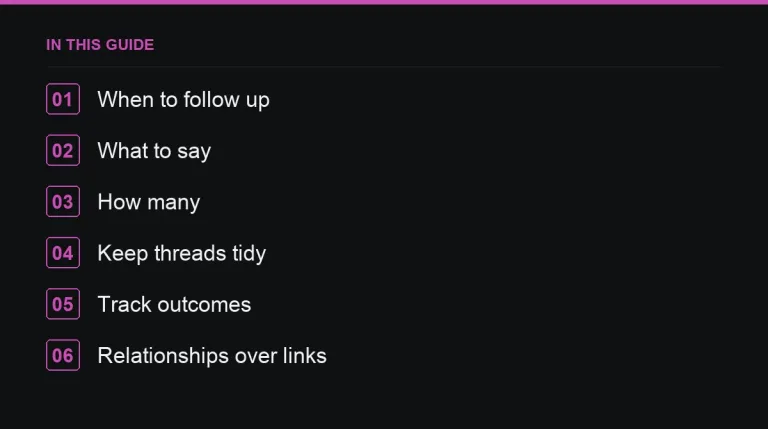
When to follow up, by outreach type
- Link and guest post outreach — about a week after the first email is the usual window; earlier reads as impatient, later and the original thread has usually gone cold.
- Journalist pitches — a few days at most, or sooner still if your story is genuinely time-sensitive; see journalist outreach for how tight these windows can get around breaking news.
- Reactive PR requests — don’t follow up at all; the deadline has almost always passed by the time a follow-up would land, and chasing a journalist past deadline reads as not understanding how the format works.
What to actually say
Add something genuinely new rather than a bare “just checking in”, which reads as pressure with nothing behind it. Useful additions include a new data point or finding since the first email, a more specific angle tailored to their audience or region, or an alternative, smaller ask if the original request was a big one. A short note that references the original topic, adds the new detail, and closes without pressure — explicitly saying it’s fine if it’s not a fit — tends to outperform anything that sounds like a nudge.
How many follow-ups is too many
One follow-up is standard for the overwhelming majority of outreach. Two, well spaced apart, is a reasonable ceiling for a genuinely high-value prospect — a site you’d get real value from, not just any prospect on the list. After that, stop entirely. Silence is itself an answer, and a third or fourth email rarely changes it; it just changes how the recipient remembers your name next time you write to them.
Keep the thread tidy
Reply within the same email thread so the full context is visible without the recipient having to scroll back through their inbox to remember what you originally asked. Resist the temptation to turn a follow-up into a different request than the original — if the guest post pitch didn’t land, don’t quietly pivot the follow-up into a backlink request instead; it reads as scattershot rather than considered.
Track outcomes properly
| Metric | Why it matters |
|---|---|
| Reply rate on first email | Shows whether your initial pitch and targeting are strong |
| Additional replies from follow-up | Shows how much of your success depends on chasing |
| Links earned per hour spent | The real efficiency number, not just total links |
If follow-ups are doing most of the work and the first email barely moves the needle on its own, the first email itself probably needs improving — see outreach email templates for the structures that tend to get a reply without needing a nudge.
Relationships outlast any single link
Editors and journalists remember people who respect their time, and they remember people who don’t. Keeping follow-ups polite, rare and genuinely useful is what makes your next outreach campaign to the same list of contacts easier rather than harder. This compounds in ways a single-campaign view of link building misses entirely — a contact who ignored you politely once is still a contact worth keeping for the next relevant pitch, six months later.
Setting expectations with clients or stakeholders
If you’re running outreach on behalf of a client, it helps to explain the follow-up policy upfront rather than after a prospect goes quiet. Clients unfamiliar with outreach sometimes expect every pitch to get a reply and push for aggressive chasing when it doesn’t, which can quietly damage relationships with exactly the sites worth the most long-term. A short, honest note in your reporting — how many first emails went out, how many follow-ups, and the overall reply rate — sets realistic expectations and gives you room to stick to the one-follow-up rule even under pressure to chase harder.
When a follow-up is actually the wrong move
- The recipient explicitly declined — a follow-up here reads as not listening.
- The opportunity was time-bound and the window has passed.
- You’ve already sent two follow-ups without any reply of any kind.
- The original pitch was weak enough that no amount of chasing will fix it — improve the pitch itself instead, as covered in finding guest post opportunities and the qualifying steps within it.
Where to go next
For the underlying pitch quality that determines whether a follow-up is even worth sending, see writing guest content that editors accept first time, and for keeping this organised across multiple live campaigns, managing link building for multiple clients. Sites open to paid placement instead of a cold pitch and follow-up cycle are listed in the marketplace.
Frequently asked questions
How many follow-up emails should I send?
One is standard for most outreach. Two at most, well spaced apart, for a genuinely high-value prospect, and then stop regardless of outcome.
What should a follow-up include?
Something new — an added data point, a sharper angle for their audience, or a smaller alternative ask — rather than a bare 'just checking in'.
Should I follow up with journalists?
Once, after a few days at most, and only if the story is still relevant; reactive requests tied to a news cycle usually shouldn't get a follow-up at all.
Is it better to follow up in the same thread or a new email?
The same thread, so the recipient has the full context visible without needing to search their inbox for what you originally asked.
Put it into practice
Filter 54,483 websites by DR, traffic, niche and price, and order with escrow — you pay only after the link is live.
Browse the marketplace