Co-Branded Surveys: Sharing the Cost and the Links of Original Research
How partnering with another brand or publisher to co-run a survey splits the cost of original research while doubling the outreach reach.
Running an original survey is one of the more reliable ways to produce genuinely linkable data, but it is also one of the more expensive tactics on this list in terms of time and sometimes direct cost. Partnering with another brand or a relevant publisher to co-run the survey splits that cost and, done well, doubles the outreach network pitching the results afterward.
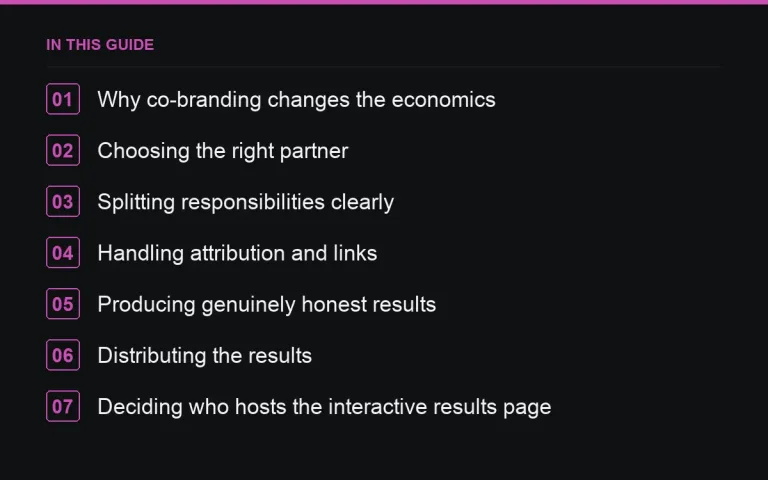
Why co-branding changes the economics
A solo survey relies entirely on your own audience for distribution and your own outreach list for coverage. A co-branded survey brings a second partner’s audience and media contacts into the mix from day one, which can meaningfully expand both the sample size of the research and the number of people willing to promote and link to the results afterward.
Choosing the right partner
- A brand with an audience that overlaps with yours but is not a direct competitor
- A partner with genuine interest in the topic, not just a name attached for appearances
- A partner whose own outreach or PR capacity adds something you do not already have
Splitting responsibilities clearly
| Task | Typical owner |
|---|---|
| Survey design and questions | Shared, agreed jointly upfront |
| Distribution to respondents | Both partners, using their respective audiences |
| Data analysis and write-up | Whichever partner has stronger content resources, credited jointly |
| Outreach and PR pitching | Both partners, ideally pitching different, non-overlapping media contacts |
Handling attribution and links
Agree upfront on how both partners will be credited in the final report and in any resulting media coverage, and confirm both partners’ sites will be linked in outreach materials pitched by either party. Disputes over credit are the most common way co-branded projects sour, so put this in writing before the survey launches.
Producing genuinely honest results
Because two brands’ reputations are attached to the same dataset, both partners have a shared incentive to report findings honestly rather than skew questions toward a predetermined conclusion. Frame survey questions neutrally and report results as they actually come in, even if they are less flattering than either partner hoped.
Distributing the results
- Publish the full report on both partners’ sites, or on one with clear co-branding and a link from the other
- Pitch media contacts from both networks, coordinating so the same journalist is not contacted twice separately
- Pull individual data points into smaller pitches, similar to the approach in https://successtoroad.com/blog/data-visualization-outreach/, to extend the outreach runway beyond the initial launch
Deciding who hosts the interactive results page
If the survey includes an interactive results explorer rather than a static report, decide early which partner’s infrastructure will host it and how both sites will link into it, since retrofitting this decision after development has started tends to be far more disruptive than agreeing on it during initial planning.
Planning a follow-up survey for next year
If the first co-branded survey performs well, plan early for a follow-up edition the next year with the same partner, allowing you to track changes over time and giving both partners’ audiences a reason to anticipate and share the next release rather than treating each survey as an isolated one-off.
Deciding how to split any direct costs
If the survey requires paid distribution, a paid survey tool, or incentives for respondents, agree upfront on how these costs will be split between partners, ideally in proportion to each partner’s expected audience contribution or benefit from the resulting coverage, to avoid a lopsided arrangement that strains the relationship later.
Agreeing on the questions before drafting anything
Both partners should review and agree on the exact survey questions before distribution begins, since a question one partner finds neutral may read as leading or biased to the other, especially if their industries or audiences have different sensitivities around the topic. Spending extra time on this step upfront avoids a much harder conversation after results are already in.
Timing the launch around a relevant moment
Survey results tied to a seasonal event, an industry conference, or a period when a topic is already getting attention tend to attract more coverage than the same research launched at a quiet time of year. Coordinate the launch date with both partners well in advance so the promotional push can be planned around a moment when journalists and readers are already primed to care about the subject.
Deciding on sample size and methodology transparency
Be upfront in the published report about how many respondents took part, how they were recruited, and any relevant limitations of the methodology. Writers citing the survey will often want to reference these details, and a report that is transparent about its own limitations is generally trusted more than one that presents findings without any methodological context.
Where to go next
If a full survey partnership feels like too large a first step, start with the lighter-weight https://successtoroad.com/blog/data-visualization-outreach/ approach using existing public data, and build toward original research once you have outreach relationships in place. See https://successtoroad.com/blog/state-of-industry-reports/ if you want to fold survey results into a larger recurring publication. Review https://successtoroad.com/blog/link-building-checklist/ before launch, and consider https://successtoroad.com/services/writing/ on https://successtoroad.com/marketplace/ for help with the report write-up.
Frequently asked questions
How do I find a good co-branding partner for a survey?
Look for a brand whose audience overlaps with yours without being a direct competitor, and who brings genuine interest in the topic plus outreach or PR capacity that complements your own.
Who owns the resulting links and coverage in a co-branded survey?
This should be agreed explicitly before the survey launches — both partners typically expect to be linked and credited in any resulting coverage, and disputes are far easier to avoid than resolve after the fact.
Is a co-branded survey cheaper than running one alone?
Usually yes in terms of both cost and effort, since distribution, analysis, and outreach responsibilities are shared between two parties rather than falling entirely on one team.
What if the survey results are not flattering to one partner's product or industry position?
Report the findings honestly regardless. A survey perceived as skewed to favour one partner damages the credibility of the research and, with it, the willingness of others to link to or cite it.
Put it into practice
Filter 54,483 websites by DR, traffic, niche and price, and order with escrow — you pay only after the link is live.
Browse the marketplace