Supplier and Vendor Directory Listings: A B2B Link Source Hiding in Plain Sight
How B2B companies can turn industry supplier directories, procurement marketplaces, and vendor lists into a steady source of relevant backlinks.

Most industries with any B2B supply chain — manufacturing, construction, professional services, wholesale — maintain supplier or vendor directories that buyers use to find qualified partners. These directories almost always link to the listed company’s website, and because they are built around a specific industry, the resulting links tend to carry strong topical relevance.
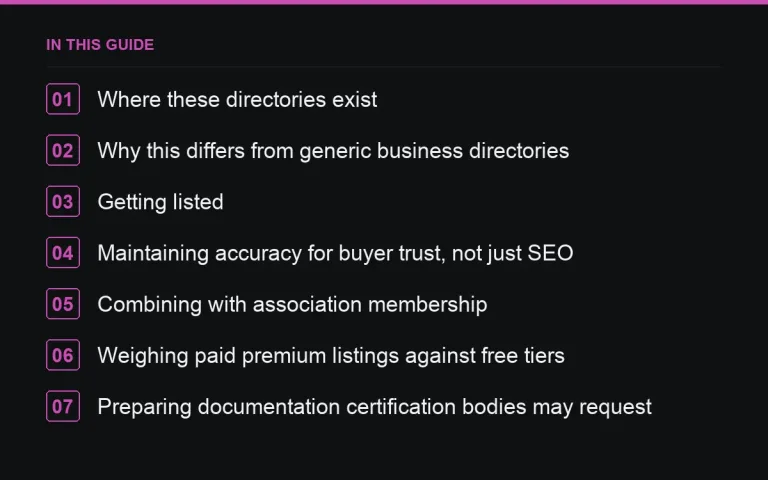
Where these directories exist
- Trade association member and supplier directories
- Industry-specific procurement or sourcing marketplaces
- Regional or chamber-of-commerce business directories
- Certification body listings, if your company holds a relevant certification
Why this differs from generic business directories
A generic local business directory listing carries only mild topical relevance since it covers all industries indiscriminately. A supplier directory built specifically for, say, industrial fastener manufacturers or commercial cleaning contractors carries much stronger relevance signals, because both the linking page and the linked company operate in the same narrow space.
Comparing directory types
| Directory type | Relevance strength |
|---|---|
| Generic local business directory | Low — covers all industries broadly |
| Trade association member directory | High — restricted to members within one industry |
| Certification body listing | High — restricted to certified companies specifically |
Getting listed
- Confirm membership or certification requirements, since many of these directories restrict listings to verified members
- Prepare a complete, accurate company profile — many directories reject incomplete submissions or place them lower in search results within the directory itself
- Keep contact details and service descriptions current, since buyers use these listings to make real purchasing decisions
Maintaining accuracy for buyer trust, not just SEO
Because these directories are used by actual procurement teams evaluating suppliers, an outdated or inaccurate listing can cost you real business opportunities beyond the link value. Treat the listing as a functioning sales channel first, with the backlink as a secondary but genuine benefit.
Combining with association membership
Joining a relevant trade association often unlocks both a directory listing and additional visibility opportunities — newsletters, event sponsorships, member spotlights — that compound the link-building value beyond the directory entry alone, echoing the relationship-building approach in https://successtoroad.com/blog/alumni-and-association-page-links/.
Weighing paid premium listings against free tiers
Many supplier directories offer a free basic listing alongside a paid, more prominent placement. Start with the free tier to confirm the directory sends genuine, relevant enquiries before committing budget to an upgrade, then reassess once you have real data on lead quality from that specific source.
Preparing documentation certification bodies may request
Certification-based directories often require supporting documentation before granting a listing — proof of certification, insurance details, or references from past clients. Gather these materials in advance so the application process does not stall waiting on paperwork you could have prepared ahead of time.
Understanding how procurement teams actually use these directories
Buyers using a supplier directory are often further along in their purchasing process than someone browsing a general search engine — they are actively comparing qualified, vetted options rather than doing early-stage research. This means a listing here can convert into real business at a higher rate than many other channels, which is worth factoring into how much effort you put into keeping each profile current and complete.
Handling multiple regional or product-line listings
Larger suppliers often qualify for more than one directory entry — a regional listing, a product-category listing, and an association-wide listing all at once. Track each one separately, since they may require different profile details, and a change to your product line or service area might need to be reflected across several listings rather than just one central profile.
Using case studies to strengthen a directory profile
Where a directory allows expanded content beyond a basic contact listing, a short, factual case study describing a past project or client relationship — without naming confidential clients if that is a concern — can make your profile stand out to a procurement team comparing several similar suppliers. This turns a passive listing into something closer to an active sales asset, while still functioning as a link source.
Coordinating with your sales and business development team
Because these directories are used by real buyers, your sales team likely already knows which ones matter most in your industry, even if they have never thought of them as a link-building channel. Loop them in when deciding which directories to prioritise — their on-the-ground knowledge of where buyers actually search is more reliable than guessing from search volume alone.
Renewing and verifying listings annually
Many association and certification directories require an annual renewal or re-verification step to keep a listing active. Build this into your yearly compliance or membership review process so a listing does not silently lapse and disappear, taking its backlink with it, simply because a renewal notice was missed.
Where to go next
Pair supplier directory listings with https://successtoroad.com/blog/partner-and-supplier-links/ if you already have customer and partner relationships worth linking to reciprocally, and revisit https://successtoroad.com/blog/directory-submissions/ for the broader framework on evaluating which directories are worth the submission effort. See https://successtoroad.com/blog/job-board-and-hiring-page-links/ for a related B2B-facing tactic that often overlaps with the same association memberships. Explore https://successtoroad.com/niche/manufacturing/ and https://successtoroad.com/niche/construction-and-repairs/ on https://successtoroad.com/marketplace/ for related publisher opportunities.
Frequently asked questions
How is a supplier directory different from a general web directory?
A supplier directory is restricted to companies within a specific industry, often requiring membership or certification, which gives the resulting link much stronger topical relevance than a generic, all-industries business directory.
Do I need to be a paying association member to get listed?
It depends on the specific directory — some require membership, others allow free basic listings with paid upgrades for enhanced visibility. Check each directory's specific requirements before assuming either model applies.
Is it worth the effort to keep these listings updated?
Yes, since procurement teams use these directories to make real purchasing decisions, an outdated listing can cost genuine business opportunities well beyond any SEO consideration.
Can this tactic work for a company that sells to consumers, not just other businesses?
It is most effective for B2B companies with a clear place in a supply chain. Consumer-facing businesses generally get more value from the local sponsorship and review-based tactics covered elsewhere on this site.
Put it into practice
Filter 54,483 websites by DR, traffic, niche and price, and order with escrow — you pay only after the link is live.
Browse the marketplace