How to Find Guest Post Opportunities in Any Niche
Finding sites that accept guest posts is easy. Finding ones worth writing for takes a better method.

There are two broad ways to get guest posts published: pitch editors who accept contributions on merit, or work with publishers who offer paid placements directly. Either route needs a list of relevant, genuinely good sites to work through, and building that list well is most of the job — the writing and outreach afterwards are comparatively straightforward once you’re pitching the right places.
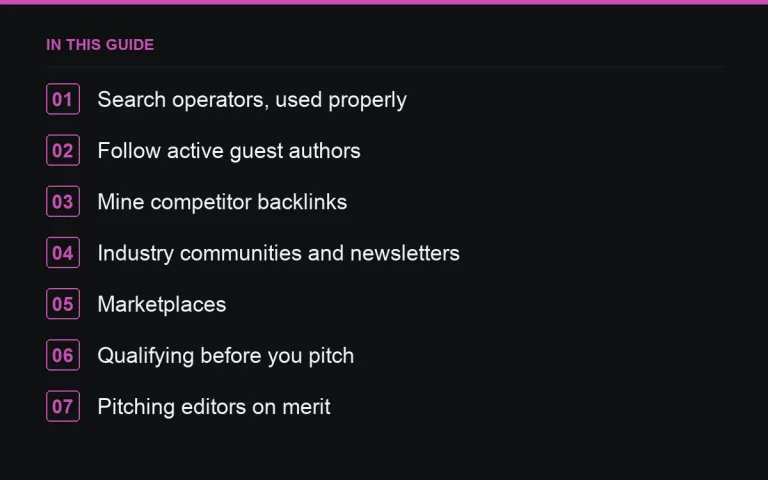
Search operators, used properly
Combine your topic with phrases publishers commonly use on submission pages: “write for us”, “guest post guidelines”, “contribute” or “submit an article”, and “guest author”. Run several variants of your core topic rather than one broad search, since niches use different conventions and a single query will miss most of the field.
Be aware that sites advertising “write for us” prominently across every category on their blog are often link farms rather than genuine publications; see guest post red flags for the tells. Search operators are a starting point for prospecting, not a quality filter — every result still needs qualifying.
Follow active guest authors
Find people in your niche who contribute widely and well. Search their name alongside “guest post”, or check their author bio pages across the sites they write for; those sites accept outside contributors by definition, and if the author’s niche overlaps with yours, the site probably fits too.
Mine competitor backlinks
A competitor backlink report will show sites that have already published guest content from similar businesses — see competitor backlink analysis for how to pull and read this. These sites have a demonstrated appetite for content in your space, which makes them warmer prospects than a cold search result.
Industry communities and newsletters
Niche communities, Slack groups and newsletters often mention publications actively looking for contributors, and editors themselves sometimes post open requests directly into these spaces. This channel produces fewer prospects than search or competitor mining, but the ones it does produce tend to convert at a higher rate because there’s already a stated need.
Marketplaces
A marketplace removes the finding step almost entirely: the Digital PR marketplace lists tens of thousands of publishers with authority, traffic, niche and language filters and clear pricing, which turns hours of prospecting into a filtered search. You still need to vet each site individually before committing — see how to evaluate a guest post site for the checklist — but the initial universe of options is already assembled and searchable.
Qualifying before you pitch
- Genuine topical relevance to your niche, not just adjacent keywords.
- Real organic traffic, not just a high authority score with no visible visitors.
- Editorial quality: readable writing, a real editorial process, an author byline policy.
- Outbound link patterns that look natural rather than stuffed with commercial anchor text.
Cut the list aggressively at this stage. A short list of well-qualified sites converts better and wastes far less of your time than a long list of maybes carried through to the pitching stage.
Pitching editors on merit
For editorial guest posts, pitch a specific idea that fits the publication’s audience and fills a visible gap in their existing content, rather than a generic offer to “write something for you.” Editors receive dozens of the generic version every week and delete them without reading past the first line. See writing guest content that editors accept first time for what a strong pitch and a strong draft look like in practice.
Keeping the pipeline from drying up
A common mistake is treating guest post prospecting as a one-time list-building exercise instead of an ongoing habit. Set aside a regular slot each month to add new prospects from each source above, retire ones that have gone quiet or changed editorial policy, and note which sources actually converted into published posts versus which just generated a long list that never got worked through. Over a year, the sources that quietly convert best are rarely the ones that felt most productive at the time — competitor mining and community mentions often outperform broad search-operator lists once you track outcomes rather than list size.
How much time to budget
Prospecting well takes longer than most teams expect, and it’s usually worth spending more time here than on the outreach emails themselves. A day spent building and qualifying forty genuinely good prospects will outperform a week spent blasting four hundred unqualified ones, both in reply rate and in the quality of sites you end up published on. Budget accordingly, and treat the qualifying checklist above as non-negotiable rather than something to skip when a deadline is close.
Building a repeatable pipeline
| Source | Volume | Typical quality |
|---|---|---|
| Search operators | High | Mixed — needs heavy filtering |
| Competitor backlinks | Medium | Good — proven appetite for guest content |
| Communities and newsletters | Low | High — stated need already exists |
| Marketplace | High | Pre-filtered by metrics, still needs manual review |
Where to go next
Once you have a qualified list, move to outreach email templates for wording, and outreach follow-ups for how to handle silence without burning the relationship. If you’re building a repeatable process across an agency’s clients, managing multiple link building clients covers keeping separate prospect lists organised.
Frequently asked questions
What search operators find guest post sites?
Combinations like your topic plus phrases such as "write for us", "guest post guidelines" or "contribute" tend to surface the most submission pages.
Are 'write for us' pages a bad sign?
Not always, but sites advertising open contributions across every single category on their blog are frequently link farms rather than genuine publications.
How do I pitch a guest post to an editor?
Suggest a specific idea that suits their readers and fills a visible gap in their existing content, rather than a generic offer to write for them.
Is it faster to use a marketplace than to prospect manually?
Usually yes for volume, since sites are pre-filtered by metrics and niche, though each one still needs a manual quality check before you commit.
Put it into practice
Filter 54,483 websites by DR, traffic, niche and price, and order with escrow — you pay only after the link is live.
Browse the marketplace