12 Red Flags That a Guest Post Site Is a Link Farm
Link farms dress up as publications. These twelve signs expose them in minutes, before you spend anything.
A link farm is a site that exists mainly to sell links. It looks like a blog, often carries decent authority metrics and publishes constantly, but almost nobody reads it and search engines are increasingly good at discounting it. Here are twelve tells, arranged roughly in the order you can check them, starting with what’s visible before you even open a single article.
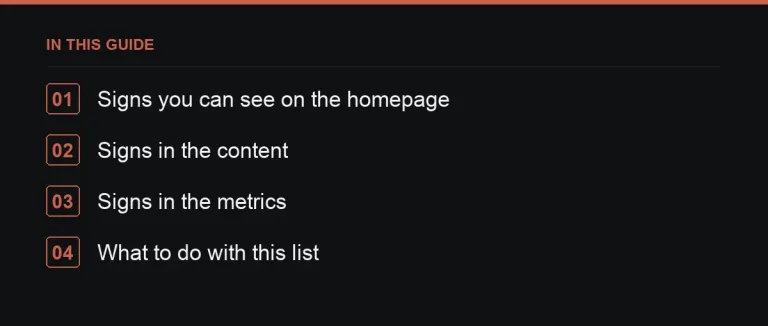
Signs you can see on the homepage
1. It covers everything at once
Crypto, gardening, dental implants and wedding dresses, all published in the same week. Real publications have a focus, because real editorial teams and real audiences have interests, not an unlimited appetite for every topic that pays.
2. Generic, domain-agnostic names
Names like “best-news-daily” or “top-trend-hub” that could plausibly be about anything, frequently sitting on unusual domain extensions chosen mainly because the common ones were taken or expensive.
3. A “write for us” page open to any topic
A prominent, permanent invitation to guest post on essentially anything, often with a visible price list and a menu of accepted payment methods, is the single fastest tell on this list.
4. No real people behind it
No named editor, no genuine author pages, no contact beyond a form. Every post credited to “admin” or to a name that never appears anywhere else online.
Signs inside the content itself
5. Posts read like placements
Short articles visibly built around one commercial link, with little else of substance surrounding it — the link is clearly the point, and the article is scaffolding.
6. Heavy outbound linking to risky niches
Casinos, payday loans, unregulated supplements and adult sites linked from otherwise unrelated, everyday articles is a strong sign the site sells to anyone.
7. Publishing volume no real team could edit
Dozens of posts a day across completely unrelated topics, with no evidence anyone reviewed them before they went live.
8. Recycled or spun text
Paste a distinctive paragraph into a search engine in quotation marks. If close variants of it appear on several other unrelated sites, the content isn’t original to that publisher.
Signs in the metrics
9. Authority without traffic
A high authority score alongside a few hundred organic visitors a month is a mismatch. Real authority usually comes with real search visibility. See domain rating vs domain authority for why these scores can be inflated relative to actual traffic.
10. Traffic that fell off a cliff
A traffic chart that dropped sharply after an algorithm update and never recovered often means the site’s rankings, and the links pointing at it, were never particularly earned in the first place.
11. Traffic from the wrong places
An English-language site nominally about US personal finance drawing most of its visits from countries with no obvious connection to that audience is worth a second look.
12. Referring domains that are also link farms
Look at who links to the site under review. If its own backlinks come mostly from a cluster of similar low-quality sites, you’re looking at a network, not an independent publication.
Why these sites still get orders
If link farms are this easy to spot, it’s worth asking why they still get paid placements at all. Mostly it comes down to price and speed: they’re cheap, they turn orders around fast, and a buyer working from a spreadsheet of authority scores alone can’t tell the difference without opening the site. Once you check traffic and editorial signals rather than authority scores in isolation, the appeal mostly disappears.
How many flags is too many
One flag on its own isn’t a verdict. A small, genuine niche blog might have no dedicated author pages and still be entirely legitimate. But three or four flags together are a strong signal, and a site showing most of this list isn’t worth buying from at any price, however cheap the listing looks.
| Flags present | What it usually means |
|---|---|
| 0–1 | Probably fine; check the remaining basics anyway |
| 2–3 | Worth extra scrutiny before ordering |
| 4+ | Treat as a link farm and skip it |
Building the habit into your workflow
A good habit is running the full evaluation routine for every new site and keeping notes, rather than re-deciding from scratch each time you’re tempted by a cheap offer. If you’re building at any real volume, folding this check into a repeatable process is covered in scaling guest posting without losing quality.
Where to go next
In our marketplace, sorting a niche by traffic rather than authority score is a quick way to push many of these sites down the list automatically, because link farms tend to carry authority without visitors. If you discover a link farm already links to you unsolicited, don’t panic — search engines generally ignore such links on their own. The disavow tool is for narrower situations, which we cover separately, and private blog networks are worth reading about too since they share several of these same tells.
Frequently asked questions
Are all general-interest news sites link farms?
No. Some legitimate general publications genuinely cover many topics with real editorial teams. The difference is audience, visible editing standards and who links back to them, not topic breadth alone.
Will a link from a link farm get my site penalised?
Usually search engines simply ignore such links rather than penalising the site they point to. The risk grows mainly when a large share of your own links follow the same manipulative pattern.
Can a link farm have a high authority score?
Yes. Authority scores mostly measure the size and shape of a backlink profile, and that profile can be manufactured. That's why traffic and visible editorial quality matter more than the score alone.
Is a small blog with few author details automatically a red flag?
Not automatically. Genuinely small, independent blogs can look sparse. Weigh it alongside the other signs rather than rejecting a site on one point in isolation.
Put it into practice
Filter 54,483 websites by DR, traffic, niche and price, and order with escrow — you pay only after the link is live.
Browse the marketplace