Guest Posting on B2B Sites: What Works
The specific approach that works for guest posting on business-to-business publications.
B2B guest posting rewards a different set of instincts than consumer-facing content. Readers here are often evaluating solutions to specific operational problems, not browsing for entertainment, and editors judge submissions accordingly.
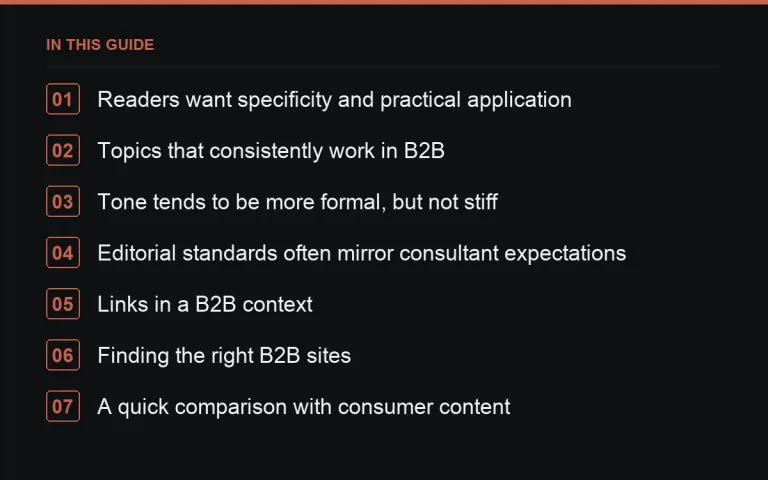
Readers want specificity and practical application
A B2B audience is generally more tolerant of technical detail and less interested in broad, motivational framing. A piece that walks through a specific process, decision framework, or operational trade-off tends to land better than one built around inspirational generalities. Vague claims about “transforming your business” read as filler to an audience evaluating real operational decisions.
Topics that consistently work in B2B
- Process and workflow breakdowns readers can adapt to their own operations
- Honest comparisons between approaches, tools, or strategies
- Lessons from specific, generalised experience — without naming confidential clients
- Practical guidance for a specific role or function, rather than broad business advice
Tone tends to be more formal, but not stiff
B2B doesn’t mean dry. The best B2B guest posts are direct and confident without excessive jargon used to sound authoritative. Avoid buzzword-heavy phrasing that says little — B2B readers, especially experienced ones, are quick to notice when a piece is padded with industry jargon instead of substance.
Editorial standards often mirror consultant expectations
Many B2B sites expect contributors to have some genuine standing in the space — a role, a track record, or direct operational experience relevant to the topic. This overlaps closely with the considerations in https://successtoroad.com/blog/guest-posts-for-consultants/, since a large share of B2B guest contributors are consultants or founders writing from direct experience.
Links in a B2B context
B2B audiences are generally comfortable with a link to a relevant tool, resource, or company site, provided it’s clearly earning its place rather than reading as an ad. A link to a genuinely useful resource — including, where relevant, https://successtoroad.com/services/writing/ or https://successtoroad.com/marketplace/ listings in a niche like https://successtoroad.com/niche/marketing/ or https://successtoroad.com/niche/software-development/ — fits naturally when the surrounding content justifies it.
Finding the right B2B sites
Filter https://successtoroad.com/marketplace/ toward https://successtoroad.com/niche/business/, https://successtoroad.com/niche/startups/, or your specific vertical, and prioritise sites with visible engagement from an actual professional audience — comments, shares, or a clear reader community — over generic high-traffic sites with a broad, undifferentiated audience.
A quick comparison with consumer content
| Aspect | B2B | Consumer |
|---|---|---|
| Tone | Direct, practical | Often more conversational |
| Depth expected | Higher tolerance for technical detail | Broader appeal usually preferred |
| Author credibility | Weighed heavily | Matters less than the content itself |
| Link tolerance | Comfortable with relevant tool/resource links | More cautious, context-dependent |
Structuring a B2B piece for a busy reader
B2B readers are often scanning during a work day, not browsing at leisure, which makes clear structure even more important than usual. Front-load the practical takeaway, use headings that let a skimming reader extract the key point of each section without reading every sentence, and avoid burying the actual recommendation deep in a long narrative build-up. https://successtoroad.com/blog/guest-post-structure-that-keeps-readers/ covers the general principles, which apply with extra weight for this audience.
Why case-study-style pieces need extra care
A B2B piece describing a specific approach or result is more persuasive than a generic one, but it also needs to stay within the bounds of what you can honestly claim. Describe a real, generalised pattern rather than presenting a single anecdote as if it were a guaranteed, repeatable outcome, and avoid implying specific, unverifiable results — the same caution that applies broadly across guest posting applies here too.
Building ongoing visibility rather than a single appearance
B2B decision cycles are often long, sometimes spanning months between a reader first encountering your name and eventually reaching out. A single guest post rarely captures that full cycle on its own, which is another reason a sustained, recurring presence on a small number of relevant B2B sites tends to outperform an isolated, one-time placement for anyone pursuing genuine business development goals.
Working with co-authors from partner organisations
Some B2B pieces work well as a joint perspective from two people at different organisations, such as a vendor and a customer describing a shared project in general terms. This can add credibility beyond a single company’s viewpoint, though it also adds coordination overhead — both parties need to agree on the framing and sign off before the pitch goes anywhere, so factor that extra step into your timeline and start the conversation earlier than you would for a solo piece. Building in extra time for both organisations to review the final draft before submission avoids a rushed, last-minute scramble closer to the deadline, which is a common source of friction in these joint arrangements between two otherwise cooperative parties working in good faith.
Where to go next
Once you’ve identified strong B2B targets, pitch with the specificity these readers expect — revisit https://successtoroad.com/blog/pitching-topic-ideas-to-a-publisher/ with this audience in mind, and consider whether a recurring arrangement makes sense if a particular B2B site responds especially well, covered in https://successtoroad.com/blog/recurring-guest-post-columns/.
Frequently asked questions
Does B2B guest posting require industry credentials to be accepted?
Often it helps, since B2B publishers tend to value demonstrated relevant experience, but it's not always a strict requirement if the content itself is specific and genuinely useful.
Is a more formal tone always expected in B2B guest posts?
Generally more direct and practical than casual consumer content, but not stiff or jargon-heavy. Clear, confident writing tends to outperform overly formal or buzzword-laden prose.
Are links to tools or resources acceptable in B2B guest posts?
Yes, when they're clearly relevant and earn their place within the content, rather than reading as an inserted advertisement disconnected from the surrounding text.
What topics tend to underperform on B2B sites?
Broad, motivational content without specific, actionable detail tends to underperform, since B2B readers are typically looking for practical application, not general inspiration.
Put it into practice
Filter 54,483 websites by DR, traffic, niche and price, and order with escrow — you pay only after the link is live.
Browse the marketplace