Private Blog Networks: How to Spot Them and Why to Avoid Them
PBN links are cheap, strong-looking and easy to buy. They're also the kind of links search engines work hardest to find and ignore.
A private blog network (PBN) is a group of sites controlled by one party and used to link to other sites for ranking purposes. They’re usually built on expired domains that still carry backlinks from their previous life, so they look authoritative on paper even though nobody visits them.
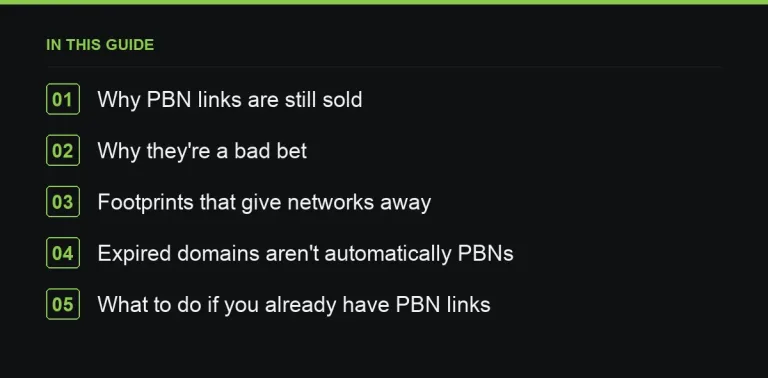
Why PBN links are still sold
They’re cheap to produce, the seller controls every link, and on metrics alone they look like good placements: high DR, sometimes decent DA, fast delivery, and an anchor text of your choosing. For a buyer who only looks at authority scores rather than organic traffic, they’re tempting, and that’s exactly the gap sellers rely on.
Why they’re a bad bet
PBNs exist solely to manipulate rankings, which puts them squarely in Google’s definition of link spam. Search engines invest heavily in identifying networks, and when a network is found, its links stop counting. At best you’ve paid for links that do nothing; at worst, a pattern of network links contributes to a manual action (see penalties and recovery), which can take months of clean-up to lift.
They also bring no real benefit beyond the link itself: no audience, no referral traffic, no brand exposure, nothing that would still be worth something if the link stopped counting tomorrow. Compare that with a placement on a site with a genuine readership, where even a nofollowed mention can send visitors and build recognition.
Footprints that give networks away
- Authority without traffic. Strong DR, almost no organic visitors. The single most common tell, and the easiest to check with any traffic-estimation tool.
- Thin, generic content written around outbound links, often across unrelated topics on the same site.
- Unrelated topic history. Check an archive: a domain that was a local bakery five years ago and is now a “business news” site is a reused expired domain (see what is an expired domain).
- Shared details. Same theme, same layout quirks, same hosting, same fake author names across several sites.
- Interlinking. The sites link to each other and to the same set of client sites, forming a closed loop that’s visible once you pull a backlink report.
- Hidden ownership. No about page, no contact beyond a form, no social presence, no way to reach an actual editor.
Expired domains aren’t automatically PBNs
Plenty of legitimate sites run on domains that were previously owned. The question is whether the site is now a real publication with an audience, or a shell that exists to sell links. Look at content quality, traffic and outbound links, as in our red flags list, and cross-check the same domain against our guide to evaluating a guest post site before you pay.
Comparing a real site to a network site
| Signal | Genuine publisher | Likely network site |
|---|---|---|
| Organic traffic | Present and roughly matches authority | Near zero despite strong DR |
| Content topics | Consistent niche over time | Random, unrelated topics |
| Outbound links | A handful, relevant to the article | Many, to unrelated commercial sites |
| Contact | Named editor or team, real email | Contact form only, no names |
What to do if you already have PBN links
If they were bought in the past and you haven’t received a manual action, the usual approach is to stop acquiring more and build genuine links going forward. Search engines typically just ignore network links rather than penalising for them retroactively. If you have a manual action for unnatural links, those links belong in your clean-up and, where removal isn’t possible, your disavow file. Run a full backlink audit first so you’re working from a complete list rather than guesswork, and keep a record of which links you flagged and why, in case you need to revisit the decision later.
Why buyers still get caught out
Even experienced buyers get fooled occasionally, usually because they trusted a screenshot of metrics instead of checking the live site themselves. A seller sending a DR figure with no link to the actual page, or refusing a quick call, is itself a signal worth weighing. It’s also worth asking what the site’s actual audience is before asking about price — a publisher who can’t describe their own readership in a sentence or two probably doesn’t have one.
None of this means every cheap, high-authority-looking link is a network site. Some publishers genuinely built authority quickly through strong content or a viral piece and haven’t yet built proportional ongoing traffic. The difference is usually visible in the content itself: is it something a real editor would publish, or filler wrapped around a paragraph of outbound links?
Where to go next
On the marketplace, sorting any niche by traffic rather than DR pushes network-style sites down the list, because they tend to have authority without visitors. Filtering by minimum traffic before you filter by price is the single fastest way to avoid this category of seller altogether, and it’s worth doing before you ever open a site’s individual metrics page. Cross-reference candidates against the red flags list one more time before you check out, especially for a site you haven’t ordered from before.
Frequently asked questions
Are PBN links against Google's guidelines?
Yes. Networks built to pass link value for ranking purposes are link spam under Google's policies.
Can a PBN link still work?
Sometimes temporarily. The risk is that it stops counting when the network is detected, and repeated network links can contribute to manual actions.
How do I check if a site is part of a network?
Compare traffic with authority, check the domain's history in an archive, and look at who else it links to and who links to it.
Put it into practice
Filter 54,483 websites by DR, traffic, niche and price, and order with escrow — you pay only after the link is live.
Browse the marketplace