A Glossary of Link Building Mistakes
This glossary lists recurring link building mistakes by name, so teams can spot and name them quickly during review.
Some link building mistakes are common enough to deserve their own shorthand names, the same way any craft develops jargon for its recurring failure modes. This glossary collects the most frequent ones, why they happen, and the quick fix for each.
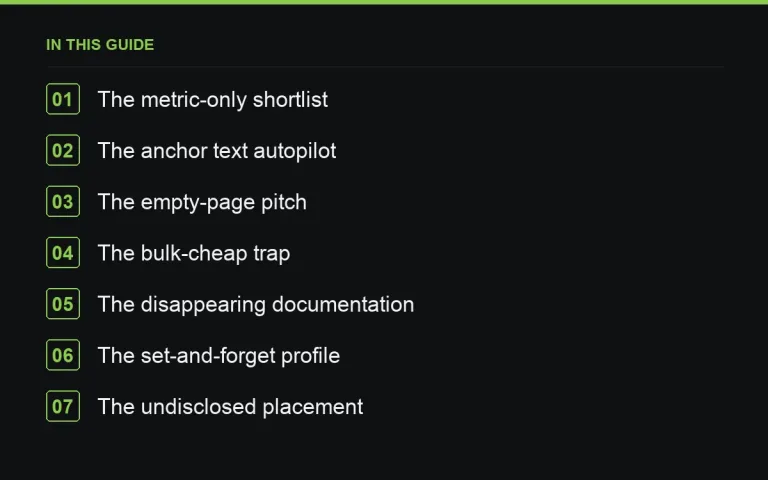
The metric-only shortlist
What it is: Choosing link targets purely by sorting a marketplace or tool by the highest authority score, without checking topical relevance. Fix: Filter by niche first, then sort by metric within that relevant shortlist — see https://successtoroad.com/blog/relevance-vs-authority-link-building/.
The anchor text autopilot
What it is: Using the same exact-match commercial anchor text across most or all outreach and guest posts, because it’s the “target keyword.” Fix: Deliberately vary anchor text — branded, generic, descriptive — and treat exact-match anchors as the occasional exception, not the default.
The empty-page pitch
What it is: Reaching out for links before the page being promoted is genuinely worth linking to. Fix: Build or improve the linkable asset first; see https://successtoroad.com/blog/beginners-first-month-link-building-plan/.
The bulk-cheap trap
What it is: Buying a large volume of very low-cost links from unfamiliar sources to hit a number quickly. Fix: Apply the https://successtoroad.com/blog/quality-vs-quantity-link-building/ framework and reject volume-first thinking on principle.
The disappearing documentation
What it is: Building links without logging them, leaving no clear record for later audits or reporting. Fix: Start a simple tracking spreadsheet from the very first link — see https://successtoroad.com/blog/documenting-links-you-build/.
The set-and-forget profile
What it is: Building a burst of links once and never revisiting the profile again, letting natural decay quietly erode it. Fix: Schedule periodic reviews — see https://successtoroad.com/blog/keeping-a-link-portfolio-healthy-over-years/.
The undisclosed placement
What it is: Presenting a paid link as pure unpaid editorial endorsement, without disclosure or an appropriate link attribute. Fix: Disclose clearly and use sponsored or nofollow attributes as appropriate — see https://successtoroad.com/blog/link-building-ethics/.
The panic pivot
What it is: Overreacting to short-term ranking fluctuations by abruptly abandoning a reasonable link building strategy after only a few weeks. Fix: Set expectations around realistic timelines from the start — see https://successtoroad.com/blog/how-long-until-links-get-discovered/ and https://successtoroad.com/blog/setting-realistic-link-building-goals/.
A quick reference table
| Mistake | Root cause |
|---|---|
| Metric-only shortlist | Sorting tools before filtering for relevance |
| Anchor text autopilot | Treating SEO keyword targeting as more important than natural variation |
| Empty-page pitch | Outreach before content readiness |
| Bulk-cheap trap | Chasing a volume target without a quality bar |
| Disappearing documentation | Treating link building as a one-off task, not an ongoing record |
The all-eggs-one-vendor mistake
What it is: relying on a single vendor, network, or even a single tactic for the vast majority of your link building, so that any change in that one source’s availability or quality immediately jeopardises your whole programme. Fix: diversify sources and tactics deliberately, even when one particular channel is currently performing well, since concentration risk tends to become visible only after something changes.
The invisible-goalpost mistake
What it is: never defining what success actually looks like for a link building effort, which makes it impossible to tell whether the current approach is working or needs to change. Fix: set explicit, reviewed goals from the start, as covered in https://successtoroad.com/blog/setting-realistic-link-building-goals/, rather than treating link building as an open-ended activity with no defined checkpoint.
Why naming these mistakes helps in practice
Giving a recurring mistake a short, memorable name makes it far easier to spot and call out during a real review or planning meeting than describing it fresh every time. Teams that develop this kind of shared shorthand tend to catch these patterns earlier, simply because naming the mistake makes it quicker to recognise and discuss.
Where to go next
Read https://successtoroad.com/blog/link-building-mistakes/ for a broader, narrative version of common errors, https://successtoroad.com/blog/link-building-myths/ for misconceptions rather than execution mistakes, and browse https://successtoroad.com/marketplace/ to practice applying the relevance-first filtering habit described above.
The false-urgency mistake
What it is: rushing a link building decision — accepting a mediocre opportunity, skipping due diligence on a new vendor — because of artificial pressure, often self-imposed, to show quick progress. Fix: separate genuine deadlines from self-created urgency, and give yourself permission to pass on a mediocre opportunity while waiting for a better one, since link building rewards patience over speed in almost every situation.
The copy-competitor-blindly mistake
What it is: replicating a competitor’s exact link building approach without checking whether their circumstances, history or resources are genuinely comparable to yours. Fix: use competitor analysis as a reference point and source of ideas, not a template to copy mechanically, since factors like domain age, existing relationships and budget can make an identical strategy perform very differently for two different sites.
Keeping this glossary visible to your team, and adding to it as new patterns emerge, turns a one-time read into an ongoing, evolving reference that keeps institutional memory sharp even as specific people and projects change over time.
A good first step: pick the three mistakes from this list that feel most relevant to your own recent work, and discuss them openly with your team this week, rather than treating this as a one-time read with no follow-up conversation.
Frequently asked questions
What's the single most common link building mistake?
Sorting for the highest authority metric without first filtering for topical relevance is among the most frequent, since it's the path of least resistance on most marketplaces and tools.
Is buying cheap, bulk links always a mistake?
It's risky as a primary strategy, since it tends to sacrifice relevance and quality for volume. Occasional low-cost, genuinely relevant opportunities are fine; a strategy built mainly around cheap bulk purchases is the actual mistake.
Why does undisclosed paid placement come up so often as a mistake?
It's tempting because disclosure can feel like it reduces a link's perceived value, but the longer-term ethical and practical risk of misrepresenting a paid link usually outweighs that short-term concern.
How can a team avoid the 'set-and-forget' mistake?
Schedule recurring reviews — at least annually — specifically to check for decay, anchor text drift, and any links that have become problematic since they were built.
Put it into practice
Filter 54,483 websites by DR, traffic, niche and price, and order with escrow — you pay only after the link is live.
Browse the marketplace