Keeping a Link Portfolio Healthy Over Years, Not Months
A healthy link portfolio needs periodic auditing, steady replacement of natural decay, and occasional pruning, sustained over years.
Most link building advice focuses on acquisition — how to get the next link. Fewer people talk about the multi-year maintenance perspective: what a link portfolio needs to stay healthy long after the initial push, once decay, algorithm shifts, and business changes all start to accumulate.
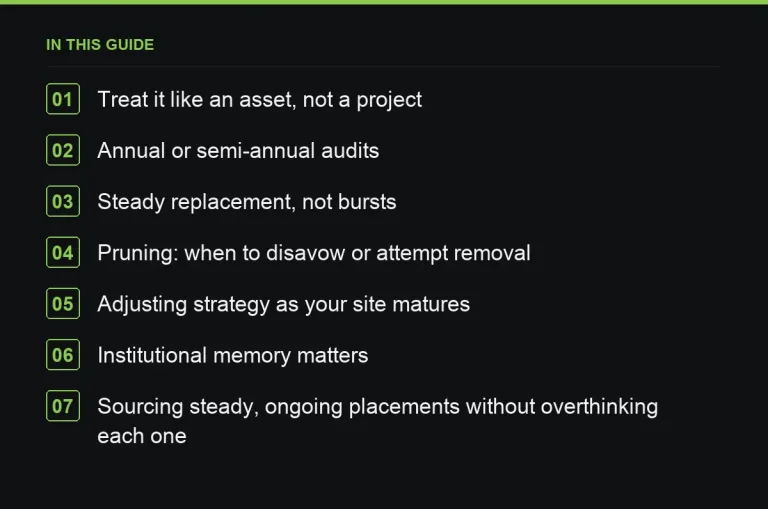
Treat it like an asset, not a project
A healthy link portfolio behaves less like a completed project and more like a maintained asset — similar to a physical property that needs ongoing upkeep, not a one-time renovation. Budgeting some ongoing time or spend for maintenance, even during quieter periods, prevents a slow, unnoticed decline.
Annual or semi-annual audits
At least once or twice a year, review the full profile: check for decay (see https://successtoroad.com/blog/link-decay/), look for any links that have become genuinely problematic (a once-reputable site that changed hands and now looks spammy, for instance), and reassess whether the anchor text distribution still looks natural given everything built since the last review.
Steady replacement, not bursts
Because links decay gradually, ongoing modest link building — even a small, steady trickle — does more for long-term health than periodic large bursts followed by long gaps. Bursts followed by silence can also look less natural than steady, ongoing activity, on top of simply failing to offset decay in the meantime.
Pruning: when to disavow or attempt removal
Occasionally a link that was fine when acquired becomes a liability — the site gets penalised, changes ownership, or is later associated with a link scheme unrelated to your original placement. Periodic review lets you catch these and decide whether removal or disavowal is warranted, rather than discovering the issue much later during an unrelated investigation.
Adjusting strategy as your site matures
| Stage | Typical maintenance focus |
|---|---|
| Early growth | Building baseline volume and relevance |
| Established, ranking well | Selective, high-relevance additions; protecting existing profile |
| Mature, long-standing site | Auditing for decay and legacy risk; steady, modest ongoing additions |
Institutional memory matters
Over years, the people managing link building for a site often change — new hires, new agencies, new priorities. A well-maintained log (see https://successtoroad.com/blog/documenting-links-you-build/) becomes essential institutional memory, preventing each new person from having to rediscover the site’s link history from scratch.
Sourcing steady, ongoing placements without overthinking each one
For the steady, ongoing portion of link building described above, it helps to have a reliable, filterable source of relevant publishers rather than reconstructing a shortlist from scratch every quarter. Using saved searches and niche filters on https://successtoroad.com/marketplace/ to maintain an ongoing pipeline of realistic opportunities makes the steady-trickle approach far easier to sustain in practice than sourcing every placement through fresh manual research each time.
Budgeting for maintenance, not just growth
When setting an annual link building budget, explicitly set aside a portion for maintenance activity — periodic audits, occasional disavow work, replacing decayed links — rather than allocating the entire budget to new growth targets. A budget that only ever funds growth, with no allowance for upkeep, tends to produce a profile that looks impressive on paper in year one but quietly degrades by year three.
Where to go next
Read https://successtoroad.com/blog/link-decay/ for the mechanics behind why ongoing maintenance is necessary, https://successtoroad.com/blog/documenting-links-you-build/ for the tracking system underneath this, and https://successtoroad.com/blog/teaching-link-building-to-a-team/ for keeping institutional knowledge alive as teams change.
Recognising when a portfolio needs more than routine maintenance
Occasionally, routine maintenance uncovers something bigger than ordinary decay or drift — a significant number of links tied to a since-penalised network, or a pattern suggesting a past team took shortcuts that need proper remediation. Distinguish between routine upkeep, which is a normal recurring task, and a genuine recovery project, which needs more focused, dedicated attention and possibly outside expertise, rather than trying to squeeze major remediation work into a standard quarterly review.
Long-term health as a competitive advantage
A site with a genuinely well-maintained, multi-year link portfolio has something that’s difficult and slow for competitors to replicate quickly, regardless of how much budget they suddenly deploy. This durability is one of the more underappreciated long-term benefits of treating link building as ongoing maintenance rather than a series of disconnected short-term campaigns.
In the end, a healthy, multi-year link portfolio is less about any single tactic and more about consistent, honest habits sustained over a long period — steady acquisition, periodic review, and prompt attention to problems as they surface rather than after they compound.
A realistic first step toward this mindset: put a single recurring calendar reminder in place today for a quarterly link portfolio review, even before you’ve built up much of a profile to review, so the habit is already established once there’s more to look at.
None of this is glamorous work, and it rarely gets the same attention as a big new campaign, but it’s precisely this unglamorous consistency that separates link portfolios that age well from ones that quietly deteriorate over several years.
Frequently asked questions
How often should a mature site audit its link profile?
Once or twice a year is reasonable for most sites, more frequently if you operate in a high-risk niche or have a history of aggressive past link building that needs closer monitoring.
Is it normal for an established site to still be building new links?
Yes. Ongoing, modest link building helps offset natural decay and keeps a profile looking active and current, rather than static or abandoned.
When should a link be disavowed rather than left alone?
Consider disavowal when a previously fine link is now clearly associated with spam, a penalised network, or a site that has changed hands into something disreputable, and removal requests have failed or aren't feasible.
Does a long-established link profile need less active management than a new one?
It needs different management, not necessarily less. The focus shifts from building volume to protecting quality, catching decay, and pruning problems rather than pure acquisition.
Put it into practice
Filter 54,483 websites by DR, traffic, niche and price, and order with escrow — you pay only after the link is live.
Browse the marketplace