Documenting the Links You Build: A Simple System
Documenting links as you build them saves enormous time later during audits, reporting, or disputes with publishers.

Six months into a link building effort, without documentation, you’re left reconstructing history from a third-party tool that may have missed things, mislabelled things, or simply reports differently than you’d expect. A simple, consistently maintained record avoids this entirely, and it costs almost nothing to set up.
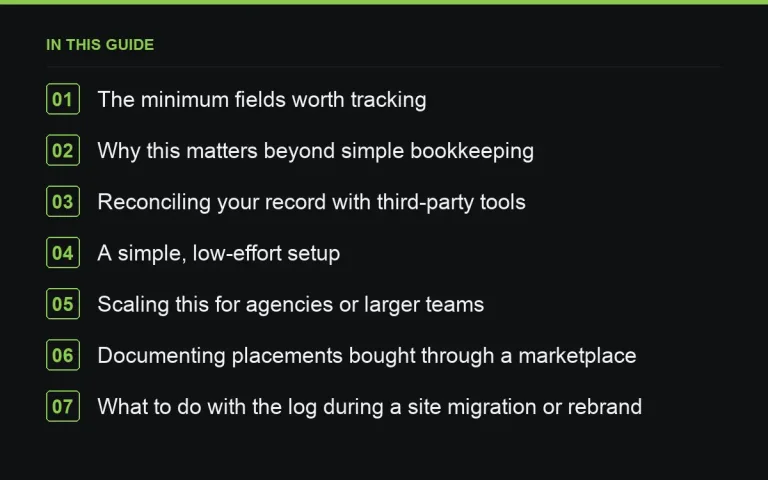
The minimum fields worth tracking
| Field | Why it matters |
|---|---|
| Linking URL (exact page) | Lets you verify the link is still live later without searching from scratch |
| Target URL on your site | Confirms which of your pages the link supports |
| Anchor text used | Tracks anchor diversity over time, flags overuse of one phrase |
| Date acquired | Supports timing analysis and helps explain acquisition patterns later |
| Method (outreach, paid, PR, etc.) | Helps you see which tactics are actually working |
| Cost, if any | Feeds directly into ROI calculations later |
| Last verified live | Supports decay tracking without re-researching from scratch |
Why this matters beyond simple bookkeeping
This record becomes essential during several situations: a client asking for proof of work delivered, a dispute with a publisher over whether a paid link is still live, an internal audit trying to explain a strange pattern in a backlink report, or simply deciding which tactics to repeat and which to drop. Without documentation, all of these become slower, more uncertain exercises.
Reconciling your record with third-party tools
Your own log and any automated backlink tool will disagree sometimes — a tool might miss a link entirely, or flag one you know you didn’t build (perhaps genuinely organic, unprompted coverage). Periodically reconcile the two; unexplained discrepancies are worth investigating, and pleasant surprises (organic links you didn’t build) are worth celebrating and, where relevant, following up on.
A simple, low-effort setup
- A shared spreadsheet is sufficient for most individuals and small teams — no dedicated software required to start.
- Update it at the point of link acquisition, not in a big batch weeks later when details are harder to recall accurately.
- Review it quarterly to check for decay (see https://successtoroad.com/blog/link-decay/) and to spot patterns worth adjusting.
Scaling this for agencies or larger teams
With multiple people building links, a shared, access-controlled version of this log prevents duplicate outreach to the same publisher and gives everyone visibility into what’s already been tried. This becomes especially important when https://successtoroad.com/blog/managing-multiple-link-building-clients/ across several accounts simultaneously.
Documenting placements bought through a marketplace
Links acquired through a structured marketplace such as https://successtoroad.com/marketplace/ are somewhat easier to document consistently, since order details, publisher information and often the live URL are already recorded in one place at the point of purchase. Even so, it’s worth pulling this information into your own master log alongside organically earned links, rather than keeping two entirely separate systems that make it harder to see your full picture in one view.
What to do with the log during a site migration or rebrand
A well-maintained link log becomes especially valuable during a site migration, domain change, or rebrand, since it gives you a concrete list of exactly which external pages need to be checked and, where necessary, contacted about updating a link to a new URL. Attempting this kind of cleanup without a prior record means relying entirely on whatever a backlink tool happens to have indexed, which is rarely complete.
Where to go next
Read https://successtoroad.com/blog/link-decay/ for what to check for during periodic reviews, https://successtoroad.com/blog/measuring-link-building-roi/ for how this data feeds ROI calculations, and https://successtoroad.com/blog/reading-a-backlink-report/ for reconciling your log against third-party tools.
Version history and change tracking
For teams with several people touching the same link log, basic version history — even something as simple as dated backup copies of the spreadsheet — protects against accidental deletions or overwrites. This is a small, low-effort safeguard that becomes valuable exactly when you least expect to need it, typically after months or years of steady data entry that would be painful to lose or reconstruct.
Combining documentation with light automation
For larger operations, some basic automation — a periodic export from a backlink tool matched against your manual log to flag new or missing entries — can reduce the manual burden of keeping documentation current without requiring dedicated software. This doesn’t need to be sophisticated to be useful; even a simple, recurring calendar reminder to reconcile the two sources on a set schedule meaningfully improves consistency over relying purely on memory.
Ultimately, the time spent documenting links is consistently repaid many times over the life of a site, in faster audits, clearer reporting, and far less painful reconstruction work whenever a question about link history comes up unexpectedly.
A minimal viable version of this system takes under an hour to set up: a spreadsheet with the seven fields listed earlier, shared with anyone else involved in link building, updated at the moment each link goes live rather than in a delayed batch weeks later.
None of this requires specialised tools to begin; the discipline of consistent, immediate logging matters far more than the sophistication of whatever system you use to store the information.
Frequently asked questions
What's the simplest way to start documenting links?
A basic spreadsheet with columns for linking URL, target page, anchor text, date acquired, and method is enough to start, and can be built out further as your programme grows.
How often should I check that logged links are still live?
Quarterly is a reasonable default for most sites, though high-value links or ones acquired at real cost are worth checking more frequently.
Should I log links I didn't build myself but that appeared organically?
Yes, it's useful to note these separately, since they can reveal what content or coverage is genuinely earning attention on its own, informing future content decisions.
Is dedicated software necessary for tracking backlinks?
Not for most individuals or small teams. A well-maintained spreadsheet covers the core need; dedicated tools become more useful at larger scale or when many team members need simultaneous access.
Put it into practice
Filter 54,483 websites by DR, traffic, niche and price, and order with escrow — you pay only after the link is live.
Browse the marketplace