Teaching Link Building to a Team
Teaching link building well means starting with judgement and relevance, not tool dashboards and tactic lists, from day one.
Link building is easy to teach badly: hand someone a list of tactics and a tool login, and they’ll produce activity without judgement. Teaching it well means building the underlying judgement first — what makes a link good — before layering on specific tactics and tools.
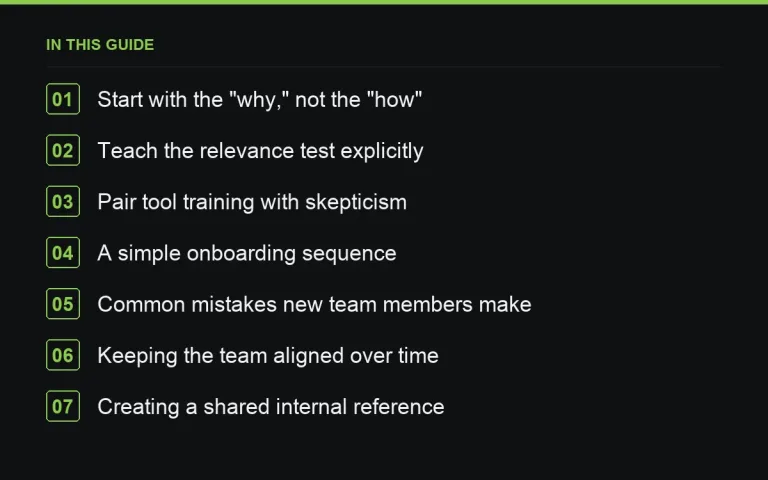
Start with the “why,” not the “how”
Before any tactic-specific training, make sure a new team member genuinely understands why links matter and what makes one good versus bad — see https://successtoroad.com/blog/why-links-still-matter/ and https://successtoroad.com/blog/what-makes-a-link-natural/ as accessible starting points. Skipping this step produces people who can execute tactics but can’t evaluate opportunities independently.
Teach the relevance test explicitly
One of the fastest ways to build good judgement is a simple, repeatable question: “would this link exist if search engines didn’t?” Have new team members practice applying this test to real, concrete examples — both good and bad — from your own past link building history or public examples, rather than only discussing it abstractly.
Pair tool training with skepticism
When introducing backlink checking tools, explicitly teach that metrics are estimates from different methodologies, not ground truth — see https://successtoroad.com/blog/dr-vs-da/. New team members who treat a single score as gospel tend to make worse decisions than ones taught to sanity-check metrics against manual relevance review.
A simple onboarding sequence
- Read the fundamentals: what a backlink is, why links matter, what makes one natural.
- Shadow a real outreach campaign or link audit before running one independently.
- Practice evaluating ten real opportunities (from https://successtoroad.com/marketplace/ or elsewhere) and explain the reasoning for each, reviewed by someone experienced.
- Run a small, low-stakes campaign independently with regular check-ins.
- Take on full ownership of a defined slice of the programme.
Common mistakes new team members make
- Over-indexing on a single authority metric while ignoring relevance entirely.
- Sending generic, unpersonalised outreach at volume instead of fewer, better-targeted pitches.
- Not documenting links as they’re built, creating cleanup work later — see https://successtoroad.com/blog/documenting-links-you-build/.
- Treating every guideline as an absolute rule rather than understanding the underlying reasoning, which makes them brittle when a genuinely unusual situation comes up.
Keeping the team aligned over time
As tactics and search engine tolerance shift, revisit fundamentals periodically as a team, not just once during onboarding. A short, recurring review of what’s working, what’s changed, and what to reconsider keeps everyone’s judgement current rather than anchored to whatever was true when they first joined.
Creating a shared internal reference
Rather than relying purely on verbal knowledge transfer, put together a short internal reference document covering your team’s specific standards: what quality bar you apply, which types of sites and placements are pre-approved, what needs escalation or review, and where to find the shared link log. This document doesn’t need to be long, but having it in writing means standards survive staff turnover far better than knowledge that only lives in one experienced person’s head.
Using real past campaigns as teaching material
Some of the most effective training material is your own team’s history: a past campaign that worked well and why, one that underperformed and what was learned, a placement that seemed fine at the time but later turned out to be problematic. Walking new team members through real, specific examples from your own work builds far more durable judgement than abstract rules alone, since it shows how the reasoning actually applied in a real situation rather than a hypothetical one.
Where to go next
Read https://successtoroad.com/blog/link-building-glossary/ and https://successtoroad.com/blog/link-building-vocabulary-confusions/ as vocabulary references for new hires, https://successtoroad.com/blog/link-building-mistakes/ for a structured list of pitfalls worth reviewing together as a team, and browse https://successtoroad.com/marketplace/ together as a practical exercise in applying relevance and quality filters as a group.
Setting realistic expectations for how fast someone becomes independent
Different people pick up link building judgement at different speeds depending on their prior marketing or writing experience, and it’s worth setting expectations accordingly rather than assuming a fixed timeline works for everyone. Someone with strong existing writing and communication skills may need less time on outreach fundamentals but more guidance on evaluating site quality, while someone from a technical background may need the reverse emphasis.
Encouraging questions rather than silent uncertainty
New team members often hesitate to ask what feels like a basic question, especially around judgement calls that seem like they should have an obvious answer. Actively encourage questions during the early training period, and treat uncertainty about a specific opportunity as a normal, healthy part of learning good judgement rather than a sign of inadequate preparation.
Ultimately, a well-trained team is one where every member can independently apply sound judgement to a new, unfamiliar opportunity, not merely follow a checklist for situations they’ve seen before. Building toward that outcome, patiently, is the real goal of any onboarding process.
A practical starting point for any manager building this kind of training programme: write down the five real examples from your own team’s history that best illustrate good and bad judgement, and use those specific stories as the backbone of onboarding rather than starting from generic external advice alone.
Frequently asked questions
What should a new hire learn first about link building?
Start with why links matter and what makes a link genuinely good versus manufactured, before introducing specific tactics or tools. Judgement built first makes every subsequent skill more effective.
Should new team members be given full tool access immediately?
It's often better to pair tool access with guided practice first, so they learn to treat metrics as estimates to sanity-check rather than absolute answers.
How long does it typically take to train someone to run outreach independently?
It varies by background, but shadowing real campaigns before running one independently, then starting with a small, low-stakes campaign, is a more reliable sequence than immediate full ownership.
What's a good way to keep an experienced team's judgement current?
Periodic team reviews of what's working, what's changed in the landscape, and real examples from recent campaigns keep judgement sharp rather than anchored to outdated assumptions.
Put it into practice
Filter 54,483 websites by DR, traffic, niche and price, and order with escrow — you pay only after the link is live.
Browse the marketplace