How to Evaluate a Guest Post Site Before You Pay
A repeatable ten-minute routine for vetting any guest post site — relevance, real traffic, outbound links and editorial quality — before money changes hands.
If you’re new to the topic, start with what guest posting is and how it works. Most disappointing guest posts are bought because the buyer looked at one number, usually DR or DA, and stopped there. A proper check takes about ten minutes per site and filters out the majority of poor placements before any money moves. Here is the routine we recommend, in order.
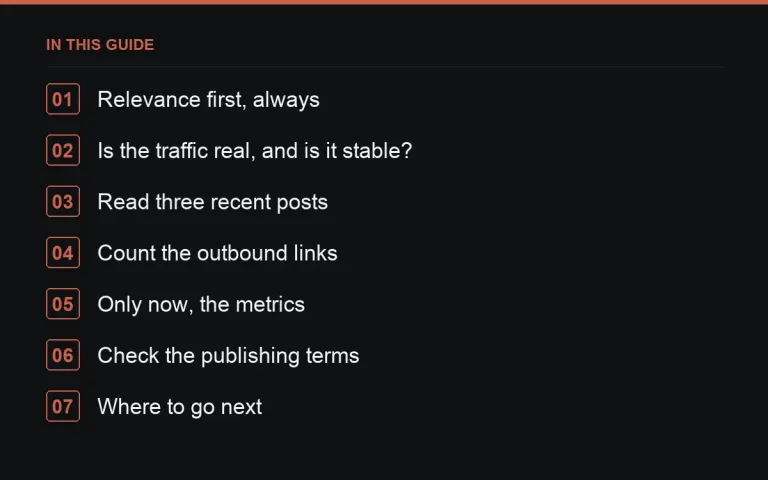
1. Relevance first, always
Ask a plain question: would a reader of this site plausibly care about your page? A link from a site in your field is worth more than a stronger site on an unrelated topic, because relevance is part of how search engines and readers interpret a link. Our guide to topical relevance explains why a smaller niche site regularly beats a big generalist for this purpose.
Warning sign: a site that covers health, crypto, home improvement and pet care in the same week, written by the same two authors. That is a publication built for selling links, not for readers, and it belongs on your list of sites to skip alongside the patterns in our red flags guide.
2. Is the traffic real, and is it stable?
Look at the organic traffic estimate and, if your SEO tool allows it, its trend over the past twelve months. You want steady or rising traffic. A sharp, sustained drop often means the site was hit by an algorithm update or lost its main traffic driver, and links from a site in that state carry less weight than the historical numbers suggest.
Also check where the traffic comes from. A site with most of its visits from countries unrelated to its stated language or topic deserves a closer look before you commit. In our marketplace you can filter listings by traffic directly; where traffic isn’t reported we show a dash rather than a zero, so treat those listings as needing your own verification.
3. Read three recent posts
This is the check people skip, and it is the most revealing one. Open three recent articles and ask:
- Is the writing edited, or does it read like unreviewed filler dropped in overnight?
- Do posts have a clear author, dates and images, the way a real publication does?
- Are the outbound links in each post natural, or does every article carry several unrelated commercial links?
If you wouldn’t want your brand appearing next to those articles, stop here and move on to the next candidate.
4. Count the outbound links
Sites that sell heavily tend to link out a lot, often to casinos, loans, supplements and similarly high-risk categories that have nothing to do with the site’s stated topic. A quick scan of recent posts, or an outbound link report if you have access to one, tells you what neighbourhood your link will live in. A few sponsored posts scattered through a site’s archive are normal. A site where nearly every article is sponsored isn’t a publication with occasional advertising — it’s a link inventory with a header and a logo.
5. Only now, the metrics
Authority metrics are useful for comparing otherwise similar sites, not for judging a site on their own:
| Metric | What it tells you | What it doesn’t |
|---|---|---|
| Ahrefs DR | Strength of the site’s backlink profile | Whether anyone actually reads the site |
| Moz DA | A predicted ranking strength score | Relevance to your specific topic |
| Organic traffic | Whether search engines send it visitors | Where those visitors come from or convert |
| Spam score | Patterns shared with penalised sites | A verdict on its own, without context |
A big gap between DR and traffic — for example DR 70 with almost no organic visitors — is a classic sign of manufactured authority, often built through the kind of scheme covered in private blog network risks. Our DR vs DA guide covers how each score is calculated and where they disagree.
6. Check the publishing terms
Before ordering, confirm the practical details, not just the content:
- Whether posts are marked as sponsored and which link attribute is used.
- How many links are allowed per post and whether homepage placement is included.
- Minimum word count, whether writing is included, and expected turnaround time.
- Whether the post is permanent or removed after a set period.
Each Digital PR listing shows these terms where the publisher has supplied them. Where a field shows a dash, message the seller before you buy rather than assuming the best case.
Where to go next
If you vet more than a handful of sites, record the checks in a simple sheet: relevance score, traffic trend, editorial quality score, outbound link quality, DR, and price. After twenty sites, patterns emerge fast, and you’ll start recognising good and bad publishers at a glance without running the full checklist each time. Once a placement is live, finish with our live-post checklist, and compare shortlisted sites side by side using the compare tool.
Frequently asked questions
What is a good DR for a guest post site?
There is no universal threshold. A relevant DR 30 site with real traffic often outperforms an irrelevant DR 70 site. Use DR to compare sites that already pass the relevance and traffic checks, not as the first filter.
How can I tell if a site's traffic is fake?
Look for traffic that doesn't match the content, visits concentrated in unrelated countries, or a DR far higher than the traffic would suggest. A sudden spike followed by a collapse is another common warning sign.
Should I avoid sites that mark posts as sponsored?
No. Marking paid posts as sponsored is what Google asks publishers to do, and sites that do it are usually more careful about quality overall. Judge the site on its audience and relevance instead.
How long should vetting a site actually take?
About ten minutes once you know the routine: a minute on relevance, a few on traffic and its trend, a few reading recent posts, and a final glance at the metrics as a tiebreaker.
Put it into practice
Filter 54,483 websites by DR, traffic, niche and price, and order with escrow — you pay only after the link is live.
Browse the marketplace