Domain Rating vs Domain Authority: What Each Metric Actually Measures
DR and DA are the two numbers every link seller quotes. Neither comes from Google. Here's what each measures and how to use them without being fooled.
Almost every guest post listing leads with two numbers: Ahrefs Domain Rating (DR) and Moz Domain Authority (DA). They’re useful shorthand for comparing sites quickly. They’re also third-party estimates that Google itself doesn’t use, and both can be pushed up artificially. Knowing what sits behind each score makes you much harder to mislead when you’re choosing where to place a link.
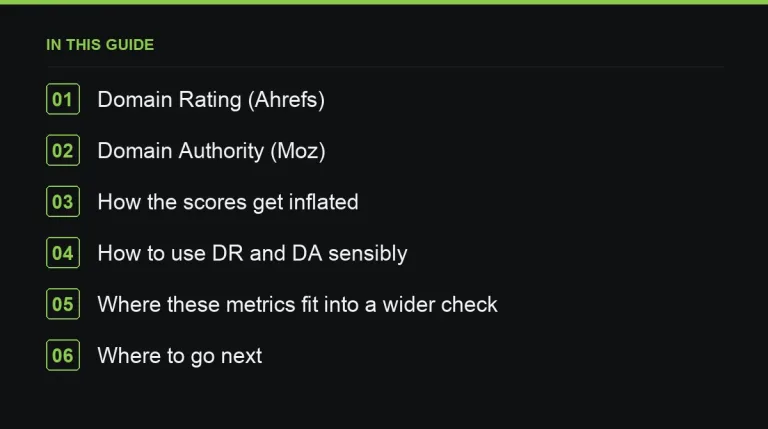
Domain Rating (Ahrefs)
DR scores the strength of a site’s backlink profile on a 0–100 scale. Roughly, it looks at how many unique domains link to a site and how strong those linking domains are themselves, based on Ahrefs’ own crawl of the web. The scale is logarithmic, which matters more than it sounds: moving from DR 20 to DR 30 takes a handful of decent links, while moving from DR 70 to DR 80 can take dozens of strong ones. Two sites eight points apart at the top of the scale are further apart in real terms than two sites eight points apart near the bottom.
What DR doesn’t consider is just as important as what it does. It ignores traffic, content quality, topical relevance, and whether the links pointing at the site were earned or manufactured. A site can have a respectable DR built almost entirely from links it bought itself, on other sites that did the same thing.
Domain Authority (Moz)
DA is also a 1–100 score, but Moz frames it differently: as a prediction of how likely a site is to rank, built with a machine-learning model trained on search results rather than a direct count of link strength. It uses link data as its main input alongside other signals Moz doesn’t fully disclose. Moz has revised the underlying model more than once, most notably with a “DA 2.0” update, which means a historical DA reading from a few years ago isn’t directly comparable to today’s number for the same site.
Because the two tools crawl the web independently and weight things differently, they will never agree perfectly, and that’s expected rather than a sign something is broken.
Why DR and DA disagree
You’ll regularly see listings like “DA 57, DR 11” or the reverse. Part of that gap is normal: different crawlers find different links, and a domain that’s well known to one index may be under-crawled by the other. A large mismatch is still worth noticing, though. It can mean the site has a genuine quirk in its link profile — for example, links concentrated on a handful of high-authority pages that one tool weighs heavily — or that one of the two scores has been deliberately targeted, because it’s cheaper to influence than the other.
How the scores get inflated
- Link networks. Groups of sites that link to each other in a closed loop raise each other’s scores without earning any real, independent links.
- Expired domains. A domain with an old, strong backlink profile gets bought after it drops, and a new, unrelated site is built on it, inheriting the metric but not the audience or the trust that produced it.
- Mass low-quality links. Large volumes of cheap directory or comment links can move DR at the lower end of the scale, even though none of them would pass a manual look.
The tell in every case is the same: authority without search traffic. A site with an unusually high DR or DA relative to its visible content and rankings almost always has a story behind the number, and it’s rarely a flattering one. That’s the core argument in why traffic is the better first filter — traffic requires an audience to already trust the site enough to click through from search results, which is much harder to manufacture than a link.
How to use DR and DA sensibly
- Filter by relevance and traffic first, then use DR and DA to compare what’s left, rather than starting from a DR threshold and working down.
- Look for consistency. A healthy site usually has DR, DA and traffic that roughly agree with each other and with how established the brand feels.
- Compare within a niche rather than across the whole web. A DR 35 site can be a leading publication in a small industry, and comparing it to a DR 70 general news site tells you very little.
- Don’t pay for the number itself. Pay for the audience and relevance the number is supposed to represent, and treat the score as a screening tool, not the goal.
Where these metrics fit into a wider check
DR and DA are a starting filter, not a decision on their own. A fuller evaluation also looks at how closely the site matches your subject, how quickly it has gained links recently (see link velocity), and what a placement is likely to cost relative to the budget you’ve planned. Treating any single metric as sufficient is how buyers end up with a portfolio of technically impressive but practically useless links.
Where to go next
Every listing in our marketplace shows both DR and DA where they’re known, alongside organic traffic, so you can compare all three at once rather than chasing one number across different tools. You can filter by any of them and sort by traffic to surface sites whose authority is backed by real visitors. Where a metric hasn’t been reported reliably, we show a dash instead of a guessed figure, which is worth checking manually before you commit to a placement in a specific niche.
More link building fundamentals
- A Beginner’s First Month of Link Building
- A Glossary of Link Building Mistakes
- Comments and Forums: The Real Link Building Value
- Documenting the Links You Build: A Simple System
- How Long Does It Take for Links to Be Discovered?
- How Search Engines Use Links Today
- How Site Speed and UX Affect Your Link Building Results
- How to Read a Backlink Report Without Getting Lost
- International Link Building Basics
- Keeping a Link Portfolio Healthy Over Years, Not Months
- Link Building Ethics: What’s Fair Game and What Isn’t
- Link Building Vocabulary Confusions, Cleared Up
- Link Building With a Large Budget: How to Spend It Well
- Link Building Without a Budget
- Link Building for Mobile Apps and Other Non-Website Assets
- Link Building for a Brand-New Website
- Link Decay: Why Backlinks Disappear Over Time
- Link Placement and Crawlability Basics
- Link Velocity: How Fast Is Too Fast?
- Links From Images, PDFs and Embeds: What Actually Counts
- Links From New Pages vs Established Pages
- Page-Level vs Domain-Level Authority
- Press Releases: What They Actually Do for Link Building
- Private Blog Networks: How to Spot Them and Why to Avoid Them
- Quality vs Quantity in Link Building: A Framework
- Referring Domains vs Backlinks: Which Number Matters
- Relevance vs Authority: The Real Link Building Trade-off
- Setting Realistic Link Building Goals
- Social Profile Links: What They Actually Do
- Sponsored, Nofollow and Dofollow: What Link Attributes Mean for You
- Teaching Link Building to a Team
- The Role of Brand in Link Building
- Topical Relevance: Why a DR 30 Niche Site Can Beat a DR 70 Generalist
- What Makes a Link ‘Natural’
- White Hat, Grey Hat and Black Hat Link Building, Explained Honestly
- Why Links Still Matter for SEO
- Why Organic Traffic Beats Authority Scores When Choosing Links
Frequently asked questions
Does Google use DR or DA?
No. Both are third-party metrics built by Ahrefs and Moz to approximate how search engines might value a site. Google has never confirmed using either score directly in ranking.
Which is better, DR or DA?
Neither is universally better. Use whichever your team already tracks consistently, and always check traffic and topical relevance alongside it before deciding.
What's a good DR for a backlink?
It depends heavily on your niche and your own site's current profile. A relevant site with real traffic matters more than crossing any specific DR threshold.
Can a site have high DR but low DA, or the reverse?
Yes, and it's common. The two tools crawl the web separately and weigh signals differently, so a gap of ten or twenty points isn't unusual on its own.
Put it into practice
Filter 54,483 websites by DR, traffic, niche and price, and order with escrow — you pay only after the link is live.
Browse the marketplace