Link Placement and Crawlability Basics
A link that search engines can't crawl, or that's buried where readers never look, delivers far less value than its metrics suggest.
Two links can come from the same domain with the same authority score and deliver wildly different results, because placement and crawlability differ. This is the practical, often-overlooked side of link building: not just which site links to you, but where on the page, and whether that link is even reachable by a crawler.
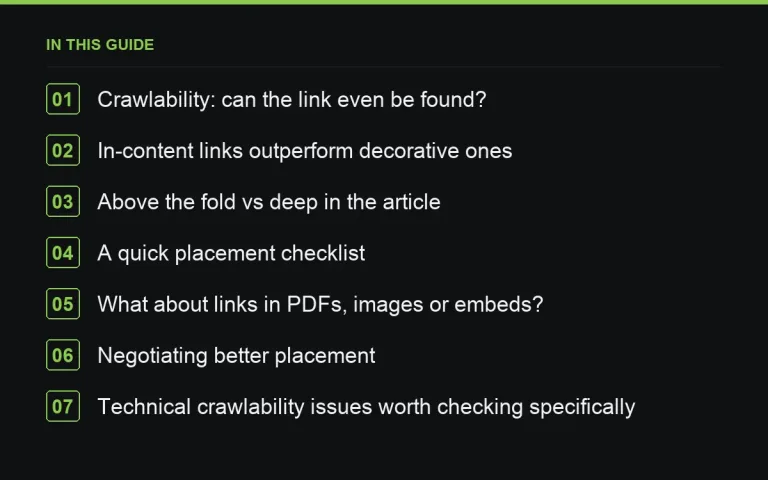
Crawlability: can the link even be found?
Some links live inside JavaScript-rendered widgets, behind login walls, in content blocked by robots.txt, or on pages the linking site itself has set to noindex. A link like this may still send occasional human traffic, but it contributes little to how search engines see your site, because it may never be crawled and passed through. Before valuing a placement, check that the linking page itself is indexed and reachable — a quick site: search or a look at https://successtoroad.com/blog/reading-a-backlink-report/ will confirm this.
In-content links outperform decorative ones
A link inside the main body of an article, surrounded by relevant text a reader is actually reading, is the strongest kind of placement. Footer links, sidebar widget links, and “partners” pages are weaker: readers rarely scroll to them, and search engines have learned to weight boilerplate areas of a page lower than main content.
Above the fold vs deep in the article
A link near the top of a long article, where most readers actually reach, tends to get more genuine clicks than one buried at the very bottom under a wall of unrelated text. This doesn’t always affect the SEO value directly, but it changes the referral traffic value substantially, and referral traffic is half the point of link building — see https://successtoroad.com/blog/why-links-still-matter/.
A quick placement checklist
- Is the linking page itself indexed and reachable without login?
- Is the link inside the main article body, not a footer, sidebar, or author bio stuffed with links?
- Does the surrounding paragraph actually relate to what you do?
- Is the link a normal HTML anchor, not hidden inside a script or an image with no alt text?
What about links in PDFs, images or embeds?
These are handled differently by crawlers and often carry less weight or get missed entirely. If a placement offer involves a link buried in a downloadable PDF or an image caption with no text link nearby, treat it as a bonus at best — see https://successtoroad.com/blog/links-from-images-pdfs-and-embeds/ for a full breakdown.
Negotiating better placement
When working with a publisher, it’s reasonable to ask, politely, whether a link can sit within the body content rather than a footer or resources page. Sites listed on https://successtoroad.com/marketplace/ typically show where sponsored or contributed content appears, which makes this easier to judge before you commit rather than after the piece is published.
Technical crawlability issues worth checking specifically
Beyond visible placement, a few technical details can quietly prevent a link from ever counting the way you’d expect. Check whether the linking page uses a canonical tag pointing somewhere else entirely, which can shift how a search engine treats the page’s own signals. Check whether the link relies on JavaScript to render — most modern crawlers handle this reasonably well now, but it’s still less reliable than a plain HTML anchor present in the page’s initial source. And check that the linking page itself returns a normal, successful response rather than a redirect chain or an error that only resolves for browsers with JavaScript enabled, which can behave inconsistently for crawlers.
A simple habit: check the page, not just the domain
It’s easy to evaluate an opportunity purely at the domain level — checking overall traffic and authority — while never actually opening the specific page your link will live on. Make it a habit to open the actual planned placement, or a very similar recent example from the same site and section, before committing. This single habit catches a surprising share of placement problems before they cost you time or money.
Where to go next
Read https://successtoroad.com/blog/what-is-a-backlink/ for the fundamentals, https://successtoroad.com/blog/how-search-engines-use-links-today/ for how crawling and indexing connect to link value, https://successtoroad.com/blog/page-vs-domain-authority/ for why the specific page matters separately from the domain, and https://successtoroad.com/blog/reading-a-backlink-report/ to learn how to audit placements you’ve already secured.
Mobile-specific placement considerations
On mobile layouts, content that appears prominently on desktop sometimes gets pushed far down the page, collapsed behind a “read more” toggle, or displaced by ads and sticky elements. Since a large share of readers now browse primarily on mobile, it’s worth checking how a specific placement actually renders on a phone screen, not just assuming a desktop preview accurately represents the real reader experience.
Working constructively with publishers on placement
Most publishers are reasonable about placement requests when asked politely and early, before content is finalised, rather than after publication when changes require more effort. Building a good working relationship with a publisher over several placements often earns you more flexibility on things like positioning and format than a one-off, purely transactional interaction ever would.
Frequently asked questions
Do footer links have any value at all?
Some, but far less than in-content links. They can still support crawlability and site-wide association, but they rarely move the needle much on their own.
How do I check if a linking page is actually indexed?
Search for the exact page URL in a search engine, or check whether it appears in the search results for its own title. If it doesn't show up at all, treat that placement as low value.
Does link placement matter more than the site's overall authority?
They interact rather than compete. A high-authority site with a poor placement still usually beats a low-authority site with great placement, but placement is the multiplier that determines how much of that authority actually transfers.
Can a link move to a better position after it's published?
Sometimes, if the publisher is willing to edit the piece. It's worth asking, especially for ongoing partnerships, but don't expect it as standard practice.
Put it into practice
Filter 54,483 websites by DR, traffic, niche and price, and order with escrow — you pay only after the link is live.
Browse the marketplace