What Makes a Link ‘Natural’
A natural link is one the linking site would have added even if SEO didn't exist — everything else is a judgement call.
The word “natural” gets thrown around in link building without much precision. The clearest working definition: a natural link is one the linking page’s owner would have added even if search engines didn’t exist, because it genuinely serves their reader. Everything else — anchor text patterns, placement, surrounding content — is really just a set of clues that either supports or undermines that core test.
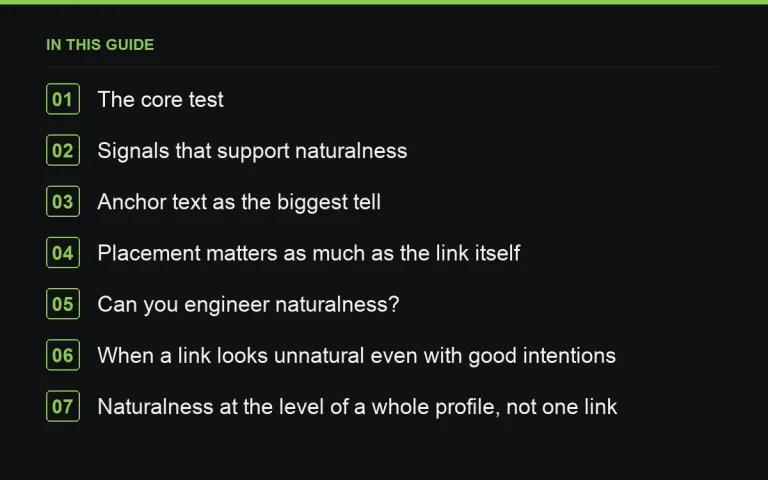
The core test
Ask: why does this link exist? If the honest answer is “because it helps the reader find more information, a source, or a related product,” it is natural. If the honest answer is “because we paid for it, swapped it, or inserted it into unrelated content purely for SEO value,” it is not — regardless of how it is disguised. This does not mean sponsored or paid placements are always bad; see https://successtoroad.com/blog/link-building-ethics/ for the nuance and disclosure requirements.
Signals that support naturalness
- The link sits in relevant, on-topic content, not bolted onto an unrelated article.
- Anchor text is varied across your link profile, not the same exact commercial phrase every time.
- The linking domain has its own real audience and publishing history, not a site that exists purely to host links.
- There is other similar linking behaviour on that site — it links out to other sources too, not just to paying clients.
Anchor text as the biggest tell
Real editorial links use a mix of anchor styles: the brand name, a naked URL, a generic phrase like “this guide,” and occasionally an exact match keyword. A link profile where most anchors are the same commercial keyword is one of the clearest signs of manufactured link building. Aim for anchor diversity as a byproduct of writing naturally, not as a spreadsheet exercise — more in https://successtoroad.com/blog/placement-and-crawlability-basics/.
Placement matters as much as the link itself
A link buried in a footer, sidebar widget, or a “resources” section stuffed with unrelated sites reads very differently from a link inside a paragraph that is actually about your topic. In-content links, surrounded by relevant prose, both perform better and look more natural, because that is genuinely how editors add links they believe in.
Can you engineer naturalness?
Somewhat. You cannot force organic behaviour, but you can put yourself in a position where natural links become likely: publish something genuinely worth linking to, place guest content on sites whose readers care about your topic, and avoid formulaic anchor text. The honest version of link building is closer to PR and content marketing than to link insertion — see https://successtoroad.com/blog/link-building-without-a-budget/ for tactics that lean on this.
When a link looks unnatural even with good intentions
Sometimes a legitimately earned link still looks suspicious in isolation — for example, a single high-value link with an exact-match anchor. Context is what saves it: if the rest of your profile is varied and the site is credible, one link like that is rarely a problem. Read https://successtoroad.com/blog/reading-a-backlink-report/ to learn how to audit your own profile the way an outsider would.
Naturalness at the level of a whole profile, not one link
It’s tempting to evaluate naturalness one link at a time, but real link profiles are judged in aggregate, and a single unusual link rarely matters much against a large, otherwise sensible backdrop. What matters more is the overall shape: a mix of link types (guest posts, mentions, directory listings where relevant, occasional press coverage), a mix of anchor styles, a spread of domains rather than heavy reliance on a handful, and a growth pattern that roughly tracks your site’s actual activity and visibility over time. Building this kind of aggregate naturalness is less about any individual outreach email and more about diversifying your tactics and sources deliberately, rather than repeating the same single approach at scale.
A common trap: optimising for a checklist instead of readers
Once people learn the signals that support naturalness — anchor variety, in-content placement, topical relevance — there’s a temptation to reverse-engineer them mechanically: deliberately rotating through a fixed list of anchor phrases, for instance, regardless of what actually reads well in context. This produces a strange, slightly artificial version of naturalness that experienced reviewers, whether human or automated, can often still detect. The more reliable approach is to write and place links the way an editor genuinely would, and let the natural signals fall out of that behaviour as a byproduct, rather than engineering the signals directly and hoping the underlying behaviour doesn’t matter.
Where to go next
Start with https://successtoroad.com/blog/what-is-a-backlink/ and https://successtoroad.com/blog/dr-vs-da/ for vocabulary, then read https://successtoroad.com/blog/link-building-ethics/ and https://successtoroad.com/blog/white-grey-black-hat-link-building/ for the boundaries. See https://successtoroad.com/blog/placement-and-crawlability-basics/ for the placement side of naturalness in more depth. When you are ready to find genuinely relevant publishers, browse https://successtoroad.com/marketplace/.
How reviewers and tools try to approximate the naturalness test
Since no tool can read intent directly, both automated systems and human reviewers rely on proxies: anchor text diversity, the relevance of surrounding content, the age and activity of the linking domain, and whether a similar pattern of links appears across many sites at once in a way that looks coordinated rather than organic. Understanding these proxies helps you self-audit your own link building before anyone else has to, since you can walk through the same checklist a reviewer would use and catch obvious issues early.
A closing thought on trying too hard
Paradoxically, some of the least natural-looking link profiles come from people trying hardest to appear natural — carefully rotating through a fixed set of anchor text templates, for instance, on a rigid schedule. Genuine natural variation tends to look a little messier than a deliberately engineered version of it. If your process for building links feels more like following a script than writing genuinely useful content and reaching out honestly, that’s worth revisiting.
Frequently asked questions
Does a sponsored link count as unnatural?
Not automatically. A properly disclosed sponsored or nofollow link on a relevant site is honest about its nature. The problem is disguising a paid link as pure editorial endorsement.
How much anchor text repetition is too much?
There's no fixed number, but if the majority of your external links use the same exact commercial phrase, that pattern stands out. Aim for branded, generic and descriptive anchors alongside occasional keyword matches.
Can guest posts be natural links?
Yes, when the content is genuinely useful to that site's readers and the link fits the context. A guest post written purely to insert a keyword-rich anchor into unrelated text is the version that causes problems.
Do nofollow links still count as natural?
They can be perfectly natural — many organic editorial links are nofollow by site policy. Naturalness is about intent and placement, not the specific link attribute.
Put it into practice
Filter 54,483 websites by DR, traffic, niche and price, and order with escrow — you pay only after the link is live.
Browse the marketplace