Quality vs Quantity in Link Building: A Framework
Quality and quantity both matter, but the right ratio depends on your site's age, competition level and current visibility.
The quality-versus-quantity debate in link building is usually framed as a binary, when it is really a ratio that shifts depending on where your site stands. A brand-new site in a competitive niche needs a different mix than an established site defending existing rankings. This is a framework for deciding, not a rule to apply blindly.
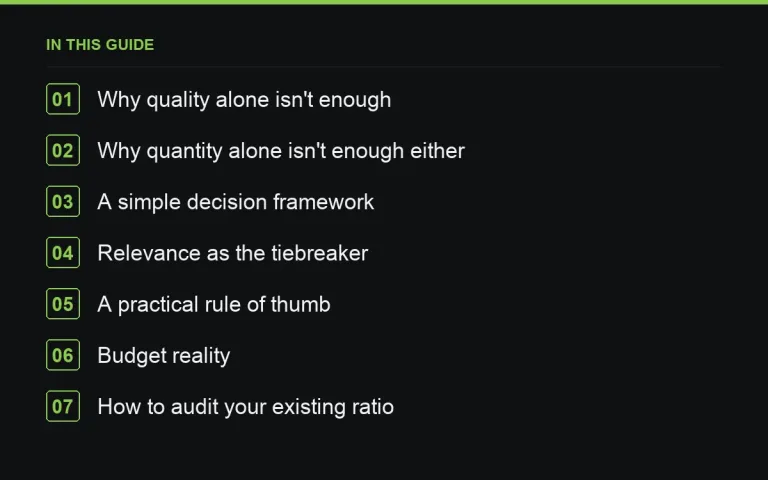
Why quality alone isn’t enough
A handful of exceptional links from major publications feels impressive, but if your site otherwise has almost no link profile, search engines see a thin, unusual pattern: two extraordinary links and nothing else. Real sites tend to accumulate a base layer of ordinary, decent links — guest posts, niche mentions, smaller press coverage — alongside anything exceptional. Quantity, within reason, provides that baseline credibility. See https://successtoroad.com/blog/link-building-for-new-sites/ for how this plays out for newer domains.
Why quantity alone isn’t enough either
A large volume of low-relevance, low-authority links, especially if acquired quickly, is a classic signature of manipulative link building — even when each individual link looks harmless. Volume without a credible source mix raises more red flags than it solves. This is the core reason https://successtoroad.com/blog/pbn-risks/ and similar shortcuts keep failing over time.
A simple decision framework
| Situation | Lean toward |
|---|---|
| New site, low authority, low competition niche | Moderate volume of decent, relevant links to build a baseline |
| New site, highly competitive niche | Fewer but stronger links; volume alone won’t compete |
| Established site defending rankings | Selective, high-relevance links; avoid diluting an already solid profile |
| Site recovering from a link penalty or bad history | Quality and caution over everything; audit before adding anything new |
Relevance as the tiebreaker
When choosing between two links of similar authority, the one from a more topically relevant site almost always wins. A moderate-authority industry blog beats a high-authority general news site for most commercial queries. This is covered in depth in https://successtoroad.com/blog/relevance-vs-authority-link-building/.
A practical rule of thumb
- Never chase quantity to the point of accepting irrelevant or low-trust sites just to hit a number.
- Never chase quality to the point of having only two or three links and nothing else supporting them.
- Reassess the ratio every few months as your site’s authority changes — what you needed at launch is not what you need a year later.
Budget reality
Quality links generally cost more time or money per link. If your budget is limited, it is usually better to secure fewer, well-chosen links than to spread the same budget across many mediocre ones. Browse https://successtoroad.com/marketplace/ and filter by relevance and traffic rather than sorting purely by the highest authority score, which tends to push budget toward quantity of the wrong kind.
How to audit your existing ratio
Before deciding whether to shift toward more quality or more quantity, look at what you already have. Count your referring domains, note how many sit clearly within your niche versus tangentially related or unrelated, and note the authority spread — are most links clustered at a similar modest level, or is there a healthy mix including a few standout placements. This simple audit usually makes the right next move obvious: a profile with plenty of volume but almost nothing standout benefits from a push toward quality, while a profile with two or three excellent links and little else benefits from building out a broader base first.
Why this ratio shifts as competitors respond
Competitive dynamics matter here too. If your competitors are actively building links, standing still means effectively falling behind even if your existing ratio was previously well balanced. Revisit this analysis periodically, not just once, since the right quality-to-quantity balance for your site today may not be the right one in a year, especially in a niche where competitors are actively investing in the same channel.
Where to go next
Read https://successtoroad.com/blog/dr-vs-da/ and https://successtoroad.com/blog/relevance-vs-authority-link-building/ for the metrics side of this decision, https://successtoroad.com/blog/reading-a-backlink-report/ for how to run the audit described above, and https://successtoroad.com/blog/setting-realistic-link-building-goals/ for how to translate a quality/quantity ratio into an actual monthly plan.
How this plays out over a full year
Looking at quality versus quantity over a single month can be misleading, since a single strong placement or a single burst of average ones both look reasonable in isolation. Reviewing a full year gives a much clearer picture: does the profile show a healthy mix of link types and authority levels, or does it lean overwhelmingly toward one end for the entire period, regardless of how individual months looked. Building this annual view into your regular reporting catches drift that month-to-month reviews often miss.
A note on team incentives
If a team or freelancer is measured purely on the number of links delivered per month, that incentive naturally pushes toward quantity, even with the best of intentions. If quality matters to you, make sure whoever is executing link building is measured, at least partly, on relevance and placement quality too, not purely on a raw count, so the incentive structure actually supports the ratio you want.
Frequently asked questions
Is there an ideal number of links per month?
No fixed number works across sites. It depends on your niche's competitiveness, your current profile size, and budget. A realistic starting point for many small sites is a handful of solid links per month rather than dozens of weak ones.
Should I ever accept a free, easy, low-quality link?
Occasionally, if it's genuinely relevant and costs nothing, it does little harm. Just don't let easy-but-irrelevant links become the bulk of your strategy.
Does link quality matter more for new or established sites?
It matters for both, but new sites also need some baseline volume to look like a normal, growing site. Established sites can afford to be more selective since dilution is a bigger risk than a thin profile.
How do I know if my link profile leans too much toward quantity?
Check {{post:reading-a-backlink-report}} for warning signs like large clusters of low-authority, irrelevant domains added in short bursts.
Put it into practice
Filter 54,483 websites by DR, traffic, niche and price, and order with escrow — you pay only after the link is live.
Browse the marketplace