Why Links Still Matter for SEO
Links still matter because they drive discovery, contribute to trust, and bring direct referral traffic — three separate benefits, not one.
Every year someone declares links dead as an SEO factor, and every year sites with strong, relevant link profiles keep outranking sites without them. The honest answer is that links matter for three separate reasons that often get conflated: they help search engines discover and trust content, and they bring people to your site directly, regardless of ranking impact.
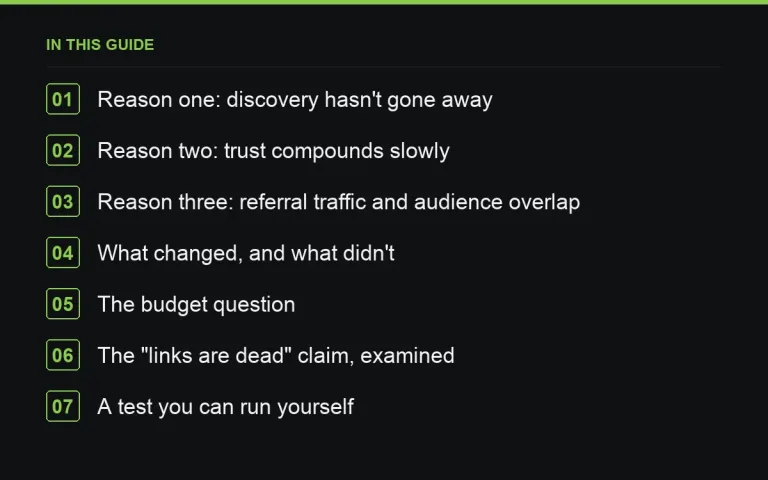
Reason one: discovery hasn’t gone away
Search engines still crawl by following links. A new page sitting on a site with no inbound links from elsewhere can take longer to be found and indexed than one with a few links pointing at it. This alone is a practical reason to build at least a handful of links to anything you want found quickly — see https://successtoroad.com/blog/how-search-engines-use-links-today/ for the mechanics.
Reason two: trust compounds slowly
No single link changes your fortunes. But a link profile built over years, from a range of genuinely relevant and reputable sources, is difficult for a competitor to fake or replicate quickly. This is one of the few genuinely durable competitive advantages left in SEO, precisely because it takes real time and real relationships to build. Compare that to on-page tactics, which any competent competitor can copy within a week.
Reason three: referral traffic and audience overlap
A link placed in front of the right readership sends visitors regardless of what a search engine ever does with it. A guest post on an industry site that regularly gets read, shared, and clicked through delivers value on day one. This is often undervalued because it doesn’t show up neatly in a backlink checker — track it in analytics referral reports instead.
A quick self-check
- Would this link exist if search engines vanished tomorrow? If yes, it is a genuinely good link.
- Would a reader on the linking page actually click it? If no, reconsider the placement.
- Is the linking site something your own customers would recognise or trust? That is closer to real authority than any single metric.
What changed, and what didn’t
What changed is the tolerance for obviously manufactured links — low-quality directories, comment spam, and paid link networks are far riskier than they used to be, as covered in https://successtoroad.com/blog/link-building-ethics/ and https://successtoroad.com/blog/white-grey-black-hat-link-building/. What didn’t change is the underlying logic: genuine endorsements from real sites, read by real people, remain valuable. The bar moved from “get any link” to “get links worth having.”
The budget question
If links still matter, the follow-up question is how much time and money to spend on them. That depends heavily on your market and current visibility — read https://successtoroad.com/blog/setting-realistic-link-building-goals/ and https://successtoroad.com/blog/link-building-without-a-budget/ before committing spend.
The “links are dead” claim, examined
The claim that links no longer matter usually rests on one of two observations: that some low-quality link building tactics stopped working, or that a particular site ranked well without an obviously large link profile. Neither observation supports the broader claim. Low-quality tactics losing effectiveness is a sign that the bar rose, not that links stopped mattering; and a site with a small but highly relevant link profile in a low-competition niche isn’t evidence that links are irrelevant everywhere, only that the competitive bar in that specific niche happens to be lower. Genuine counter-evidence would need to show competitive, well-resourced niches where sites with weak link profiles reliably outrank sites with strong, relevant ones — and that pattern simply isn’t what practitioners consistently observe across industries.
A test you can run yourself
Pick five competitive keywords in your niche and look at what’s ranking in the top results. In almost every competitive market, you’ll find that the top-ranking pages have a materially stronger link profile than pages ranking lower, even after accounting for content quality differences. This isn’t proof of causation on its own, but it’s a useful, low-effort sanity check before deciding how much weight to put on link building for your own site.
Where to go next
Start with the fundamentals in https://successtoroad.com/blog/what-is-a-backlink/ and https://successtoroad.com/blog/dr-vs-da/, then read https://successtoroad.com/blog/quality-vs-quantity-link-building/ for a framework on judging any individual opportunity, https://successtoroad.com/blog/how-search-engines-use-links-today/ for the mechanics behind why links help, and browse https://successtoroad.com/marketplace/ to see the range of publishers available across niches.
How to explain this to a skeptical stakeholder
If someone in your organisation questions whether link building is worth continued investment, the clearest argument is usually a side-by-side competitive comparison rather than an abstract defence of the tactic. Show them what your top-ranking competitors’ link profiles look like against your own, and let the gap speak for itself. Abstract arguments about algorithms rarely persuade as effectively as a concrete, visible difference in referring domains and relevance between you and whoever currently outranks you.
A final word on patience
Link building is one of the slower-moving levers in SEO, and its value is easiest to see in hindsight, over a year or two, rather than session to session. Treat it as a long-term investment in how discoverable and trustworthy your site appears, not a short-term campaign with an immediate, easily measured payoff every single month.
Frequently asked questions
Are links still a top ranking factor?
They remain an important factor, but not the only one. Content quality, technical health and user experience all matter too. Treat links as one strong lever among several rather than the entire strategy.
Can a site rank well with almost no backlinks?
In low-competition niches, yes, sometimes. In competitive markets, sites without any meaningful link profile rarely outrank established competitors who have both content and links.
Do internal links matter as much as external ones?
They serve different purposes. Internal links spread authority and context around your own site; external links bring outside trust and discovery. Both matter, but external links are harder to earn.
Is referral traffic from a link valuable even if it doesn't affect rankings?
Yes. A link that sends genuinely interested visitors has value in its own right, through leads, sign-ups, or brand awareness, independent of any SEO benefit.
Does the age of a domain make links matter less?
Not directly. What matters more is whether the domain has built genuine trust and relevance over that time. A newer domain with excellent, relevant links can still compete against an older domain with a thin or irrelevant profile.
Put it into practice
Filter 54,483 websites by DR, traffic, niche and price, and order with escrow — you pay only after the link is live.
Browse the marketplace