Link Building Vocabulary Confusions, Cleared Up
Several link building terms get used interchangeably even though they mean different things — here's the practical distinction between them.
Link building has accumulated a pile of overlapping jargon, and a lot of confusion in the field comes from people using terms loosely rather than genuinely disagreeing about strategy. This clears up the most commonly confused pairs.
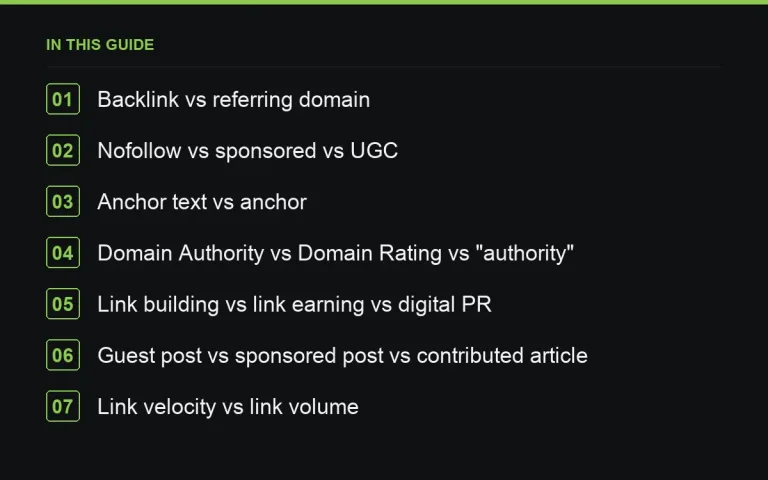
Backlink vs referring domain
A backlink is a single link. A referring domain is a whole domain that links to you, potentially through several backlinks. Ten backlinks from one domain still counts as one referring domain. This distinction matters a lot when judging profile diversity — see https://successtoroad.com/blog/referring-domains-vs-backlinks/ for the full comparison.
Nofollow vs sponsored vs UGC
These are all link attributes, not separate categories of link quality. Nofollow is the general-purpose “don’t necessarily pass trust through this” tag. Sponsored specifically marks paid or advertising links. UGC marks user-generated content like blog comments. None of them make a link worthless — they’re disclosure signals, covered in https://successtoroad.com/blog/sponsored-tags-and-rel-attributes/.
Anchor text vs anchor
These are used interchangeably in practice, both referring to the clickable text of a link. There’s no meaningful distinction worth preserving here — if someone draws one, they likely mean something more specific like “exact match anchor” or “branded anchor.”
Domain Authority vs Domain Rating vs “authority”
Domain Authority and Domain Rating are specific metrics from different tools, often confused as if they were the same measurement on the same scale. “Authority” as a general word is used loosely to mean either, or neither, specifically. See https://successtoroad.com/blog/dr-vs-da/ for the precise distinction.
Link building vs link earning vs digital PR
| Term | What it usually means |
|---|---|
| Link building | Umbrella term for any deliberate effort to acquire links |
| Link earning | Links acquired passively because content is good enough to attract them without outreach |
| Digital PR | Link building through press-style tactics: pitches to journalists, data stories, expert commentary |
Guest post vs sponsored post vs contributed article
These overlap heavily in practice. A guest post can be unpaid or paid; a sponsored post is explicitly paid and usually disclosed; a contributed article is a neutral term some publishers prefer regardless of payment. Ask directly about payment and disclosure rather than assuming from the label alone.
Link velocity vs link volume
Volume is simply how many links you have. Velocity is the rate at which you’re gaining (or losing) them over time. A site can have low volume but currently high velocity, or vice versa — see https://successtoroad.com/blog/link-velocity/ for why the rate matters separately from the total.
Why this matters practically
Miscommunication between clients, freelancers and agencies often comes down to using these terms loosely. Being precise — saying “referring domains” instead of just “links” when that’s what you mean — avoids a lot of confusion in reporting and planning.
Internal link vs external link vs backlink
Another frequent mix-up: an internal link connects two pages on your own site, an external link is any link pointing away from your site to somewhere else, and a backlink specifically means an external link pointing toward your site from someone else’s. People sometimes use “external link” and “backlink” interchangeably, but they describe the link from opposite directions — a backlink to you is an external link from the other site’s point of view.
Do-follow vs follow
“Do-follow” isn’t an official attribute at all — it’s informal shorthand for the absence of a nofollow tag, meaning the link behaves in the default way without any restriction added. You’ll see it used constantly in outreach and marketplace listings, including on https://successtoroad.com/marketplace/, even though technically a link is simply either tagged nofollow, sponsored, or UGC, or it carries no special attribute at all.
Where to go next
Read https://successtoroad.com/blog/what-is-a-backlink/ and https://successtoroad.com/blog/dr-vs-da/ for the foundational definitions, https://successtoroad.com/blog/referring-domains-vs-backlinks/ for the deeper dive, https://successtoroad.com/blog/sponsored-tags-and-rel-attributes/ for the do-follow/nofollow distinction in full, and the https://successtoroad.com/blog/link-building-glossary/ for a fuller list of terms.
Jargon that’s often used inconsistently across the industry
Terms like “authority,” “trust,” and “quality” get used constantly in link building discussions without a shared, precise definition, since they’re general concepts rather than specific metrics. When reading advice or a vendor’s pitch that leans heavily on these words without further specifics, it’s reasonable to ask directly what they actually mean by them in this context, since the answer often reveals whether the advice is grounded in something concrete or largely vague reassurance.
Building your own shared glossary internally
For teams working together regularly, it can help to agree internally on precise definitions for the terms you use most, even if those definitions are slightly narrower than how the wider industry uses them. This reduces miscommunication during planning and reporting far more effectively than assuming everyone already shares the same understanding of loosely used jargon.
Finally, remember that vocabulary precision is a means to clearer communication, not an end in itself. Correcting someone’s terminology mid-conversation rarely helps; using precise language yourself, consistently, tends to raise the general clarity of a team’s discussions over time without needing to police everyone else’s phrasing.
Frequently asked questions
Are Domain Authority and Domain Rating the same thing?
No, they're metrics from different tools measured on different scales, even though both aim to estimate a domain's general link-based strength. See {{post:dr-vs-da}} for the full comparison.
Is a nofollow link worthless?
No. It's a disclosure attribute, not a quality judgment. A relevant, well-placed nofollow link can still bring referral traffic and contextual value.
What's the difference between link building and digital PR?
Digital PR is a specific style of link building that leans on press-style tactics like data stories and journalist pitches, while link building is the broader umbrella covering any deliberate link acquisition effort.
Does 'link juice' mean the same as authority?
It's an informal, older term for the trust or ranking value passed through a link. It's largely fallen out of formal use but still appears colloquially to mean roughly the same thing as a link's authority contribution.
Put it into practice
Filter 54,483 websites by DR, traffic, niche and price, and order with escrow — you pay only after the link is live.
Browse the marketplace