Link Building for a Brand-New Website
A new site has no link history, which makes every early link more visible. Here's how to start in the right order.
New sites face a chicken-and-egg problem: they need links to rank, and links are hard to earn with no audience. The temptation is to buy a big batch of placements immediately. That tends to backfire, because on a site with no history, every link stands out, and a sudden spike is exactly the pattern a spam filter looks for.
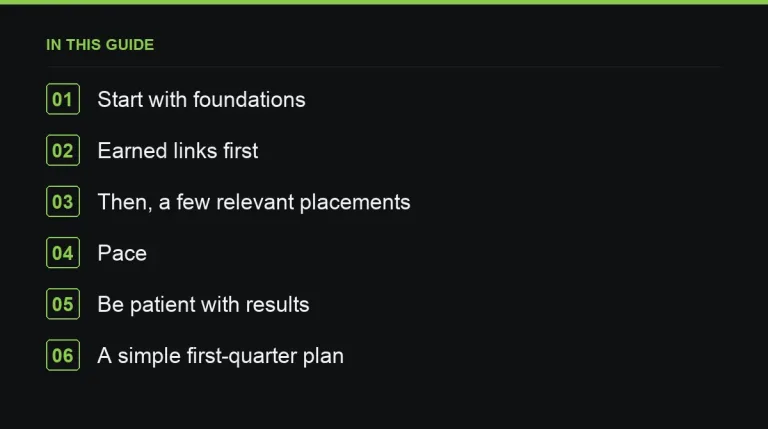
Start with foundations
Before any outreach or buying:
- Make sure the site is technically sound and indexable (checklist).
- Publish a core set of genuinely useful pages that match search intent in your niche.
- Set up the easy, legitimate profiles: business listings, social profiles, relevant directories and memberships.
- Get the links you’re naturally entitled to: suppliers, partners, clients, associations, and your own other properties (partner and supplier links).
Earned links first
Early earned links set the tone of your profile. Good options for a young site:
- Expert commentary for journalists and publications (how to get quoted).
- A linkable asset — a tool, dataset or definitive guide in your niche (ideas here).
- Genuine guest contributions pitched to relevant publications on merit (writing content editors accept).
What not to do in month one
It’s tempting to treat a new site launch like a race, especially when a competitor already ranks and you’re starting from nothing. Resist ordering a large batch of links in the first few weeks, resist keyword-stuffed anchors to compensate for lost time, and resist any offer that promises fast rankings for a brand-new domain — no legitimate link building shortens that timeline much, and the sites that promise otherwise are usually the ones described in common link building mistakes.
Then, a few relevant placements
Once the foundations are in place, a small number of carefully chosen placements can speed things up. For a new site, that means:
- Relevance over authority. Niche sites with real traffic, not the highest DR you can find (why relevance beats a high DR generalist).
- Branded and descriptive anchors. A new site with keyword anchors looks manufactured from day one (anchor guide).
- Informational targets. Link to guides and resources, then use internal links to support commercial pages (internal linking).
Pace
A new site’s natural baseline is close to zero, so a sudden jump is conspicuous. Start with a few quality links a month and grow alongside your content and audience. Link velocity explains how to set the pace, and it’s worth revisiting every time you add a new content section.
Common early mistakes
| Mistake | Why it hurts a new site |
|---|---|
| Buying dozens of links in the first month | Looks manufactured against a site with no history |
| Exact-match anchors on every link | The single most obvious manipulation signal |
| Only linking to the homepage | Wastes the chance to support the pages that need to rank |
| Ignoring on-site content quality | Links can’t compensate for pages that don’t answer the query |
Be patient with results
New domains often take months to rank for competitive terms even with good links. Track leading indicators, such as indexed pages, impressions in Search Console and rankings for long-tail terms, rather than waiting for head terms to move. How long backlinks take to work covers realistic timelines in more detail.
It also helps to set expectations with anyone funding the work up front. A founder or client who expects page-one rankings in month two, on a domain that didn’t exist in month one, will read a perfectly normal trajectory as failure. Share the leading indicators every few weeks so the pace of progress is visible even before rankings move.
A simple first-quarter plan
- Month 1: technical setup, core content, foundational profiles and partner links.
- Month 2: one linkable asset and a round of expert-commentary pitching.
- Month 3: a handful of relevant placements to informational pages, chosen via the marketplace.
Where to go next
Once you have a first quarter of steady, relevant links behind you, move on to setting a full link building budget so growth stays deliberate rather than reactive. New sites that get this order right — foundations, earned links, then a measured pace of placements — tend to avoid the volatility that hits sites which try to shortcut the process. If budget is tight, it’s worth reading link building for startups on a small budget alongside this guide, since the two constraints (a new site and a small budget) usually arrive together.
Finally, resist comparing your new site’s link profile to an established competitor’s. That competitor has years of accumulated links you can’t replicate in a quarter, and trying to match their raw numbers quickly is what leads to the conspicuous, front-loaded buying pattern this guide is trying to help you avoid. Match their relevance and quality instead, at a pace your own site’s age can support.
Frequently asked questions
Can I buy links for a brand-new site?
You can, but keep it to a few relevant placements after the site has solid content, and use natural anchors. Heavy early buying is conspicuous.
How long does a new site take to rank?
Often several months for competitive terms. Long-tail keywords usually move first.
What's the first link a new site should get?
Links you're naturally entitled to: partners, suppliers, associations and genuine directories relevant to your business.
Put it into practice
Filter 54,483 websites by DR, traffic, niche and price, and order with escrow — you pay only after the link is live.
Browse the marketplace