Link Building for Startups on a Small Budget
Startups have little budget but plenty of story. Here's how to turn that into links.
Startups rarely have link building budgets, but they have things established companies don’t: a founding story, launches, novelty and founders who can speak for the company. Used well, those earn links that money struggles to buy, and they compound faster than a paid campaign started from zero.
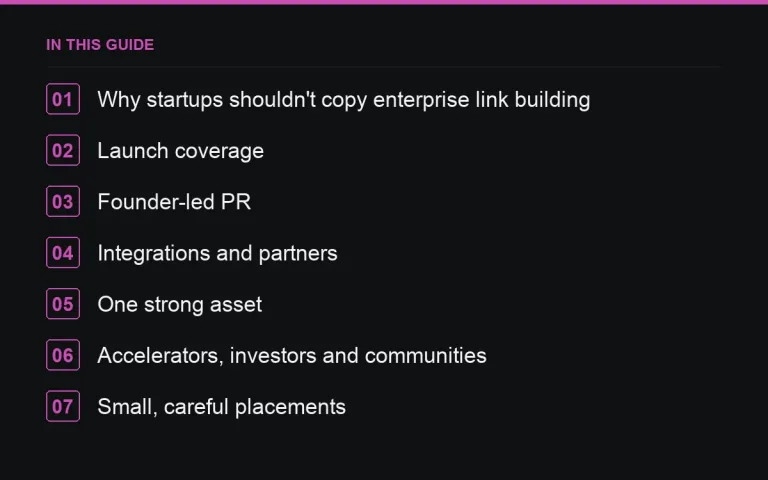
Why startups shouldn’t copy enterprise link building
A large company’s playbook — big-budget digital PR, agency retainers, dozens of monthly placements — assumes a domain with history and a team to run it. A brand-new site doesn’t have that history, and the pattern of results looks different: early links matter more for discovery and trust than for rankings, which take time regardless of budget (link building for a brand-new website). Spend the first months on things that don’t depend on budget.
1. Launch coverage
Product launches, funding rounds and notable partnerships are news, at least to the trade press covering your space. Prepare a simple press page with facts, quotes and images ready to use, pitch relevant tech and trade journalists directly, and list the launch on product discovery platforms (press releases and SEO, journalist outreach that gets replies).
2. Founder-led PR
Founders commenting on their industry, appearing on podcasts and writing opinion pieces earn links and credibility that a company blog post rarely does — journalists want a named, quotable person, not a brand voice. Make yourself available for expert commentary and pitch a handful of podcasts in your space (getting quoted as an expert, podcast guesting).
3. Integrations and partners
Every integration and partnership is a listing waiting to happen, and often a co-marketing opportunity beyond it. If you build on top of another platform, ask about their partner directory. If you have suppliers, resellers or affiliates, make sure each one links back (partner and supplier links, link building for SaaS).
4. One strong asset
Rather than a content calendar you can’t sustain, build one genuinely useful free tool, template or dataset in your space, and make it excellent. A single well-promoted asset earns more links over its lifetime than a dozen thin blog posts (free tools and calculators, linkable assets).
5. Accelerators, investors and communities
Accelerator portfolios, investor sites, startup directories and founder communities list companies with links, and completing every profile takes an afternoon. It’s low effort, genuinely relevant, and adds up across a dozen or more sources over the life of the company.
6. Small, careful placements
Once there’s real traction — some traffic, some customers, content worth linking to — a few relevant placements can support key pages. Keep anchors branded rather than exact-match, keep the pace gentle, and choose sites you’d want to be associated with regardless of the link (anchor text strategy, link velocity).
What to avoid early on
| Temptation | Why it backfires |
|---|---|
| Cheap bulk link packages to “kickstart” a new domain | Low-quality links attached to a young domain draw more attention, not less |
| Vanity coverage that doesn’t reach customers | A mention on an irrelevant high-authority site rarely converts or ranks you for anything useful |
| Buying links before the product page is ready | Wastes the link on a page that won’t convert or rank (technical SEO before links) |
Sequencing it over the first year
| Phase | Focus |
|---|---|
| Pre-launch and launch | Press page, journalist pitches, product discovery listings |
| First few months | Founder commentary, partner and integration listings, accelerator profiles |
| Once there’s a working product with users | Build the one strong free asset; start collecting testimonials for tools used |
| Once there’s real traction | Small, careful placements to support key pages |
Budget without a budget
Most of this list costs time rather than money, which suits a stage where cash is tight and every dollar is watched. The exception is the free asset, which may need design or development time, and the eventual placements, which are worth paying for once there’s a product and pages worth pointing links at. Resist the temptation to spend on placements before that point — a link to a landing page that doesn’t yet convert or rank for anything relevant does very little.
What investors and mentors usually recommend
Ask around most startup communities and the advice on paid link building converges quickly: wait longer than feels comfortable before spending on placements, and spend more time than feels comfortable on the free, relationship-based options above. That’s not because paid placements don’t work — it’s because a young domain with a thin content footprint gets more from a handful of well-earned links and a genuinely useful resource than from an early batch of purchased ones with nothing else to reinforce them.
What “traction” looks like before you start paying for links
- The target page you’d support is live, converts reasonably and matches search intent.
- You have at least a small amount of organic traffic and some ranking signal to build on.
- You’ve exhausted the free options above, or they’re running in parallel already.
Where to go next
Once you’ve worked through founder-led PR and partner listings, browse the marketplace for a handful of relevant, well-trafficked sites to support your strongest pages, and keep standards from spotting link farm red flags in mind from day one.
Frequently asked questions
What's the best free link source for a startup?
Launch coverage, partner and accelerator listings, and founder-led commentary.
Should startups buy links early?
Only a few careful, relevant placements after you have solid content and some traction.
Do product launch platforms help SEO?
Mainly through exposure that leads to coverage and links elsewhere.
Put it into practice
Filter 54,483 websites by DR, traffic, niche and price, and order with escrow — you pay only after the link is live.
Browse the marketplace