Do Press Releases Still Help SEO?
Wire distribution won't build your rankings on its own. A press release that earns real journalist coverage can. Here's the difference.
Press releases have a mixed reputation in SEO, mostly because of how they used to be abused: publish a release stuffed with keyword anchors, distribute it to hundreds of sites, collect hundreds of links. Search engines stopped rewarding that a long time ago. But press releases themselves still have a job, just not the one they were used for a decade ago.
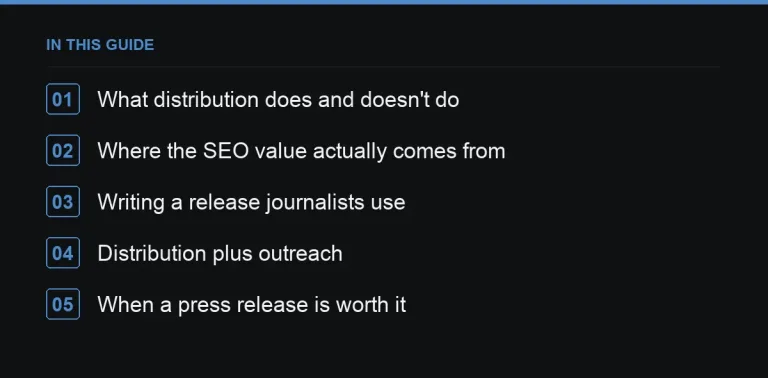
What distribution does and doesn’t do
Wire services syndicate your release across partner sites. Those copies are duplicates of the same text, often on pages few people read, and links in them are typically nofollowed or treated as low value. Google has specifically called out keyword-rich links in widely distributed press releases as an example of unnatural linking, in the same category discussed in what is a link scheme.
So distribution alone is not an SEO strategy. What it can do:
- make your announcement available to journalists who monitor the wires,
- create a record of the news that appears in branded searches,
- support visibility for genuinely newsworthy events like funding or acquisitions.
Where the SEO value actually comes from
The value comes when a journalist reads the release and writes their own story, citing and linking to you. That’s editorial coverage, the same outcome as any digital PR campaign. The release is just the vehicle. If it’s genuinely newsworthy, treat it like a mini digital PR campaign: strong headline, defensible facts and a pitch that goes beyond the wire.
Writing a release journalists use
- Lead with the news in the first sentence: who, what, why it matters.
- Keep it short and factual. Journalists skim.
- Include a quote that adds opinion or context, not marketing slogans.
- Give data and sources where you have them.
- Link sparingly — your homepage or the relevant page, with branded anchors (anchor text guidance applies here too).
- Add contact details for a real person who will answer.
Distribution plus outreach
The releases that earn coverage are usually also pitched directly to relevant journalists with a tailored note (outreach guide). Wire distribution widens the net; direct outreach is what lands stories. Treat the wire as a backstop that ensures a record exists, not as the main event.
When a press release is worth it
| Worth a release | Probably not |
|---|---|
| Funding, acquisition, major partnership | Minor feature update |
| Original research or data | A new blog post |
| A notable hire or expert appointment | Routine staff changes |
| A product launch with a clear story | “We’ve redesigned our website” |
Reclaiming value after the fact
Once coverage runs, review each article: did it link, and to the right page? Where it names you without a link, a short, polite request often succeeds (turning mentions into links). Where a journalist did link, check the anchor and destination match what you’d have chosen, and use internal links from that page to spread the benefit further.
Timing a release around bigger news
Check the news calendar before you set a date. A funding announcement or product launch scheduled the same morning as a major national story, a big scheduled data release, or a competitor’s own announcement will get buried regardless of how well it’s written. If the news is genuinely time-sensitive and the date can’t move, at least brief the spokesperson that pickup may be lighter than usual, so expectations match what actually happens.
What to send alongside the release
Journalists working from a wire feed rarely have time to chase you for extras, so attach or link to a short fact sheet, a high-resolution logo, and a headshot of the named spokesperson at the point of distribution rather than after the first request. It sounds minor, but it removes the friction that causes a busy reporter to skip a mildly interesting story in favour of one that’s ready to publish immediately.
Choosing a distribution service
If you do distribute, pick a service based on which journalists and outlets actually pick up its feed, not on the raw number of “publishing partners” listed on its pricing page — many of those partners are exactly the low-traffic syndication sites that provide no real value. A smaller service with genuine relationships to trade press in your sector often beats a larger one that scatters your release across generic aggregators.
A brief history of why the reputation stuck
The bad reputation press releases have in SEO circles comes from a specific era: agencies would write a release with the exact-match keyword as anchor text, submit it to dozens of low-quality “news” sites that existed purely to host syndicated content, and count the resulting links as SEO work. Search engines adapted, those links stopped counting, and some sites that relied heavily on the tactic saw real ranking damage. The releases themselves weren’t the problem; the specific, repeated pattern of manufactured anchor-text links was, and it’s the same pattern to avoid in any other channel, not just press releases.
Where to go next
If you’d rather hand it off, you can hire writers and distribution specialists in press release writing and distribution services, and use the marketplace for the placements that give a launch page links even when press coverage alone falls short.
Frequently asked questions
Do press release links count for SEO?
Links in syndicated copies of a release generally carry little or no weight. Links from journalists' own stories about the news can be very valuable.
Should press release links be nofollow?
Google recommends that links in distributed press releases be nofollowed, especially where anchors are optimised. Keep links branded and minimal.
Is press release distribution a waste of money?
Not for genuinely newsworthy announcements, but it's not a link-building shortcut. Pair it with direct outreach.
Put it into practice
Filter 54,483 websites by DR, traffic, niche and price, and order with escrow — you pay only after the link is live.
Browse the marketplace