Making Backlinks Work Harder With Internal Linking
A backlink lands on one page. Internal links decide how much of its value reaches the pages you actually want to rank.
Every backlink points to one URL. What happens next depends on your internal links. A strong page with no internal links out is a dead end; the same page linking thoughtfully to related content passes relevance and authority to the pages that need it. It’s the cheapest way to get more out of links you already paid for, and it costs nothing beyond an afternoon with a spreadsheet.
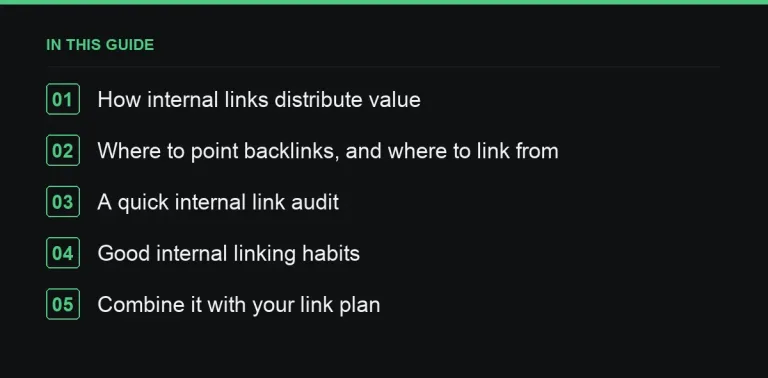
How internal links distribute value
Search engines follow links within your site the same way they follow links between sites. Pages that receive many internal links, especially from strong pages, are treated as more important. Internal link anchor text also helps describe the linked page, in the same way anchor text does for external links (see anchor text strategy for the external side of that).
That means a guest post pointing at a popular guide can lift your product or category pages, if the guide links to them. The backlink brings authority into the site through one door; internal links carry it down the hallway to the rooms that actually need it.
Where to point backlinks, and where to link from
It’s often easier to earn and buy links to informational pages (guides, research, tools) than to product pages. That’s fine, and it’s actually the standard pattern for building a healthy link profile (more on target selection in choosing which pages to build links to). Build links to the informational page, then link from it to the commercial pages it relates to.
| Backlinks land on | Internal links should go to |
|---|---|
| A how-to guide | The product or category that solves the problem |
| A data study | The service page the data supports |
| A glossary entry | Deeper guides and the related commercial page |
| A comparison page | The specific product or plan it recommends |
A quick internal link audit
- List your pages with the most backlinks (your SEO tool’s “best by links” report, or Search Console’s top pages by impressions as a proxy).
- Open each one. Does it link to your target pages? Is the anchor descriptive?
- Find orphan pages — important pages with few or no internal links pointing to them. These are usually new pages nobody has gone back to link into, or old category pages that fell out of the main navigation.
- Add links where they help the reader. Two or three contextual links from a strong page often matter more than another backlink.
- Check depth. If a page needs more than three or four clicks from the homepage to reach, it’s likely under-linked and under-crawled.
Good internal linking habits
- Use descriptive anchors (“our guide to anchor text”), not “click here”.
- Link from body content, where it’s contextual, not only from menus and footers.
- Keep important pages within a few clicks of the homepage.
- Update old articles to link to new ones on related topics. It’s also part of refreshing old content.
- Group related articles into clusters that link to and from a central pillar page — see content clusters and links for the structure.
- Don’t overdo it. A page with a hundred links in the body helps no one, and it dilutes the value each individual link carries.
Internal links and technical health
Internal linking only works if the pages you’re linking to are actually indexable. Before investing time in an audit, confirm you’re not fighting canonical tags, noindex directives or a redirect chain that quietly breaks the path from a strong page to a weak one — see technical SEO to fix before you buy links. A backlink that lands on a page blocked from indexing, or an internal link that ends in a 404, wastes the same budget either way. It’s worth spot-checking your most-linked-to pages in Search Console’s coverage report before you spend more on external links pointing at them.
Navigation and footer links matter too, but they carry less specific signal than a contextual link inside an article, because every page on the site includes them. A single sentence in the body of a relevant guide, pointing to the exact page a reader would want next, tends to do more for both users and rankings than another line in a mega-menu.
Combine it with your link plan
When planning a campaign (budget guide), map each backlink target to the internal links that will pass value onward. Sometimes the best “link building” for a stubborn page is five internal links from pages that already have strong backlinks, done before you spend anything on new placements. It’s also worth tracking in the same report you use for measuring link building ROI, since a page that suddenly gains internal links often moves at the same time new backlinks arrive, and it helps to know which one did the work.
Where to go next
Run the audit above once a quarter, and treat it as a standing item alongside any new campaign. It’s a habit that pays off well beyond link building too: fixing orphan pages and adding contextual links tends to improve crawling, time on page and even conversion paths, since visitors reach the next relevant page instead of bouncing. When you’re ready to add external links on top of a properly linked site, the marketplace lets you find relevant sites for the informational pages that sit at the top of these chains, filtered by niche, traffic and price so you can match the placement to the page it needs to support. Pair new placements with a quick internal-link check on the target page itself, so the value you’re paying for has somewhere to go the moment the link goes live.
Frequently asked questions
How many internal links should a page have?
As many as genuinely help the reader. For most articles that's a handful of contextual links plus navigation.
Should I use exact-match anchors internally?
Descriptive anchors that include the topic are fine internally and help search engines. Keep them natural and varied.
Do internal links pass PageRank?
They pass value within your site in a similar way to external links, which is why linking from strong pages helps.
Put it into practice
Filter 54,483 websites by DR, traffic, niche and price, and order with escrow — you pay only after the link is live.
Browse the marketplace