How to Plan a Link Building Budget
Most link building budgets are a round number someone picked in a meeting. Here's how to work one out from the actual gap between you and the sites you want to outrank.

“How much should we spend on links?” usually gets answered with a number that felt reasonable in a meeting rather than one derived from anything measurable. A better answer starts from the gap between you and the pages you’re trying to outrank, and works backwards from there to a monthly figure you can defend.
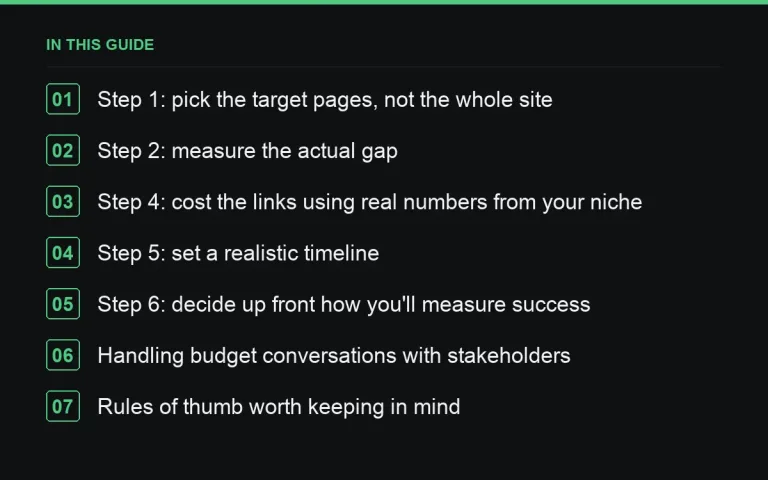
Step 1: pick the target pages, not the whole site
Budget per page rather than per domain. List the pages that matter commercially and the keyword or keywords each should rank for. For most sites that’s somewhere between five and twenty pages, not the entire catalogue, and it’s far easier to plan and measure against a short, specific list.
Step 2: measure the actual gap
For each target keyword, look at the pages currently sitting in the top five results. Note the number of referring domains pointing at each ranking page, and whether those links look relevant to the topic, then compare that against your own page.
This gap isn’t a precise number of links you “need”; rankings depend on content quality and search intent match as well as raw link count. But it does tell you, roughly, whether you’re a handful of relevant links behind or genuinely dozens, and that distinction changes the whole budget.
Step 3: rule out the page itself as the bottleneck
Links amplify pages that already deserve to rank; they rarely rescue one that doesn’t. Before spending anything, confirm the target page actually matches search intent and that the site has no technical issues holding it back, using a checklist like our technical review before link building. Money spent on links to a page with an underlying content or technical problem is largely wasted until that’s fixed.
Step 4: cost the links using real numbers from your niche
Use actual prices from your specific niche, not averages quoted in generic blog posts. In the marketplace, filter your niche by the traffic and DR range you’d accept and note the typical price band that comes back. Then build a simple table like this one:
| Target page | Estimated gap | Price band | Monthly pace | Monthly cost |
|---|---|---|---|---|
| /guide-a/ | ~15 relevant domains | $150–300 | 3 | $450–900 |
| /category-b/ | ~8 relevant domains | $100–200 | 2 | $200–400 |
Add writing costs if you’re not using publisher-written content as part of the placement, and leave some room for a few premium placements where they’re clearly worth the extra cost; see what actually drives guest post prices for how to judge that.
Step 5: set a realistic timeline
Spread the work over several months at a steady pace rather than trying to close the whole gap at once. Rankings typically respond over a period of months, not days, so budget for at least two quarters of consistent activity before judging whether the plan is working.
Step 6: decide up front how you’ll measure success
Agree in advance what success actually looks like: rankings for the target keywords, organic traffic to those specific pages, and ideally conversions from that traffic rather than link counts on their own. Our ROI guide walks through turning those numbers into something you can report against the budget you set here.
Handling budget conversations with stakeholders
A budget built this way is much easier to defend internally than a round number, because you can point to the specific pages it’s meant to move and the gap it’s meant to close. When a stakeholder asks why the figure looks like it does, walk them through the target pages, the estimated gap and the price bands in your niche rather than citing an industry rule of thumb. If budget gets cut mid-campaign, the same table tells you which pages to drop first: cut the ones furthest from their target or lowest in commercial value, not an even percentage across everything.
Common ways budgets go wrong
- Spreading too thin. Splitting a modest budget across twenty pages instead of five means no page gets enough links to move meaningfully.
- Ignoring content costs. Placements are only half the spend if the content still needs writing to a standard publishers will accept.
- No reserve for opportunities. A strong, timely placement or a PR opportunity can come up mid-quarter; a fully committed budget can’t take advantage of it.
- Judging too early. Cutting a campaign after six weeks because rankings haven’t moved yet, before the typical response window has even passed.
Rules of thumb worth keeping in mind
- Fewer, better placements consistently beat many weak ones, even at the same total spend.
- Protect a slice of the budget for links earned through digital PR rather than bought directly; they’re often the strongest signal in the mix.
- Review the plan monthly and reallocate budget away from pages that have already reached their target.
- As volume grows, systemise vetting and quality checks; see scaling guest posting for how that changes at higher volume.
Where to go next
Once the budget is set, check topical relevance and DR versus DA before shortlisting individual sites, and revisit organic traffic as a metric to make sure the budget is buying real audiences rather than just numbers. Browse relevant niches directly, such as finance or marketing, to see current price bands before finalising the plan.
Frequently asked questions
How much does link building cost per month?
It depends on niche, competition and the quality bar you set. Build the figure from the gap to competitors and real prices in your niche rather than a generic industry benchmark.
How long before link building shows results?
Usually several months. Budget for at least two full quarters before judging results, and track rankings and traffic on the target pages rather than raw link counts.
Should I spend on links or content first?
If the target page doesn't already satisfy search intent, fix the content first. Links amplify pages that deserve to rank; they don't compensate for a page that doesn't.
How do I split budget across many target pages?
Prioritise pages closest to ranking and those with the highest commercial value, then allocate more of the monthly budget to those before spreading it thinner across the rest of the list.
Put it into practice
Filter 54,483 websites by DR, traffic, niche and price, and order with escrow — you pay only after the link is live.
Browse the marketplace