Scaling Guest Posting Without Losing Quality
Ten guest posts a month is easy. A hundred, without the quality collapsing, takes a system. Here's the one that works.

The hardest part of guest posting isn’t the first placement, it’s the hundredth. At low volume, careful judgement covers for the lack of a system. At scale, shortcuts creep in almost without anyone deciding to take them: vetting gets lighter, briefs get vaguer, and a campaign that started with carefully chosen publishers drifts into buying whatever is cheap and available this week. This is the system that keeps volume growing without that drift.
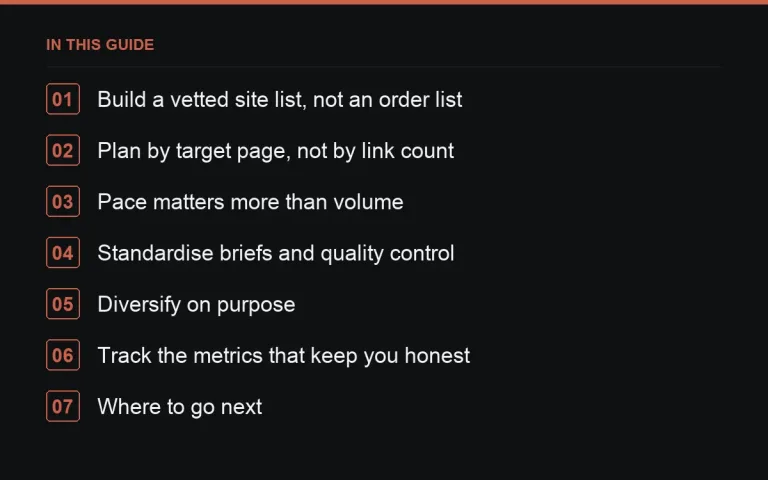
Build a vetted site list, not an order list
Separate the act of choosing sites from the act of placing orders. Maintain a standing list of publishers that have passed your evaluation routine, tagged by niche, traffic band, price and past delivery quality. When a new campaign starts, the team picks from that list rather than searching from scratch under time pressure, which is when quality standards quietly slip.
Review the list on a fixed schedule, not just when something goes wrong. Traffic changes, sites get sold to new owners, and a publisher that was excellent last year may not be today — the same red flags covered in our link farm checklist are worth re-running against sites already on your approved list, not just new ones.
Plan by target page, not by link count
At scale, it’s tempting to track a single number: links placed this month. Track pages instead. For each target page, write down:
- how many relevant referring domains the pages currently outranking it have,
- which niches and publications are genuinely relevant to it,
- the anchor list for it, planned in advance (see anchor text strategy),
- the monthly pace you intend to build links at for that specific page.
This keeps effort pointed at the pages that actually matter for your goals and stops one high-priority page from quietly absorbing every placement while others get none.
Pace matters more than volume
A steady, unhurried cadence looks like a site that is gradually and naturally getting noticed. A sudden burst of placements followed by months of silence looks like a campaign, because it is one. There’s no universal safe number; it depends heavily on how many links your site already earns on its own. Our piece on link velocity covers how to judge a sensible pace for your specific site rather than copying someone else’s schedule.
Standardise briefs and quality control
Use a single brief template for every order, and a single live-post checklist for every delivery, so quality control doesn’t depend on which team member happened to place a given order. At volume, that checklist catches problems you would otherwise miss entirely: wrong destination URLs, noindexed pages, extra links quietly added by the publisher.
If you outsource writing to freelancers or an agency, spot-check a fixed percentage of articles every month, and check more heavily with writers who are new to the account.
Give the team a shared vocabulary
Part of what breaks down at scale is language, not process. If one person’s “good site” is another person’s “acceptable if cheap enough,” the standard has already slipped. Write down what a passing site looks like in concrete terms — minimum traffic, editorial signals, response time — so a new hire evaluates sites the same way a founder would, without needing to ask about every borderline case.
Set a clear escalation path
Decide in advance who reviews a flagged site, who approves an exception to a normal rule, and who signs off on dropping a publisher that keeps causing problems. Without this, decisions get made ad hoc by whoever is placing the order that day, and standards drift depending on who’s busy.
Diversify on purpose
- Across publishers — avoid concentrating many links on one site or one obviously connected network of sites.
- Across link types — mix guest posts with niche edits, digital PR coverage and links you earn without paying for placement.
- Across target pages — include informational and resource pages, not only the pages that sell something.
Track the metrics that keep you honest
| Metric | Why it keeps you honest |
|---|---|
| Cost per placement by quality tier | Shows whether the average order is quietly drifting toward cheaper, weaker sites |
| Share of placements with real, verifiable traffic | A falling share is an early warning long before rankings react |
| Delivery issues per publisher | Identifies which publishers to drop from the approved list |
| Target page rankings and organic traffic | The outcome that actually matters, as opposed to activity metrics |
Reporting these numbers regularly, rather than just listing placements delivered, is covered in more depth in measuring the ROI of link building.
Where to go next
On Digital PR you can filter the marketplace by niche, traffic, authority score, language and price, save publishers you trust to reorder from later, and manage every order, revision and approval from one buyer panel. Escrow on every order means a problem delivery never costs more than the time it takes to raise it. If your team is managing this across several clients rather than one brand, managing multiple link building clients covers the additional layer that adds.
Frequently asked questions
How many guest posts per month is safe?
It depends heavily on how many links your site already earns naturally. Grow the pace gradually and keep quality constant rather than chasing a fixed number you saw somewhere else.
Should agencies use the same sites for every client?
Only where the site is genuinely relevant to each client. Reusing the same small set of sites across unrelated clients creates visible patterns and weakens the relevance signal for everyone involved.
How do I keep freelance writers' quality consistent at volume?
Use a standard brief, give direct feedback on the first few pieces from any new writer, and keep spot-checking regularly rather than assuming quality holds once it's been good a few times.
Is it better to add publishers quickly or grow the vetted list slowly?
Slowly. A smaller list of thoroughly checked publishers you can reorder from confidently is worth more than a large list nobody has properly vetted.
Put it into practice
Filter 54,483 websites by DR, traffic, niche and price, and order with escrow — you pay only after the link is live.
Browse the marketplace