How to Write a Guest Post Brief Publishers Actually Follow
Most disappointing guest posts start with a vague brief. This template tells a publisher exactly what to write — and what not to.
When a guest post comes back off-topic, overly salesy, or with the link jammed into an awkward spot, the problem almost always started with the brief. Publishers and their writers produce dozens of articles a week. The clearer your instructions, the closer the finished piece lands to what you actually pictured, and the fewer rounds of revisions it takes to get there.
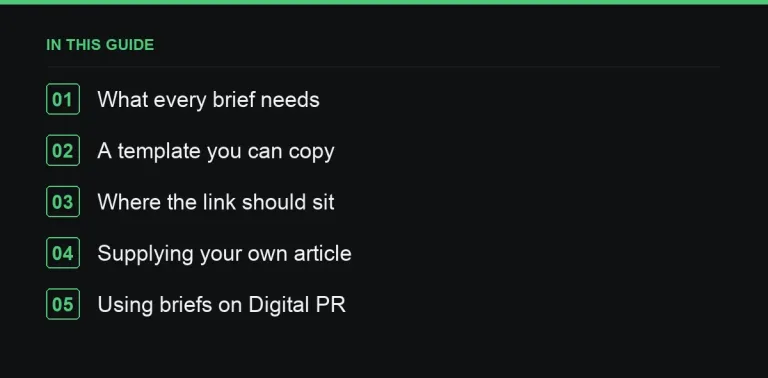
What every brief needs
1. The target URL and why it matters
Give the exact page you want linked, and one sentence on what it covers. “Our guide to choosing running shoes for flat feet” gives a writer far more to work with than a bare URL with no context at all.
2. Anchor text, with a fallback
Provide the anchor you’d prefer and explicitly allow a natural alternative. Rigid exact-match anchors tend to produce clumsy, obviously inserted sentences. Our anchor text guide explains a safe mix to aim for across a set of placements.
3. The angle
Suggest a topic that serves the host site’s readers first and connects to your page second. Good angles answer a question the audience already has. “Five mistakes first-time runners make” can link to a shoe guide naturally within the story; “Why our shoes are the best” cannot, and most editors will reject it on sight.
4. Audience and tone
Beginners or experts? Formal or conversational? One line here saves an entire round of revisions later, and helps the writer match the register of content editors actually accept on that specific site.
5. Sources and facts
If you want specific data mentioned, supply the source yourself. Ask the writer to cite reputable sources for any statistic and never to invent numbers to make a sentence sound more authoritative — that habit creates real problems later, as covered in writing case studies that earn trust.
6. What to avoid
List competitors not to mention, claims that are legally sensitive in your industry, and phrases your brand simply doesn’t use. This one section prevents most of the awkward back-and-forth after a first draft comes in.
A template you can copy
Keep the brief itself short. A simple structure covers almost every case:
- Target page: the URL, plus a one-line description of what it is for.
- Preferred anchor: your first choice, plus a note allowing a natural alternative phrase.
- Suggested topic: a title idea that stands on its own as useful to the site’s readers.
- Placement: link in the body where it adds context, not in the first sentence or the author bio.
- Tone and length: practical or formal, and a rough word count, commonly 900 to 1,200 words.
- Must include / avoid: any required points or sources, and anything off-limits.
Where the link should sit
A link placed in the middle of the article, inside a sentence that genuinely references your page, reads better for readers and looks more natural to anyone reviewing the piece afterward. Avoid asking for the link in the opening line, in a bolded call to action, or stacked together with other commercial links. If you request more than one link, give each of them a clear reason to exist, following the guidance in how many links a guest post should include.
Supplying your own article instead
If you write the article yourself rather than briefing the publisher, follow the host site’s existing style: heading structure, typical length, image use and tone of voice. Editors accept pieces faster when they already look like the rest of the site, rather than like an obvious outside submission. Our guide on writing content editors accept first time goes deeper into this, and if you’re producing content at any real volume, using AI without cutting corners is worth reading before you scale up.
Common brief mistakes worth avoiding
A few patterns show up again and again in weak briefs. The first is asking for a topic that only makes sense from the buyer’s point of view, with no benefit to the host site’s own readers — editors spot this instantly and either reject it or rewrite the angle themselves, often losing your intended context in the process. The second is over-specifying the exact wording of sentences near the link, which reads as inserted rather than written. The third is leaving out a word count entirely, which leads to thin, rushed articles that don’t serve either side well.
A brief that names the target page, gives a workable angle, and trusts the writer with the rest usually produces a better article than one that tries to control every sentence.
Where to go next
When you order a guest post in the marketplace, the brief field goes straight to the publisher alongside your target URL and preferred anchor. For content produced separately from a specific listing, sellers ask their own questions at checkout, and you can also hire writers directly through writing services or AI-assisted content services.
Frequently asked questions
How long should a guest post brief be?
Short enough to read in two minutes. The structure above is usually enough for most sites and most topics. Long, dense briefs often get skimmed rather than followed closely.
Should I specify exact anchor text?
Give a preferred anchor and explicitly allow natural variations around it. Forcing one exact phrase into every placement often produces awkward sentences that editors either reject or quietly soften.
Can I ask for revisions after the draft comes back?
On most sites, yes, within the scope you originally agreed. A clear, specific brief keeps the number of revision rounds to a minimum, which is faster for both sides.
Do I need a different brief for every site?
The core details stay the same, but tone and suggested angle should shift to match each site's audience. Reusing one generic brief everywhere is a common reason drafts come back needing heavy edits.
Put it into practice
Filter 54,483 websites by DR, traffic, niche and price, and order with escrow — you pay only after the link is live.
Browse the marketplace