Plagiarism and Originality Checks for Guest Posts
An originality check protects the publisher, the writer, and the byline; run it before every submission.
Plagiarism in guest posting isn’t always the dramatic, obvious copy-paste people picture — it’s more often subtle: a paraphrase too close to a source’s original structure, a recycled paragraph from the writer’s own previous work submitted to a different site without disclosure, or AI-generated text that happens to closely mirror existing published content. Running an originality check before submission catches most of these before they become a real problem.
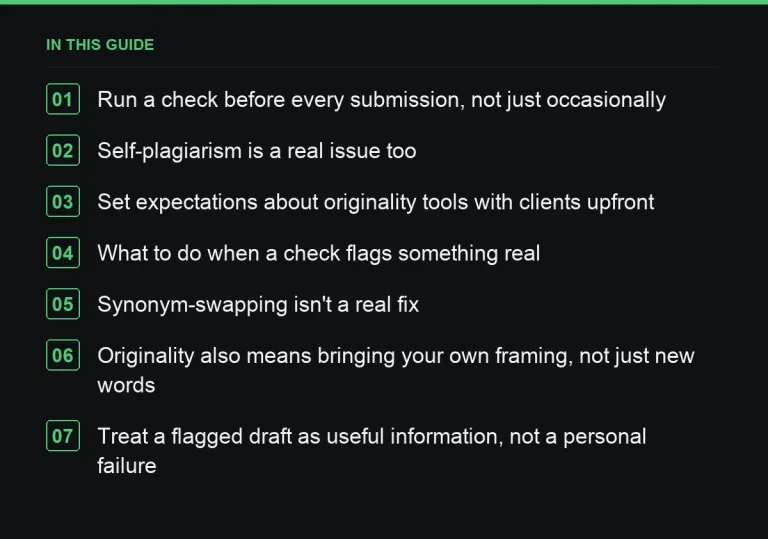
Run a check before every submission, not just occasionally
Treating originality checks as a routine, non-negotiable step — like a final proofread — catches problems before they reach an editor rather than after, when the consequences (a rejected pitch, a damaged relationship with a publication, a reputation hit) are harder to undo. Most originality-checking tools are quick enough that skipping this step is rarely a meaningful time saving.
Understand what a similarity score actually means
A flagged match doesn’t automatically mean plagiarism — common phrases, properly quoted material, or widely used industry terminology often trigger false positives. Read flagged sections yourself rather than treating any nonzero score as disqualifying; the goal is catching genuine copying, not achieving a perfect zero on a tool that can’t distinguish coincidental phrasing from actual duplication.
Self-plagiarism is a real issue too
Submitting the same or a very similar article to multiple publications without disclosure is its own form of originality problem, even though no other author’s work is involved — many publications explicitly require exclusive or substantially unique content, and violating this can damage a writer’s standing even when nothing was technically copied from someone else.
AI-assisted drafts need their own originality check
Content produced with AI assistance can sometimes closely mirror existing published material it was trained on, particularly for well-covered topics, without the writer intending any copying. Run the same originality check on AI-assisted drafts as on fully human-written ones — the tool doesn’t need to know how the draft was produced to flag a genuine similarity issue, as covered further in https://successtoroad.com/blog/ai-content-guest-posts/.
Set expectations about originality tools with clients upfront
If you’re producing content for a client or publication that runs its own separate originality check, it’s worth asking in advance what tool and threshold they use, since different checkers can flag different things and a piece that passes one may still get flagged by another. Aligning expectations before submission avoids a surprising rejection over a tool discrepancy neither side anticipated.
What to do when a check flags something real
- Rewrite the flagged section in your own structure and words, not just swapped synonyms.
- If the content is genuinely a close paraphrase of a specific source, cite that source properly per https://successtoroad.com/blog/citing-sources-in-guest-posts/ rather than disguising the similarity.
- Re-run the check after revising to confirm the fix actually resolved the flagged similarity.
Synonym-swapping isn’t a real fix
Replacing individual words in a copied passage while keeping the same sentence structure and argument order is usually still detectable as unoriginal, and more importantly, it’s still not genuinely original thinking — the honest fix is understanding the source’s point well enough to explain it in your own structure, not disguising a paraphrase mechanically.
Originality also means bringing your own framing, not just new words
Two articles can use entirely different sentences while still covering a topic in an identical order with the same examples and the same structure, which is a subtler form of unoriginality that similarity checkers don’t always catch. Genuine originality means developing your own angle on a topic, not just avoiding word-for-word overlap with existing coverage.
Treat a flagged draft as useful information, not a personal failure
Even careful, experienced writers occasionally trigger a similarity flag on a genuinely original passage, particularly on well-covered topics with limited ways to phrase a common idea. Respond to a flag by reviewing it calmly and revising where genuinely warranted, rather than treating every flag as an accusation, since the tool’s job is to surface possibilities for review, not to render a final verdict on its own.
Build the check into your workflow, not as an emergency response
Treating originality checking as something you only do reactively, after a publication raises a concern, means you’re finding problems at the worst possible time — after submission, with a relationship already at risk. Building it into a standard pre-submission checklist, alongside the https://successtoroad.com/blog/editing-your-own-draft/ process, means most issues are caught and fixed quietly before anyone outside your own process ever sees them.
Explain your process proactively with new clients or publications
If you’re establishing a new working relationship, briefly mentioning that originality checking is a standard part of your process can build confidence upfront, particularly with publications or clients who’ve been burned by unoriginal content before. It’s a small detail that signals professionalism without needing to be stated defensively.
Where to go next
Pair this with https://successtoroad.com/blog/editing-your-own-draft/ since an originality check fits naturally into a broader pre-submission review process, and https://successtoroad.com/blog/ai-content-guest-posts/ for the specific considerations around AI-assisted writing. If you’re managing content across multiple writers, https://successtoroad.com/services/writing/ can help you find contributors with a track record of clean originality, and https://successtoroad.com/marketplace/ remains the place to confirm publication standards before you submit.
Frequently asked questions
Do I need to run an originality check on every single guest post?
Yes, as a routine final step — it's quick, catches both accidental duplication and self-plagiarism, and prevents avoidable rejection or reputational issues down the line.
Does quoting a source count as plagiarism if it's flagged by a checker?
No, properly attributed and clearly marked quotations are legitimate and expected to show some similarity to the source — the concern is unattributed copying, not honest quotation.
Is submitting a similar article to two different publications a problem?
Often yes, if either publication expects exclusive content, which many do — check the specific publication's policy and disclose if you're repurposing content rather than assuming it's fine.
Can AI-generated content pass an originality check and still be a problem?
Yes — passing a similarity check doesn't guarantee the content is accurate, well-reasoned, or free of fabricated claims, so originality checks are one safeguard among several, not a complete quality check on their own.
Put it into practice
Filter 54,483 websites by DR, traffic, niche and price, and order with escrow — you pay only after the link is live.
Browse the marketplace