Updating a Guest Post After Publication
A published guest post is not finished forever; here is when and how to update one responsibly.
A guest post published a year or two ago can quietly become inaccurate — a mentioned tool changes its pricing, a statistic ages out of relevance, a process the article described no longer works the way it did. Deciding when and how to update older guest content is a real part of the writing craft, not just a maintenance afterthought.
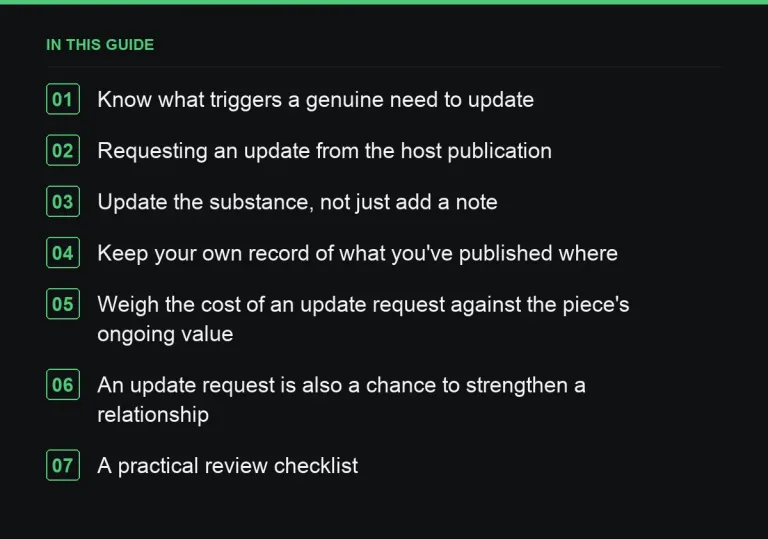
Know what triggers a genuine need to update
Not every small change in the world requires revisiting an old article, but certain triggers are worth acting on: a factual claim that’s become outdated or wrong, a linked resource that no longer exists or has changed significantly, or a process described that no longer reflects current practice. Periodically reviewing older placements against these triggers, rather than only reacting to complaints, catches problems before readers do.
Distinguish outdated from simply older
An article can be several years old and still entirely accurate if the underlying advice hasn’t changed — age alone isn’t a reason to update. The trigger should be a specific, identifiable inaccuracy or gap, not a vague sense that older content deserves a refresh regardless of whether anything in it is actually wrong.
Requesting an update from the host publication
Since guest posts live on someone else’s site, updating one means reaching out to the publication rather than editing it directly. Frame the request specifically — what’s outdated, what the correction should say, and why it matters — rather than a vague request to “refresh” the piece, which is harder for an editor to prioritise or action quickly.
Some publications welcome this more than others
Publications vary widely in how they handle update requests for contributed content — some have an established process, others rarely revisit older guest posts at all. It’s reasonable to ask, but be prepared for the request to take time or go unanswered, particularly for less actively maintained sites or older relationships where the original editor may no longer be there.
Update the substance, not just add a note
A brief “update: this section is outdated” note is better than nothing, but where possible, request the actual outdated content be revised properly rather than just flagged — readers finding an article through search still expect the content itself to be accurate and current, not just honestly labelled as stale.
Keep your own record of what you’ve published where
A simple log of guest posts, their publication dates, and any claims likely to age — pricing, specific tool features, statistics tied to a particular year — makes future review far easier than trying to remember or rediscover everything you’ve published once enough time has passed for something to need checking.
Weigh the cost of an update request against the piece’s ongoing value
Chasing an update on every minor stale detail across a large portfolio of placements isn’t a realistic use of time; prioritise pieces that still receive meaningful traffic or that contain the kind of error that could genuinely mislead a reader, and let lower-impact, low-traffic pieces with minor staleness sit lower on the list.
An update request is also a chance to strengthen a relationship
Reaching back out to an editor or publication months after a piece went live, with a specific, well-reasoned request, reminds them you’re a contributor who cares about accuracy over time, not just about securing the initial placement. Handled well, this kind of follow-up can lead to future commissioning opportunities rather than being purely a maintenance task.
A practical review checklist
- Are any specific numbers, prices, or dates now outdated?
- Do any linked resources or mentioned tools still exist and function as described?
- Has the underlying process or advice changed since publication?
- Would a new reader today still be well served by this piece as it stands?
Updating can also mean strengthening, not just correcting
Not every update is a fix for something wrong — sometimes a piece was accurate but thin, and a later pass adds a genuinely useful example, a clarified section, or a missing edge case a reader pointed out in a comment or a follow-up email. Treat these improvement-driven updates the same way as correction-driven ones: propose them specifically to the editor rather than assuming an older placement is untouchable once published, following the same collaborative approach covered in https://successtoroad.com/blog/reviewing-a-writers-draft/.
Coordinate updates with whoever manages the site’s SEO
If a guest post update changes its core claims meaningfully, it’s worth checking whether the change affects how the piece ranks or is indexed, particularly for content that’s part of a broader https://successtoroad.com/blog/editorial-calendar-for-seo/ strategy on the host site. A well-communicated update, done in coordination with the publication rather than as a one-off request, tends to go more smoothly and is more likely to be actioned promptly.
Where to go next
Pair this with https://successtoroad.com/blog/updating-old-content/ for the equivalent process on owned-site content rather than guest placements, and https://successtoroad.com/blog/fact-checking-without-fabricating/ for the verification discipline that applies just as much to an update as to an original draft. If you’re managing an active portfolio of guest placements, https://successtoroad.com/services/writing/ can help with revision work, and https://successtoroad.com/marketplace/ remains useful for tracking where your content actually lives across publishers.
Frequently asked questions
How often should I review old guest posts for accuracy?
There's no fixed schedule, but an annual review of placements with pricing, statistics, or fast-changing tools mentioned is a reasonable baseline for catching the most common triggers.
Can I update a guest post myself once it's published?
Not directly in most cases, since it lives on the host publication's site — you'll typically need to request the change through the editor or whoever manages that content.
What if the publication doesn't respond to an update request?
Follow up once after a reasonable interval, and if there's still no response, note the issue in your own records; for anything seriously misleading, consider whether a public correction elsewhere is warranted.
Is it worth updating a guest post that gets very little traffic now?
Prioritise based on real impact — a low-traffic older piece with an outdated but low-consequence detail is a lower priority than a well-trafficked piece with a claim that could genuinely mislead current readers.
Put it into practice
Filter 54,483 websites by DR, traffic, niche and price, and order with escrow — you pay only after the link is live.
Browse the marketplace