Writing Templates That Do Not Read Like Templates
A good template speeds up writing without making every finished piece sound like it came from the same mold.

Templates are essential for producing guest content at any real volume, but a template applied too rigidly produces articles that feel interchangeable — the same intro pattern, the same section order, the same closing phrase, regardless of topic. The skill is building a template that speeds up the mechanical parts of writing while leaving room for each piece’s actual substance to shape its structure.
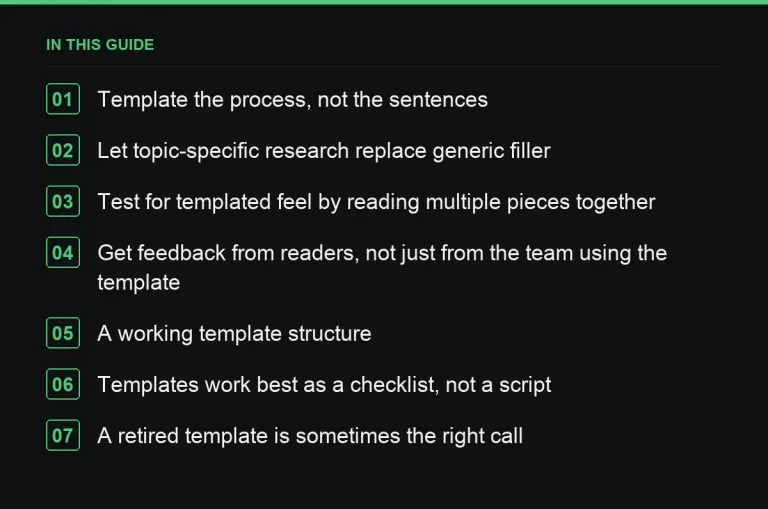
Template the process, not the sentences
The most useful templates specify a sequence of questions to answer — what problem does this solve, what’s the counterintuitive part, what should the reader do next — rather than literal sentence structures to fill in. A template that dictates exact phrasing produces exact phrasing repeated across every article; a template that dictates a thinking process produces varied writing built on a consistent foundation.
Vary the opening pattern deliberately
If every article using the template opens with the same rhetorical move — a question, then a statistic, then “in this article” — readers and editors who see multiple pieces from the same source notice the pattern quickly. Rotate between two or three different opening approaches across a template’s use, matching the specific approach to what best serves each topic, per https://successtoroad.com/blog/writing-introductions-that-earn-the-read/.
Let topic-specific research replace generic filler
A template section for “why this matters” filled with a generic paragraph about the importance of digital marketing, repeated with minor edits across many articles, is exactly the kind of content that reads as templated. Replace that slot every time with something specific to the actual topic — a real example, a genuine nuance, a specific reader scenario — rather than a interchangeable placeholder paragraph.
Build in flexibility for topics that don’t fit the mold
Not every topic suits the same section order or format. A rigid template applied to a topic that doesn’t naturally fit it produces an awkward article that’s clearly been forced into a shape it doesn’t belong in. Treat the template as a strong default, not an unbreakable rule, and adjust section order or drop sections that genuinely don’t serve a specific topic.
Test for templated feel by reading multiple pieces together
The best way to catch a template that’s become too rigid is to read several articles produced from it back to back — patterns invisible when reading one article in isolation become obvious when several are read consecutively. If the same transitions, structures, or phrases keep recurring verbatim, that’s a signal to loosen the template’s constraints.
Get feedback from readers, not just from the team using the template
Internal satisfaction with a template’s efficiency doesn’t always match how engaging the resulting content actually feels to an outside reader encountering several pieces from the same source. Where possible, gather genuine reader feedback or engagement data on template-produced content periodically, rather than relying solely on the writing team’s own sense that the template is working well.
A working template structure
- Opening: answer the core question directly, varying the specific approach by topic.
- Body: two to four sections built around genuine sub-questions specific to this topic, not generic filler.
- At least one concrete example or specific detail unique to this article.
- Closing: one clear takeaway and next step, phrased freshly each time.
Templates work best as a checklist, not a script
Framing a template as “make sure you’ve covered these things” rather than “write these exact sentences” preserves the efficiency benefit while avoiding the sameness problem — this connects to the broader theme in https://successtoroad.com/blog/briefing-a-freelance-writer/ of giving writers enough structure to move quickly without removing their judgment entirely.
A retired template is sometimes the right call
If a template consistently produces content that feels stale despite repeated attempts to loosen it, the honest fix may be retiring it rather than continuing to patch it — content formats and reader expectations shift over time, and a template built for an earlier content strategy may simply no longer fit the way a publication or niche has evolved.
Revisit templates as your understanding of a topic deepens
A template built early on, before you’d written much in a given area, often reflects an incomplete understanding of what actually varies between topics in that space. Revisit and refine your templates periodically as you accumulate more experience, the same way you’d refine a personal brief format based on real recurring feedback, rather than treating an early template as a permanent, unquestioned structure.
Share the reasoning behind a template, not just its structure
If a template is used by more than one writer, explaining why each section exists — what question it’s meant to answer, not just what to put there — helps every writer apply it with judgment rather than mechanically, which is ultimately what prevents the sameness problem a rigid template can otherwise create across a whole team’s output.
Where to go next
Pair this with https://successtoroad.com/blog/editorial-calendar-for-seo/ for planning template use across a broader content plan, and https://successtoroad.com/blog/writing-checklists-that-get-used/ for the format closest to a good writing template. If you’re producing content at volume across many writers, https://successtoroad.com/services/writing/ and https://successtoroad.com/marketplace/ both support finding the right team and placements for a consistent but not repetitive content operation.
Frequently asked questions
How do I know if my template has become too rigid?
Read several articles produced from it back to back — if the same phrases, transitions, or section content keep recurring almost verbatim, the template needs more flexibility built in.
Should every writer on a team use the exact same template?
A shared structural checklist helps consistency, but allowing individual writers some latitude in execution prevents an entire content operation from reading as obviously templated.
Is it faster to write from a strict template or a loose one?
A strict template is faster per article but risks sameness at scale; a loose, checklist-style template takes slightly longer per piece but produces more distinctive, higher-quality results overall.
Can templates work for genuinely unique or unusual topics?
Yes, if the template specifies a thinking process rather than literal structure — an unusual topic may need sections reordered or dropped, but the underlying questions still apply.
Put it into practice
Filter 54,483 websites by DR, traffic, niche and price, and order with escrow — you pay only after the link is live.
Browse the marketplace