Using AI in Guest Post Content Without Cutting Corners
AI can speed up research and drafting. It can't supply experience or verify facts. Here's a workflow that keeps both.
AI writing tools are now a normal part of most content workflows, including guest posting. Used well, they take the slow, mechanical parts off a writer’s plate. Used carelessly, they produce generic articles that editors reject on sight and that search engines are increasingly good at treating as low-value. The distinction isn’t whether AI touched the draft — it’s whether a knowledgeable person shaped and verified what came out the other end.
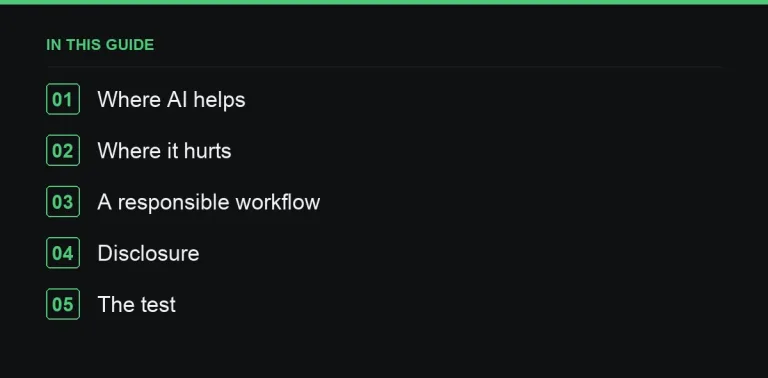
Where AI genuinely earns its place
- Research starting points — a quick summary of a topic so you know what to go and verify properly, rather than starting from a blank page.
- Outline suggestions — a structure to react to and correct against what’s actually ranking, not one to publish unchanged.
- Drafts of routine sections — background context, definitions, transitions between the parts that actually need a human’s judgement.
- Editing assistance — tightening sentences, suggesting alternative headings, flagging unclear passages.
- Variations for testing — alternative titles, meta descriptions and intros to choose between.
Where it causes real damage
- Facts and figures. AI tools can state incorrect information with total confidence, including statistics and sources that don’t exist. This is the single biggest risk for guest content, where a fabricated number can end a relationship with a publisher permanently.
- Direct experience. It cannot supply first-hand testing, opinions formed from actually doing the work, or examples from a real project.
- Originality. Unedited output tends toward the same handful of generic points every competitor’s AI-assisted draft also lands on.
- Voice. Experienced editors recognise unedited AI text quickly, and many now reject it outright regardless of topic quality.
A workflow that keeps the upside and drops the risk
- Start from a real brief with a specific angle — see writing a content brief.
- Use AI where it’s useful for outlining or first drafts of routine sections.
- Add what only a person can supply: real examples, direct experience, sourced data, an actual opinion.
- Fact-check every claim against a primary source and link to it. Delete anything you can’t independently verify — don’t soften it, remove it.
- Edit for voice and match the host site’s style, covered in writing for publishers.
- Have one named person accountable for the final text before it’s submitted anywhere.
Disclosure matters
Publisher policies on AI assistance vary widely — some require disclosure, some prohibit it outright, most say nothing and just judge the result. Check before you submit, and if a publisher or client asks directly how a piece was produced, answer honestly.
Signs an editor will spot immediately
Certain patterns in unedited AI text give it away faster than anything else: repeated sentence structures across paragraphs, a habit of restating the question before answering it, transitions like “in conclusion” or “it’s worth noting” used mechanically, and a strange evenness of tone across a topic that should have peaks of genuine opinion. None of these are fatal on their own, but together they read as a piece nobody actually cared enough to rewrite. Read your draft aloud before submitting — it’s the fastest way to catch this kind of flatness.
Building this into a team process
If several people on a team are producing guest content, write the workflow down rather than leaving it to individual judgement. Specify which stages AI is allowed to touch, who owns fact-checking, and what “edited” actually means in practice — a light pass for typos is not the same as rewriting for voice and verifying every claim. A written process also makes it much easier to spot, in hindsight, which submissions caused rejections and why.
It also protects freelancers and in-house writers alike. Without clear expectations, some will over-rely on AI output because nobody said otherwise, and others will avoid useful tools entirely out of caution. A short, explicit policy removes the guesswork for everyone and gives you a consistent standard to hold every submission to, whoever produced the first draft.
Keeping a paper trail
For anything published under your brand or a client’s, keep a simple record of which sources backed each claim in the final piece, especially for numbers. If a publisher or a reader questions something months later, being able to point to exactly where a figure came from takes minutes instead of forcing you to reconstruct the research from scratch, and it makes clear the claim was verified rather than generated.
The test before you hit submit
Ask yourself: would this article be worth reading if the link inside it were removed entirely? If the honest answer is no, it isn’t ready yet, regardless of whether a person or a tool produced the first draft. Publishers in the marketplace set their own editorial standards, and if you’d rather not build this workflow in-house, AI content specialists can run it for you with proper human editing built in.
Where to go next
Pair this with a clear guest post brief so the AI-assisted draft has something specific to work from, and if you’re publishing this style of content on your own site rather than pitching it out, see refreshing old content for how the same fact-checking discipline applies there too.
Frequently asked questions
Does Google penalise content just for being AI-written?
Google has said it evaluates content on quality regardless of how it was produced, but low-value content produced at scale is treated as spam either way, whoever or whatever wrote it.
Can AI-written guest posts be submitted to publishers?
Only where the host allows it and the piece has been thoroughly fact-checked, edited and made genuinely useful. Many editors reject unedited AI text on sight, so heavy editing isn't optional.
How do I stop AI tools inventing statistics in a draft?
Treat every number as unverified until you've checked it against a primary source and linked to that source. If you can't find the source, remove the claim rather than keep it.
Is it acceptable to disclose AI assistance to a publisher?
Yes, and in some cases it's required. Check the specific publication's policy before submitting, since practice varies from full disclosure to no mention at all.
Put it into practice
Filter 54,483 websites by DR, traffic, niche and price, and order with escrow — you pay only after the link is live.
Browse the marketplace