SEO Content Briefs: A Template That Works
A good brief is the difference between content that ranks and content that needs a rewrite.

A content brief tells a writer exactly what to produce, for whom, and why — in enough detail that the result can rank without a rewrite. It’s one of the highest-leverage documents an in-house SEO team produces, because it fixes quality problems before they cost anyone a draft.
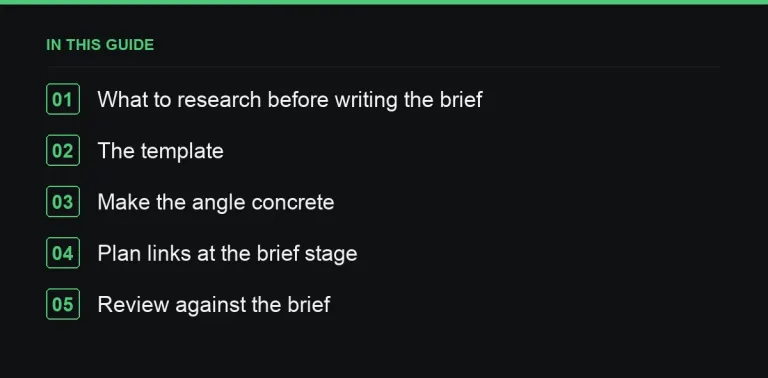
Research before you write the brief
- Search the target keyword yourself and study what currently ranks. Are the top results guides, comparison tables, lists, product pages?
- Collect the real questions people ask — from “People also ask” boxes, forum threads, and questions your own support team fields regularly.
- Note what the top pages already cover, so the brief can require those subtopics as a baseline, plus whatever gap you’ve spotted.
- Define your unique angle. What can this page add that the current top results can’t — original data, direct experience, a clearer worked example?
A brief template you can copy
Keep every field short and specific. A brief that takes twenty minutes to fill in properly saves hours of revision later.
- Working title: a draft headline, subject to change once the draft exists
- Primary keyword and secondaries: the terms this page must rank for
- Search intent: informational, comparison, transactional — state it plainly rather than assuming the writer will guess correctly
- Audience: who’s reading, and what they already know coming in
- Goal of the page: what the reader should do immediately after reading
- Our angle: what makes this version worth ranking over the current top results
- Outline: the H2/H3 structure, in the order it should appear
- Questions to answer: the specific reader questions gathered during research
- Must include: any data, examples or visuals required, each with a source noted
- Internal links: pages this should link to, and existing pages that should link to it once published
- Length guide: a range based on intent, never a fixed target to pad toward
- Tone and style notes: anything specific to the brand voice worth flagging up front
- Definition of done: fact-checked, sources linked, meta title and description drafted
Treat the template as a starting point, not a fixed form. A comparison page needs a “criteria” field; a how-to needs a “prerequisites” field. Add what the specific page requires and drop what it doesn’t.
Make the angle concrete, not aspirational
“Better than the competition” is not an angle a writer can act on. “Includes pricing ranges pulled from our own order data” is. “Written with worked examples from a specific use case” is. The angle is what makes a page worth linking to once it’s live — see what makes content earn links on its own if the page is meant to become a linkable asset rather than just rank.
Plan the internal links at brief stage, not after
List which existing pages the new content should link to, and which existing pages should be updated to link to it once it’s published. If the page is being built specifically as a future link target, say so in the brief, so it’s written with that goal in mind rather than retrofitted later.
Reviewing the draft against the brief
When a draft comes back, check it section by section against the brief rather than reading it once and reacting on feel. It turns feedback into something specific and fair — “the brief asked for three worked examples, there’s one” is actionable in a way “this feels thin” isn’t — and it speeds up revisions because the writer knows exactly what’s missing.
Briefs for different content types
A brief for a comparison page needs an explicit list of criteria and the exact competitors or options being compared, agreed in advance so the writer isn’t guessing which four tools to include out of a dozen. A brief for a how-to needs prerequisites stated up front — what the reader needs installed, purchased or already understood — so the piece doesn’t lose half its audience in paragraph two. A brief for a page meant to support a product launch needs the launch date and any embargo attached directly to the document, not communicated separately and forgotten.
Common brief mistakes
- Copying the outline straight from a competitor. It reproduces their structure, including its weaknesses, and gives you no angle of your own.
- Leaving intent vague. “Informational” isn’t enough detail — say whether the reader wants a definition, a full walkthrough, or a decision made for them.
- Skipping the angle field. Without it, writers default to restating what’s already ranking, which produces content with nothing to distinguish it.
- Treating the brief as fixed once written. If research during drafting turns up a better angle, update the brief rather than ignore it.
Where to go next
The same structure works, shortened, for outreach pieces — see writing a guest post brief — and pairs well with a plan for refreshing older pages that are underperforming against a brief written after the fact. If you’d rather hand the brief to someone else entirely, writing services in the marketplace can take it from brief to published draft.
Frequently asked questions
How long should an SEO brief be?
One to two pages is usually enough. It should remove guesswork for the writer without becoming a document nobody actually reads before starting.
Should a brief specify an exact word count?
Give a range based on what the intent and topic genuinely need. A fixed target invites padding, which hurts the page more than it helps.
Who should write the brief?
Whoever understands both the search landscape and the business goal for the page — typically the SEO lead or content strategist, not the writer producing the draft.
Do briefs need to include competitor URLs?
Yes, at least a few. Naming what currently ranks makes the required subtopics and the gap you're filling concrete instead of abstract.
Put it into practice
Filter 54,483 websites by DR, traffic, niche and price, and order with escrow — you pay only after the link is live.
Browse the marketplace