Getting Quoted as an Expert: A Step-by-Step Process
Journalists quote people they trust to be quick, accurate and quotable. Here's how to become one of them — and turn quotes into links.
Expert commentary means giving journalists quotes and insight for their articles. It’s one of the most reliable ways for smaller brands to appear in major publications, because the journalist needs expertise, not a big brand name, and a well-briefed founder or specialist can compete with a much bigger competitor’s press office.
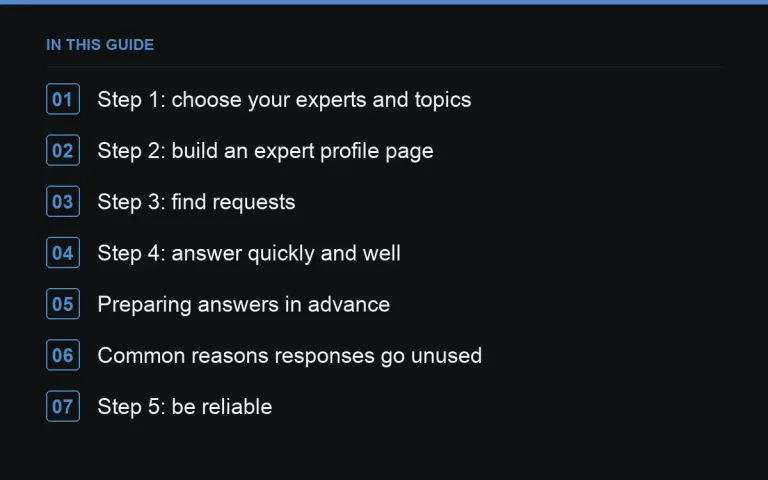
Step 1: choose your experts and topics
Pick one to three people with genuine expertise and define what each can speak on. Narrow is better: “mortgage rates for first-time buyers” beats “finance”. Journalists want the specific expert for their specific story, not a generalist who could technically comment on anything.
Step 2: build an expert profile page
Create a page on your site for each expert with their credentials, experience, topics and a photo. It gives journalists confidence, gives them something to link to, and supports the trust signals discussed in E-E-A-T and links. It’s a small piece of on-site work with an outsized payoff, since every future quote can point back to it.
Step 3: find requests
- Journalist request services that email source requests daily (journalist request platforms).
- Social media, where journalists post requests with specific hashtags.
- Direct relationships with journalists on your beat (outreach guide).
Step 4: answer quickly and well
A good response:
- answers the exact question asked,
- starts with the most quotable sentence,
- adds one specific, practical insight,
- stays within 100–200 words unless more is requested,
- includes name, title, company and a one-line credential.
Don’t pitch your product. Journalists cut promotional lines, and a response that’s mostly promotion won’t be used at all.
Preparing answers in advance
For the topics your experts cover most often, draft a few short, ready-to-adapt answers to the questions journalists tend to ask repeatedly — what a policy change means for consumers, what a common mistake looks like, what to expect next. Having a starting point cuts response time dramatically and reduces the temptation to rush a first draft under deadline pressure. Update these standing answers whenever the underlying facts change, so nothing stale goes out by accident.
Common reasons responses go unused
- Too long — journalists rarely use anything past a couple of sentences unless they asked for a full explainer.
- Too generic — anyone in the industry could have written it, so there’s no reason to choose you specifically.
- Late — even a great answer is useless after the deadline.
- Promotional — a response that reads like marketing copy gets cut regardless of the insight buried inside it.
Step 5: be reliable
Respond fast, meet deadlines, and never overstate. If a journalist follows up, answer the same day. Reliable sources get called back directly, which is where expert commentary becomes efficient — the same dynamic as reactive PR, just running on a slightly less urgent clock.
Step 6: turn quotes into links
Many quotes include a link to your site; many don’t. Where it’s appropriate, politely ask for the quote to link to the expert’s profile page or a relevant guide (how to ask).
Tracking hit rate over time
| Metric | Why track it |
|---|---|
| Requests answered | Volume of effort going in |
| Requests used | Actual hit rate — expect it to rise over months |
| Publications secured | Quality and relevance of pickup |
| Links vs unlinked mentions | What still needs following up |
How this supports the rest of the site
A well-maintained expert profile page tends to accumulate its own signals over time — inbound links from articles that quoted the expert, internal links from related content, and a growing list of credentials as coverage builds. Treat it as living content: update it whenever a notable piece of coverage lands, rather than writing it once and forgetting about it.
What to expect
Hit rates are low at first: many responses won’t be used. Consistency changes that. After a few months of regular, quality responses, you’ll see more placements and journalists reaching out directly, which is when the effort-to-result ratio really improves.
Scaling beyond one person
Once the process works for one expert, it’s usually straightforward to add a second or third, each with their own narrow topic and profile page. Avoid the temptation to have every spokesperson comment on everything — journalists notice when the same name appears attached to unrelated subjects, and it undermines the credibility the whole exercise is meant to build. Keep each expert’s lane clearly defined and resist stretching it just to answer more requests.
Where to go next
Expert commentary builds exactly the kind of authoritative, editorial links that are impossible to buy, and it strengthens every other page on the site by association once the expert profile is established. Report on it the way described in digital PR metrics beyond link counts, and pair it with targeted placements from the marketplace for pages coverage rarely points to.
Frequently asked questions
Do I need to be famous to get quoted?
No. Journalists need relevant expertise and fast, clear answers. Specific expertise often beats a big name.
How many requests should I answer?
Answer those that genuinely fit your expertise. A few strong responses a week is better than many weak ones.
Can I pay to be quoted?
Paying for editorial quotes isn't how journalism works at reputable outlets. Some request platforms charge for access to requests, which is different.
Put it into practice
Filter 54,483 websites by DR, traffic, niche and price, and order with escrow — you pay only after the link is live.
Browse the marketplace