Link Building for SaaS: Integrations, Comparisons and Guest Posts
SaaS companies have link opportunities most businesses don't. Here is how to use integrations, data and community properly.

Software companies start link building from an unusually strong position: the product itself generates reasons to be referenced that a plumber or a fashion retailer simply doesn’t have. Integrations, usage data, templates and free tools all create natural linking opportunities. The catch is that the pages that actually drive revenue — pricing, feature pages, comparison pages — are almost always the hardest ones to earn links to directly.
Links that come from the product itself
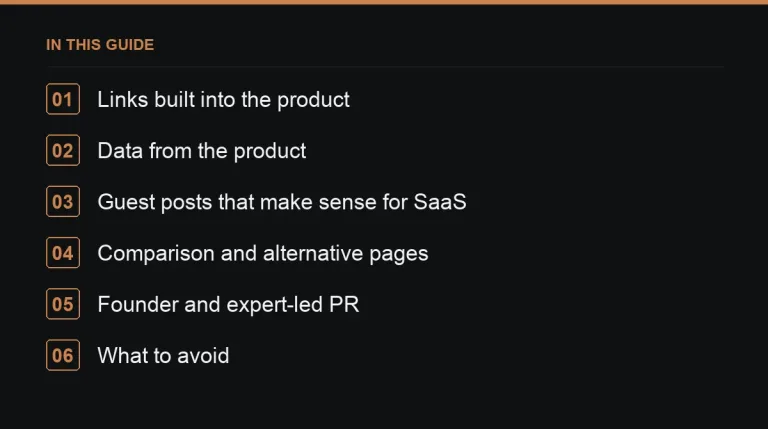
Integration and partner directories
Every integration partner you have typically maintains a marketplace or directory listing. Check that each one actually links through to your integration page rather than just naming you in text, and follow up where it doesn’t. Active co-marketing with partners often produces joint blog posts and case studies as a side effect.
Attribution links in the product
A small, optional “powered by” mention in embedded widgets, exported documents or public-facing pages can generate links at scale. Keep it understated and always let customers turn it off — a forced badge invites resentment and removal requests.
Templates and a free tier
Templates, checklists and cut-down free versions of paid features are genuinely linkable assets that blogs and resource pages reference for years (content that earns links).
Turning product data into press
Aggregated, anonymised usage data can produce a story nobody else can tell — how a category of teams actually works, benchmarks by industry, adoption trends. Publish the methodology alongside the numbers and pitch it to trade and technology press rather than burying it in a blog post nobody finds (running a data PR campaign).
Guest posts that make sense for software
Write for the publications your actual buyers read — marketing, operations, engineering or industry-specific trade press — about problems your product solves, without turning the piece into a pitch. Link to educational content, templates or benchmark data rather than straight to a pricing page. Relevant publishers sit in the technology, software development and marketing niches.
Comparison and alternative pages
“X vs Y” and “alternatives to X” pages convert extremely well but almost never earn links directly — nobody references a competitor comparison as a source. Support them instead with internal links from the content on your site that does earn links naturally (internal linking that supports backlinks), so the authority still reaches them.
Founder and specialist-led PR
A founder or in-house specialist who consistently comments on industry shifts, appears on relevant podcasts and writes the occasional opinion piece builds links and brand recognition together, and tends to age better than a purely tactical outreach programme (building expert commentary relationships).
What to avoid
| Practice | Problem |
|---|---|
| Reciprocal link exchanges with other SaaS tools | Pattern is easy to detect and rarely moves rankings |
| Listing on hundreds of “software directories” | Most carry no real traffic or editorial value |
| Exact-match anchors into feature pages at scale | Reads as manipulative across many placements (anchor text strategy) |
Community links most SaaS teams overlook
Developer and user communities are an underused link source for software companies that aren’t purely developer tools. Documentation sites, changelogs and open-source components you maintain often get referenced from community forums, Stack Overflow-style Q&A sites and internal engineering blogs at other companies, none of which you have to pitch — they happen because the resource is genuinely useful. Making documentation public, keeping a changelog that’s easy to link to a specific version, and open-sourcing small internal tools where it makes sense all create these links passively over time.
Review sites are another category worth treating deliberately rather than as an afterthought. Encouraging genuine customers to leave reviews on the major software review platforms doesn’t just influence buyers browsing those sites directly — some of those platforms carry real authority themselves, and a strong review profile there is referenced by bloggers writing “best tools for X” roundups who use review volume and rating as a shortcut for legitimacy.
Timing product launches around linkable moments
A major feature launch or a significant product data release is one of the few predictable moments a software company gets real press attention. Treat it the way a consumer brand would treat a product launch: brief a small number of relevant journalists under embargo, have the supporting data or template ready to publish alongside the announcement, and make sure the page you want links pointing at is live and complete before the embargo lifts. Launching the announcement before the destination page is ready is a surprisingly common and entirely avoidable way to waste the attention a launch generates.
Where to go next
If you sell into a regulated vertical like fintech or healthtech, read the niche-specific rules in finance link building or health link building before pitching those publications. For measuring whether any of this is working, see measuring link building ROI. When you’re ready to find guest post and partner opportunities, the software development niche and the wider marketplace are good starting points.
Frequently asked questions
What's the single best link building tactic for a SaaS company?
Usually something product-driven — integrations, templates, free tools or data only your product can produce. Guest posts and founder-led PR work best as a complement, not a replacement.
Should SaaS companies try to build links straight to pricing pages?
Rarely directly. Build authority on educational or product-adjacent content and route it to pricing and feature pages with internal links instead.
Are software directories still worth listing on?
The handful of major, genuinely used ones are. Submitting to hundreds of low-quality directories mostly wastes time and adds no measurable value.
How do integration partnerships translate into links?
Most partners maintain a public directory or marketplace that should link to your integration page — check each one individually, since not all do it by default.
Put it into practice
Filter 54,483 websites by DR, traffic, niche and price, and order with escrow — you pay only after the link is live.
Browse the marketplace