Link Building for Science Communication Websites
A guide to earning backlinks for science communication, research and STEM education publishers.
Science communication is a niche where credibility is the entire currency: publishers and readers expect claims to be traceable to genuine research, and content that oversimplifies or sensationalises findings tends to be called out quickly, sometimes by the very researchers whose work is being covered.
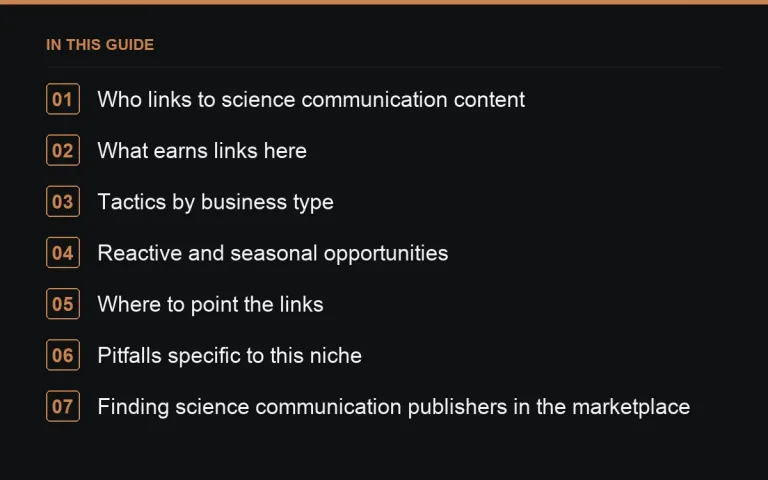
Who links to science communication content
Science journalism and popular science media, academic and research institution communications, STEM education platforms, and specialist science blogs run by working scientists or science writers make up the core publisher base. Museums and science centres with an education mission are a further, often underused, source.
What earns links here
- Clear, accurate explainers of genuine research findings, properly sourced
- Original data or citizen-science tools that researchers or educators can use
- Interviews with working scientists on their actual research
- STEM education resources genuinely useful in classrooms
A plain-language explainer FAQ addressing common misconceptions about a specific area of research tends to be linked to repeatedly by science journalists needing a quick, accurate reference to link readers to for background, rather than re-explaining the same concept in every article.
Tactics by business type
| Business type | Best-fit tactic | Notes |
|---|---|---|
| Science media publisher | https://successtoroad.com/blog/expert-roundups/ | Contributions from working scientists add genuine credibility |
| STEM education platform | https://successtoroad.com/blog/resource-page-link-building/ | Teacher resource pages reference well-made STEM learning tools |
| Research organisation | https://successtoroad.com/blog/statistics-pages-for-links/ | Well-documented data pages become a lasting reference for journalists |
| Science-adjacent product company | https://successtoroad.com/blog/link-building-for-media-publishers/ | Science press covers genuinely novel product applications carefully vetted for accuracy |
Where a research area is prone to public misunderstanding, proactively publishing a clear, accessible explainer ahead of an expected wave of coverage — a predictable astronomical event, for instance — positions your organisation as a ready reference before journalists start their own research.
Reactive and seasonal opportunities
Major research publication dates, science awareness weeks, and significant astronomical or natural events all generate predictable coverage windows. Being available with an accurate, well-qualified comment ahead of a known publication date is far more effective than reacting after the story has already run.
Where a finding has been misreported elsewhere, publishing a clear, calm correction that explains specifically what was inaccurate, without being combative toward the original outlet, tends to be picked up and linked to as the more reliable, more citable source going forward.
Where to point the links
Send links to the specific research or explainer page relevant to the citing article, not a general homepage. Data pages and citizen-science tools, once established as credible and current, tend to accumulate citations from educators and journalists over an extended period.
Where a finding is genuinely complex, producing two versions of the same explainer at different technical levels — one for a general audience, one for a more specialist readership — increases the range of publishers who can use your content directly rather than needing to rewrite it themselves.
A short methods summary written for a general audience, kept alongside the more technical version, helps science journalists accurately represent your research without needing to interpret the full technical paper themselves.
Pitfalls specific to this niche
Sensationalised headlines or overstated findings are the fastest way to lose credibility with science publishers and their readers, many of whom fact-check against the original research. Avoid presenting preliminary or single-study findings as settled science. Be transparent about funding sources, particularly for research content connected to a commercial product, since undisclosed conflicts of interest are treated seriously in this niche.
Where a study has limitations the original researchers themselves have flagged, including those limitations in any secondary coverage demonstrates a level of rigour that distinguishes credible science communication from simplified, promotional summaries.
Finding science communication publishers in the marketplace
https://successtoroad.com/niche/science/ in the marketplace surfaces relevant science media and education sites; check editorial credibility carefully, since this category includes both rigorous science journalism and lower-quality clickbait sites using science-adjacent branding.
Working directly with researchers
The most credible science communication content usually involves the actual researchers behind a finding, not a marketing team’s interpretation of a paper they didn’t write. Where possible, involve a genuine co-author or research contact directly in reviewing content before publication, and be upfront in any pitch about the level of direct researcher involvement, since science journalists specifically ask about this when evaluating whether to trust and cite a piece.
Keep a clear boundary between describing a finding and interpreting its broader implications; publishers and readers alike distinguish between what a study actually showed and what a company might want it to mean for their product, and blurring that line is one of the fastest ways to lose credibility with a scientifically literate audience.
Where a research finding has genuine, practical relevance to a non-specialist audience, framing that relevance clearly without overstating it tends to be what separates a widely shared explainer from one that only reaches an already-specialist readership.
Where to go next
See https://successtoroad.com/blog/eeat-and-links/ for the trust standards this niche shares with health and policy content, and https://successtoroad.com/blog/topical-relevance/ for prioritising genuinely credible science publishers.
Frequently asked questions
How should preliminary research findings be presented?
Clearly labelled as preliminary or single-study, with appropriate caveats, rather than presented as settled or universally accepted science.
Do science journalists fact-check cited claims closely?
Generally yes, often against the original research paper directly, which makes accuracy in outreach content especially important in this niche.
Is contributing to citizen-science projects a link tactic?
Yes, in a sense; building or supporting a genuinely useful citizen-science tool tends to earn organic citations from researchers and educators who use it.
What's a red flag for a low-quality 'science' publisher?
Sensationalised headlines that don't match the substance of the underlying research, and a lack of clear sourcing or citation for specific claims.
Put it into practice
Filter 54,483 websites by DR, traffic, niche and price, and order with escrow — you pay only after the link is live.
Browse the marketplace