Link Building for Programming and Developer Communities
A guide to earning backlinks for programming education platforms, coding communities and developer-focused content sites.
Programming as a niche is distinct from software development agencies: it’s about the communities, education platforms and content built around the craft of coding itself, aimed at developers learning, teaching or discussing programming rather than agencies selling development services.
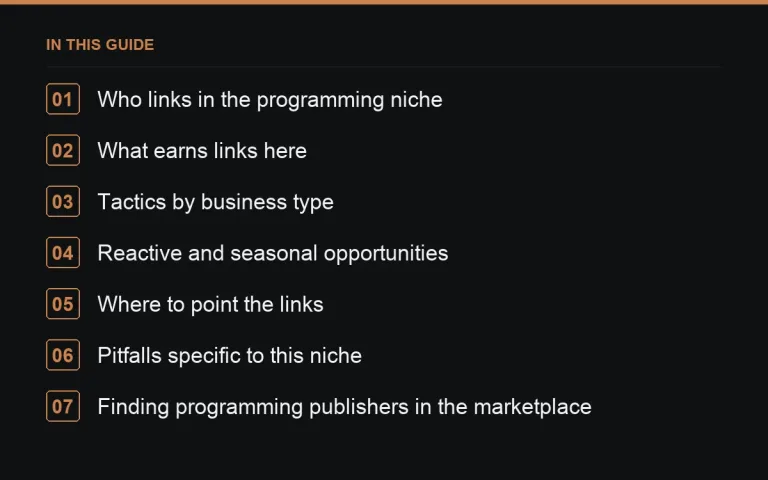
Who links in the programming niche
Programming education platforms and coding bootcamps, developer community forums and Q&A sites, language and framework-specific blogs, and technical newsletter writers make up the core publisher base. University computer science departments are a further, education-focused source for genuinely rigorous content.
What earns links here
- Clear, well-explained tutorials that solve a genuinely common learning problem
- Original coding exercises, challenges or practice tools
- Language or framework comparison content grounded in real experience
- Contributions to open-source projects and documentation
A well-maintained comparison of competing libraries or frameworks for a specific, common task tends to be linked to repeatedly by developers explaining their own technology choices, provided it stays honestly updated as the ecosystem evolves.
Tactics by business type
| Business type | Best-fit tactic | Notes |
|---|---|---|
| Coding education platform | https://successtoroad.com/blog/resource-page-link-building/ | Teacher and self-learner resource pages reference well-made tutorials |
| Developer tool or platform | https://successtoroad.com/blog/calculators-and-tools-for-links/ | Free coding tools and generators are a strong, durable linkable asset |
| Technical newsletter or blog | https://successtoroad.com/blog/community-and-forum-links/ | Developer communities cite genuinely useful, well-written content |
| Coding bootcamp | https://successtoroad.com/blog/expert-roundups/ | Contribute career-transition insights to broader education roundups |
Where your platform or tool integrates with a popular third-party service, publishing a clear integration guide gives users of that other service a concrete reason to discover and link to your content when searching for that specific integration.
Reactive and seasonal opportunities
New language or framework version releases, annual developer survey cycles, and back-to-school or career-change seasons for education platforms all create predictable outreach windows. A quick, accurate technical take on a new release can earn coverage that a slower, more generic piece won’t.
Where a tutorial covers a topic with several valid approaches, briefly acknowledging the alternatives and why you chose the one you’re demonstrating tends to earn more trust from experienced developers than presenting a single approach as the only correct one.
Where to point the links
Send links to specific tutorial, tool or course pages relevant to the referring content, not a general homepage. Open-source project pages are strong, durable link targets in their own right and should be actively maintained as part of the site’s content strategy.
Answering genuine questions in public developer forums and Q&A sites, using your real name and affiliation rather than anonymously, builds a visible, searchable track record of expertise that developers researching a topic later encounter organically, well beyond any single piece of published content.
A short, plain-language summary at the top of any deeply technical tutorial helps less experienced developers decide quickly whether the content matches their current skill level before committing to reading the full piece.
Pitfalls specific to this niche
Factually incorrect code examples or outdated syntax get called out quickly and publicly in developer communities, damaging credibility well beyond the specific piece of content. Avoid generic “learn to code” content that doesn’t differentiate itself from the enormous existing volume of similar material. And be careful with AI-generated tutorial content that hasn’t been tested by an actual developer; errors in code examples are especially damaging in this niche.
Where a tutorial references a third-party service or API, noting the exact version or date it was tested against helps future readers quickly judge whether the content is still likely to be accurate for their own current environment.
Finding programming publishers in the marketplace
https://successtoroad.com/niche/programming/ in the marketplace surfaces relevant developer education and community sites; check traffic and engagement carefully, since this niche ranges from genuinely active technical communities to low-effort content farms recycling generic tutorials.
Testing every code example before publishing
The single most damaging mistake in programming content is a code example that doesn’t actually run as written. Before publishing any tutorial or technical explainer, have someone other than the original author execute the code exactly as presented, ideally in a clean environment rather than one already configured to hide missing dependencies. This basic step catches the majority of errors that would otherwise surface publicly in developer community comments, which is a slower and more damaging way to find out.
Version your tutorials clearly against the specific language, framework or library version they were written for, and note when they’re due for a review. Programming content ages faster than almost any other content category, and an unmaintained tutorial that quietly becomes outdated is one of the more common reasons a previously earned link stops sending meaningful value.
Where a tutorial addresses a problem that’s frequently asked about on public Q&A sites, linking to it directly from an answer on that platform, where permitted by the platform’s own rules, is often more effective than waiting for organic discovery alone.
Where to go next
See https://successtoroad.com/blog/link-building-for-startups/ if you’re an early-stage coding education platform, and https://successtoroad.com/blog/topical-relevance/ for why a well-matched, language-specific developer blog often outperforms a much larger general tech site.
Frequently asked questions
How is this different from software development link building?
This niche focuses on programming education, communities and developer content, while software development link building targets agencies and consultancies selling custom development services; the audiences and publishers differ.
Do open-source contributions really function as link building?
Yes; a genuinely useful open-source project or contribution tends to accumulate organic citations from developers writing about their own use of it.
How quickly should content react to a new language release?
As quickly as accuracy allows; being early with a correct, useful take earns more coverage than a slower, more polished piece published after interest has moved on.
What's the biggest risk with AI-assisted tutorial content?
Untested code examples containing errors, which developer communities notice and call out quickly, damaging credibility for the whole site rather than just one article.
Put it into practice
Filter 54,483 websites by DR, traffic, niche and price, and order with escrow — you pay only after the link is live.
Browse the marketplace