Link Building in Health: YMYL Rules and Safe Sites
A bad link neighbourhood or an unreviewed claim can do real damage in health. Here is how to build authority responsibly.
Health is the one niche where a link building mistake isn’t just a wasted budget line — it can mean amplifying something inaccurate to people making decisions about their wellbeing. Search engines respond to that risk by holding health content to their highest standard, which means the work has to start before a single outreach email is sent.
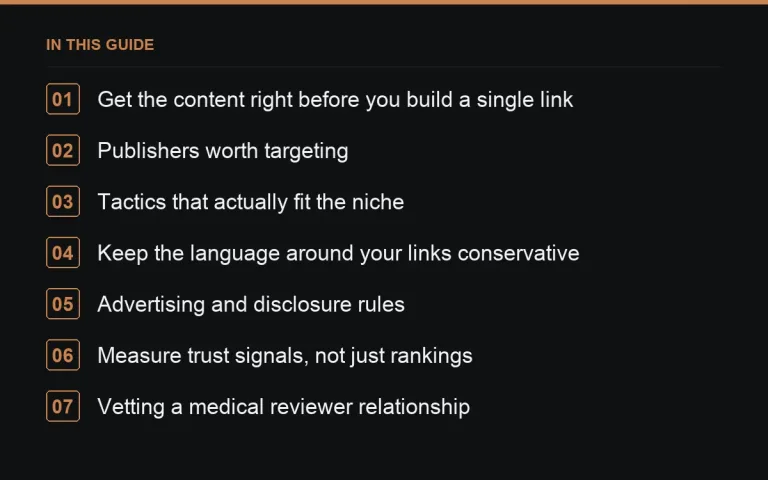
Get the content right before you build a single link
- Have content written or reviewed by someone with relevant clinical or professional qualifications, and say so visibly on the page.
- Cite sources a reader could actually check: peer-reviewed research, national health bodies, clinical guidelines — not other blogs.
- Date every page and set a review schedule; guidance in health changes.
- Never let a page claim more than your product, service or evidence base can support.
This is the foundation everything else in this guide sits on top of — see E-E-A-T and links for the broader trust framework.
Publishers worth targeting
Look for health and wellbeing publications with a visible editorial process and named medical reviewers, fitness and nutrition sites relevant to your specific specialism, patient communities and charities for genuine partnerships, and professional or trade publications aimed at practitioners rather than consumers. Browse the health niche and adjacent categories like sports or beauty, but check each candidate’s editorial approach individually — health is one niche where metrics alone tell you almost nothing about safety.
Neighbourhoods to avoid outright
- Sites promoting unproven cures, “detox” claims or pseudoscience.
- Sites heavily linked to unregulated supplements, online pharmacies without verification, or adult content.
- General-interest sites with a “health” category that’s really sponsored filler with no editorial oversight.
A link from any of these doesn’t just fail to help — it associates your brand with content that could damage the trust you’re trying to build.
Tactics that actually fit the niche
Expert commentary
Qualified practitioners commenting on new guidelines, seasonal illnesses or public health news fill a constant need for journalists (how to get quoted as an expert).
Research summaries for patients
Translating a new study into plain language, accurately and without overstating the findings, is genuinely useful and gets picked up by other health writers.
Reviewed tools and resources
Symptom guides checked by clinicians, or simple calculators (BMI, hydration, recommended activity) with clear caveats about their limits, attract links the way finance calculators do.
Transparent charity and association partnerships
Where a genuine relationship exists with a charity or professional association, disclosed partnership content can earn links that would be inappropriate to buy outright.
Keep the language around your links conservative
In health, the anchor text and the surrounding sentence are effectively part of what you’re publishing. Avoid anchors that imply a guarantee — “cure for back pain” — in favour of accurate, descriptive phrasing such as “guide to managing lower back pain”. The guest article carrying that link should meet the same review bar as content on your own domain; a link doesn’t get a pass just because it lives on someone else’s site.
Advertising and disclosure rules
Health products and services are frequently subject to advertising regulation that has nothing to do with search engines. Sponsored content must be labelled as such, and product claims need to comply with the rules of whatever market you’re publishing in. Check with whoever handles regulatory compliance before any sponsored health placement goes live, not after.
Measure trust signals, not just rankings
For health sites, branded search volume, citations from professional bodies and mentions by other health publishers are worth tracking alongside position data (reporting on digital PR beyond link counts). They tend to grow together when link building is genuinely built on expertise, and each one makes the next placement easier to earn.
Vetting a medical reviewer relationship
If you don’t have clinical staff in-house, working with an external medical reviewer is common and reasonable, but it needs to be a real relationship, not a name borrowed for a byline. Confirm the reviewer actually reads the content they’re credited on, keep a record of when each page was last reviewed, and be willing to remove or update content the reviewer flags as outdated even if that means pulling a page that currently ranks well. A reviewer credit that turns out to be nominal, if it ever comes to light, damages trust far more than having no named reviewer at all.
The same logic applies to any charity or association partnership you build links through. Before agreeing to a collaboration, ask what editorial control the partner organisation has over content published under the arrangement, and get clarity on whether any placement needs to be labelled as sponsored or partnered. Ambiguity here tends to surface at the worst possible time — usually when a journalist or regulator asks about it directly.
Handling outdated content you’ve already linked to
Health guidance changes, and pages that were accurate two years ago can become misleading without anyone noticing until a reader or a journalist flags it. Build a simple recurring review cycle — quarterly for fast-moving topics, annually for stable ones — and treat updating existing linked pages as part of your link building work, not separate from it. A backlink pointing at outdated medical content is a liability sitting on someone else’s site, and it’s much easier to fix by updating your own page than by trying to get the link removed.
Where to go next
If your organisation also touches regulated financial products, the same review discipline applies in finance link building. For the mechanics of pitching a qualified voice to a journalist, read reactive PR, and for how to talk about results internally without overselling early wins, see measuring link building ROI. When you’re ready to shortlist sites, the health niche marketplace is the place to start.
Frequently asked questions
Do health pages need medically reviewed content to rank well?
Content produced or checked by someone with relevant expertise, with sources clearly cited, is a core trust signal for health topics and supports everything built on top of it, including links.
Can supplement companies do link building safely?
Yes, but with extra care about which claims are made, what regulations apply in each market, and which sites are willing to host that content.
Are links from general lifestyle sites useful for a health brand?
They can help when the specific article is relevant and the site has real editorial standards, but specialist health publishers with named reviewers carry more weight for YMYL topics.
What's the fastest way to damage a health site's trust with bad links?
Accepting placements on sites that also promote unproven cures or unregulated products, since search engines and readers both associate you with the company you keep.
Put it into practice
Filter 54,483 websites by DR, traffic, niche and price, and order with escrow — you pay only after the link is live.
Browse the marketplace