How Long Do Backlinks Take to Work?
A backlink doesn't work the day it goes live. Here's the realistic sequence, and what speeds it up or slows it down.
“How long until links work?” is one of the most common questions in SEO, and one of the hardest to answer honestly, because “it depends” is true but unsatisfying. The realistic answer is usually weeks to months, shaped by a sequence of steps that has to happen before a link can influence anything. Here’s what happens in between, and what you can control.
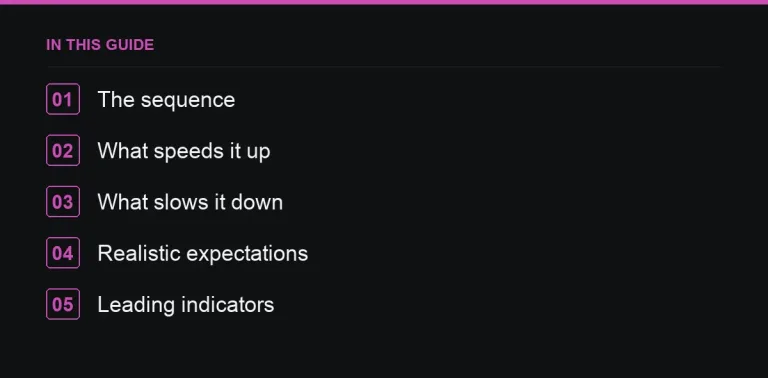
The sequence
- Crawling the linking page — search engines must first find the page carrying your link. Pages on sites crawled often, and linked from a homepage or category page, are found faster than a buried post nobody links to.
- Indexing — the linking page has to be indexed for its outbound links to be counted at all (checking a live guest post).
- Re-evaluating your page — the new link becomes one input the next time your target page is assessed, alongside its content, technical health and every other signal.
- Ranking changes — visible shifts appear once the new signals are incorporated and weighed against what competing pages offer.
None of these steps is instantaneous, and a delay at any stage pushes the whole sequence back.
What speeds it up
- Links on sites that are crawled frequently, placed on pages linked from their homepage or category pages rather than buried deep in an archive.
- Target pages that are already close to ranking, where a link is the missing signal rather than one of many gaps (choosing which pages to build links to).
- Genuinely relevant links, which tend to be weighed more heavily than links from unrelated sites (topical relevance).
- Less competitive keywords, where fewer strong pages are competing for the same result.
What slows it down
- New domains with little history, which take longer to be trusted regardless of the links pointing at them (link building for a brand-new website).
- Highly competitive keywords, where dozens of strong pages already compete.
- Technical issues on your target page — slow loading, poor indexability, thin content (technical SEO before links).
- Links placed on orphaned or rarely crawled pages that take longer to be found in the first place.
A realistic timeline
| Stage | Typical range |
|---|---|
| Linking page crawled | Days to a few weeks |
| Linking page indexed | Days to weeks after crawling |
| Target page re-evaluated | Varies with how often your own site is crawled |
| Visible ranking movement | Weeks for low-competition terms, months for competitive ones |
Because of this spread, campaigns should be judged over a quarter or two, not over the first few weeks (measuring the ROI of link building).
Leading indicators to watch before rankings move
- Rising impressions for the target page in Search Console, even before position improves.
- Movement on long-tail variations of your target keyword.
- New queries the page starts appearing for that it didn’t before (using Search Console’s links report).
Why some links seem to “work” faster than others
When a link appears to move rankings within days, it’s usually not the link itself acting alone — it’s more likely that the target page was already close to ranking, or the site was in the middle of being re-evaluated for other reasons, and the link was simply the last piece to fall into place. Treat any single fast result as an exception rather than the pattern to expect from every placement.
Setting expectations with stakeholders
The most common source of frustration with link building isn’t poor results — it’s a mismatch between what was promised and this realistic timeline. Share the sequence above before a campaign starts, agree what leading indicators will be reported monthly, and agree that the first real read on outcomes comes at the end of a full quarter, not after the first invoice.
How this varies by site age and history
A well-established domain with a long, clean history and frequent crawling by search engines will generally see the effect of a strong new link faster than a domain that’s only a year or two old, even with an identical link on an identical page. This isn’t a penalty against newer sites; it’s simply that established sites are re-evaluated more often and have more existing signal for a new link to combine with (link building for a brand-new website).
What not to do while waiting
- Don’t reorder the same page’s links every few weeks hoping for a faster result — that just adds noise and cost.
- Don’t judge a whole campaign on one competitive keyword that was always going to take longest.
- Don’t stop reporting leading indicators just because the headline ranking hasn’t moved yet.
Where to go next
Set expectations with stakeholders using this timeline up front, track progress with the right link building KPIs, and when choosing your next placements, prioritise sites and pages from the marketplace that are already reasonably close to ranking rather than starting from zero.
Frequently asked questions
How long does it take for a backlink to be indexed?
Often days to weeks, depending on how frequently the linking site is crawled.
Why haven't my new links improved rankings?
It often takes months, and depends on competition, relevance and your page's quality.
Can I speed up how fast links work?
Choose relevant, frequently crawled sites and target pages already close to ranking.
Put it into practice
Filter 54,483 websites by DR, traffic, niche and price, and order with escrow — you pay only after the link is live.
Browse the marketplace